

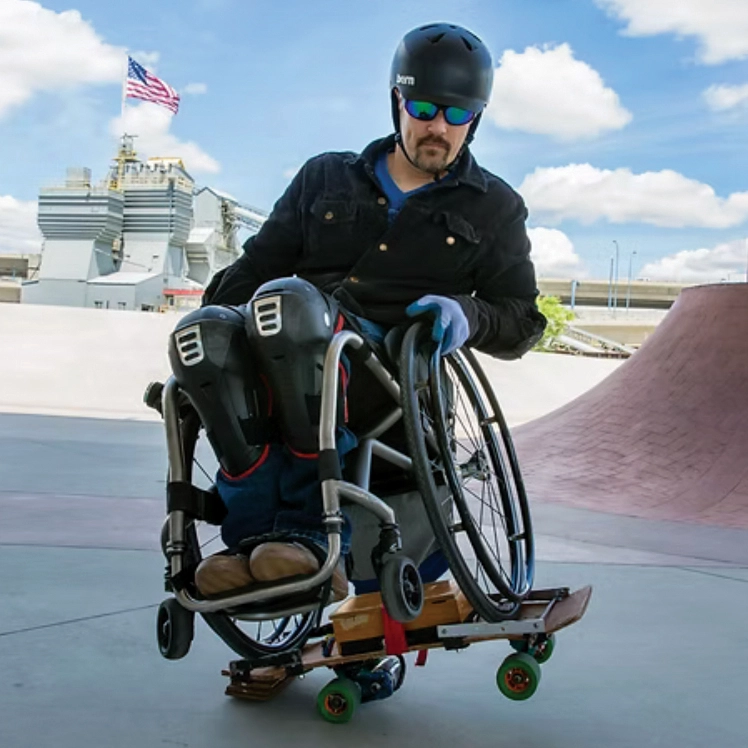
An estimated 6 million Americans use a wheelchair as their primary mode of mobility—about 2.3 percent of US adults. But for many, getting a wheelchair that truly fits their body, lifestyle, and environment remains a challenge. Erik Kondo is working to change that.
A longtime wheelchair user and engineer, Kondo is the founder of Open Source Wheelchairs, a project focused on designing affordable, customizable, do-it-yourself wheelchairs that users can build, repair, and adapt themselves. His goal is simple: make mobility more accessible, functional, and empowering.
Kondo has lived with a spinal cord injury since 1984, but his life has never been defined by limitation. Over the past four decades, he has immersed himself in adaptive sports—wheelchair skateboarding, longboarding, snowboarding, scooter boarding, and skim boarding—pushing both his body and his equipment to perform. That lived experience exposed a major gap.
“I’ve been focusing on mobility devices for maybe ten years now,” Kondo says. “Wheelchairs, skateboarding, electric skateboarding, and hoverboards mainly.”
What he found was frustration—not just with cost, but with design. Many wheelchairs, especially lower-cost options, are poorly suited to individual users. Repairs can be expensive and difficult to access. For those without strong insurance coverage, options are often limited.
“I feel there are five specific problems in wheelchair provision throughout the entire world,” Kondo says. They include poorly fitted “one-size-fits-all” chairs, high repair costs, limited access in rural areas, and a system that prioritizes profit over long-term usability. There’s also what he describes as low “wheelchair literacy,” or a lack of understanding about how chairs function across different environments.
For Kondo, the solution is hands-on. Through Open Source Wheelchairs, he designs modular, repairable chairs using parts sourced globally—often from manufacturers in China and India that offer a balance of quality and affordability. Many of these parts are available through his eBay shop.
But the project goes beyond parts. Kondo has partnered with nonprofits and worked internationally in countries like Nigeria, Zimbabwe, and Pakistan, teaching people how to build and repair their own wheelchairs. The emphasis is on independence—not just owning a chair, but understanding it.
Kondo’s philosophy centers on three elements: knowledge, ability, and materials. When combined, he believes they can dramatically improve quality of life. A well-designed chair, he says, should do more than provide mobility—it should enhance participation, enable performance, create pride of ownership, and offer comfort and practicality, all at an affordable cost.
Ultimately, his work challenges a fundamental assumption: that mobility solutions must be expensive or out of reach. Instead, Kondo is building a model rooted in access, education, and adaptability—one that puts control back into the hands of users.