

When the shooting dies down after major American wars, prosthetic research labs start to crank up.
By Larry Borowsky

If you’re wearing a prosthetic limb today—whether it’s a microprocessor knee, a bionic hand, or a carbon fiber running blade—it’s using technology that was shaped in some fundamental way by an American war.
That might sound like hyperbole, but it’s literally true. The materials, suspension systems, joint designs, socket interfaces, and other elements of modern prostheses can trace their origins (whether directly or indirectly) back to a spurt of innovation that came immediately after a major armed conflict. The same holds for many amputee-serving programs related to employment, athletics, and education.
To be clear, this isn’t meant as an endorsement of warfare—especially not with the war in Ukraine now in its fifth year, and with American ground forces facing possible deployment to Iran. (This step had not yet happened as Amplitude went to press.) But it’s a fact that many of the advances that benefit amputees today—civilians included—emerged from a desire to support wounded warriors who lost limbs in combat. And this 160-year history belongs to the entire limb loss and limb difference community. It’s a story not only of battlefield heroism but also of a national commitment to use public resources for the benefit of amputees and people with other disabilities.
In the past, that type of commitment has generally happened in the wake of military conflict—but it can just as easily be made during peacetime, and should be in the future. Because May is Military Appreciation Month, this is an ideal time to recognize how veterans of each American war have spawned advances in limb care for amputees. We should also resolve to make such sacrifices unnecessary in generations to come.
The Birth of an Industry
In a very real sense, the modern prosthetics industry began with the most awful conflict in US history: the Civil War. It’s estimated that as many as 70,000 soldiers on both sides lost limbs, more than in all other US wars combined. By the time the surrender papers were signed at Appomattox, close to 1 percent of the nation’s adult male population had experienced limb loss.
The scale of need forced the federal government to take action. Congress allocated funds to provide a prosthetic limb to every Union veteran with a documented combat-related amputation. Confederate veterans were ineligible for the federal subsidy because they had rebelled against the United States, but at least three Southern states (Virginia, Mississippi, and North Carolina) funded similar programs for their soldiers. The State of Mississippi famously spent approximately half its entire annual budget in 1866 fitting Confederate veterans with artificial limbs.
The prosthetics marketplace, which previously had lacked enough steady customers to be considered a true industry, was suddenly awash in millions of dollars. Entrepreneurs crowded into the field, vying to grab a share of this lucrative new business, and the competition spurred loads of investment in start-up technologies. In the 15 years leading up to the Civil War, the US Patent Office issued just 34 patents related to prosthetic limbs. In the 12 years after the war began, it issued 133 more.
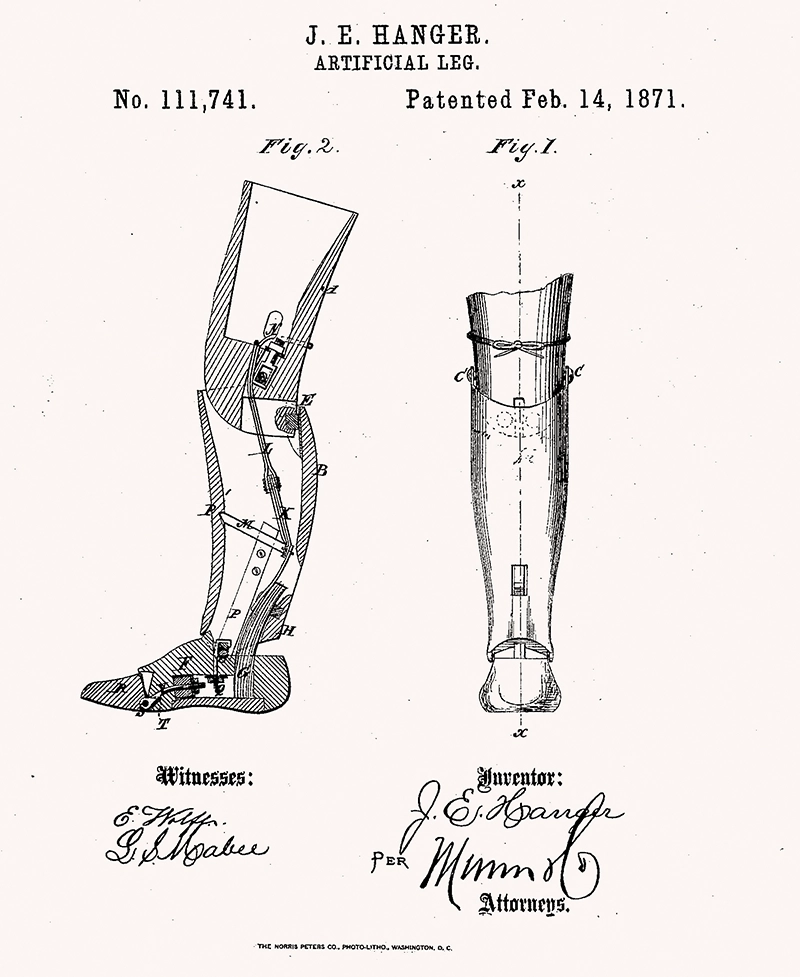
The most successful of those entrepreneurs was, ironically, one of the first—perhaps the very first—recorded amputees of the Civil War. James Hanger lost his left leg at the Battle of Philippi, West Virginia, on June 3, 1861. He returned home to Churchville, Virginia, a few months later, with a wooden peg-leg that made walking all but impossible. A former engineering student, Hanger quickly fashioned a more functional model out of barrel staves. By war’s end, he’d won a contract from the Confederate government to supply prosthetic limbs to wounded rebels, and he continued iterating in the years following the armistice. Hanger’s major breakthrough occurred in 1871, nearly a decade after his injury, when he patented what came to be known as the Hanger Leg—the first lower-limb prosthesis to feature stable, flexible knee and ankle joints. The revolutionary device allowed amputees to walk with a far more natural gait than ever before. It also launched the company that has remained a leader in the American O&P industry.
But the Civil War gave rise to more than one device and one company. Beyond that, it established the federal government’s commitment to rehabilitate wounded soldiers, and to invest taxpayer dollars in that effort. That principle created the profit potential which incentivized prosthetics manufacturers to cultivate a consumer market, making devices affordable and accessible for civilians as well as veterans. The same pattern has driven prosthetics research ever since. Every major American conflict has been followed by a surge in funding, a burst of innovation, and a wave of benefits filtering through to the broader amputee population.
Made for the Masses
If the Civil War marked the birth of the US prosthetics industry, World War I brought it to global scale. The combination of deadlier killing machinery with improved life-saving medical techniques meant that soldiers were surviving severe injuries—including limb loss—that would have killed them in any previous war. Worldwide, an estimated 300,000 to 500,000 soldiers came home as amputees. The sheer size of the need necessitated a shift to mass production.
The man who rose to the challenge, like James Hanger before him, has become synonymous with high-quality limb care. German prosthetist Otto Bock developed a new manufacturing method in which limbs were constructed from standardized, mix-and-match components, rather than crafted as indivisible units. The same assembly-line approach had made everything from clothes to automobiles more cheaply and readily available, and it had the same impact on prosthetic limbs. Instead of spending days or weeks on a single limb, a limb retailer could now produce multiple limbs in single day. Moreover, an amputee in San Francisco could get the exact same product as someone in New York City, Berlin, or anywhere else in the industrialized world.
The other major innovation that came out of World War I became one of the most widely used terminal devices for users of upper-limb prosthetic devices: the split hook. Patented in 1912 by an amputee dentist named David Dorrance, it sacrificed cosmetic appeal for functionality, enabling amputees to grip and manipulate objects with dexterity. This technology empowered thousands of disabled veterans to return to work in farms, factories, and offices, while attaining new levels of self-sufficiency in daily tasks such as dressing and cooking. The split hook remains popular with upper-limb amputees to this day, a testament to how well it meets the core need.
Better prosthetics also facilitated the rise of rehabilitation as a discipline in its own right. Before the Great War, getting fitted with a prosthesis was considered the end of the care process. That now became merely the first step in a broader process of societal reintegration. Dedicated programs began to emerge for vocational training, adaptive sports, and what we now know as physical therapy. Doctors began studying amputee care as a separate discipline, and a new professional specialty—prosthetist—began to emerge. The precursor to today’s American Orthotics and Prosthetics Association (AOPA) was founded in 1917, largely to create an infrastructure capable of responding to the postwar demand for limb care.
That’s perhaps the biggest takeaway for today’s amputees. World War I transformed prosthetic technology from an end in itself into one pillar of a rehabilitation process that would not merely “replace” the missing limb but also restore a high quality of life.
Prosthetic Advances After World War II
World War II brought the largest wave of wartime amputees since the Civil War: More than 15,000 US servicemen lost limbs in combat. Between the federal government’s growth under FDR and a financial mobilization that dwarfed anything before or since, amputee veterans benefited from an extraordinary level of resources and organizational capacity.
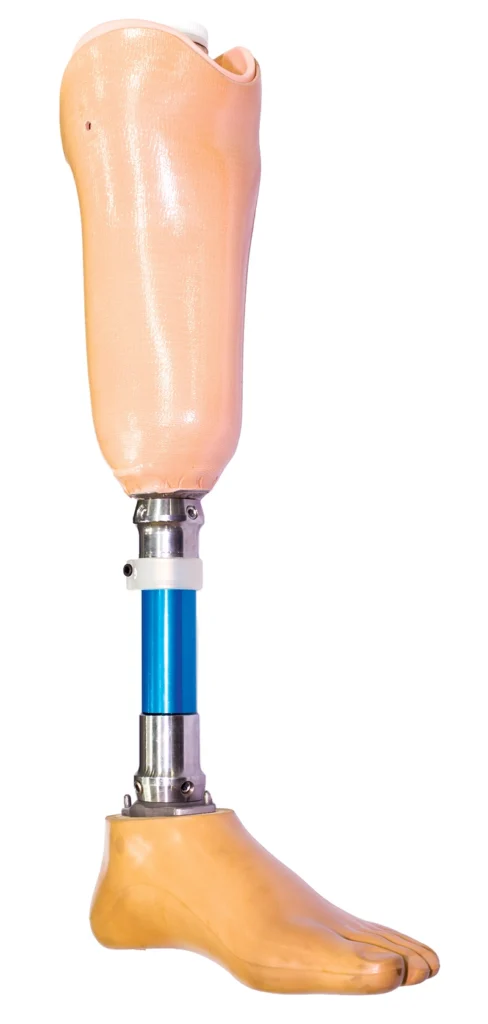
The most immediate material advance came in prosthetic materials. Wood and steel, the dominant materials for nearly a century, gave way to lightweight aluminum right after the war and, in subsequent years, plastics and fiberglass. These materials reduced the weight of prosthetic devices significantly, which mattered enormously to anyone wearing one for eight to 12 hours a day. It also allowed for better-fitting sockets, since plastics could be molded more precisely to the individual residual limb than their predecessors.
In addition, socket design and suspension systems advanced considerably during this period, making devices more comfortable and more functional than anything available before the war. These might sound like incremental improvements, but anyone who has dealt with a poorly fitting socket knows it’s more than a secondary concern.
In the early 1950s, the Veterans Administration (the precursor to today’s Department of Veterans Affairs) began centralizing and professionalizing its limb-care services. It also established dedicated research programs focused specifically on improving prosthetic outcomes. To reduce the large postwar backlog of individuals waiting for prosthetic devices, Congress allowed the VA to purchase prosthetics outside of cumbersome federal procurement rules, which streamlined delivery and took months off recipients’ wait times. This policy remained on the books for decades after the war, enabling the VA to keep pace with rapid gains in technology. All these reforms had lasting consequences for how veterans—and, eventually, civilians—accessed devices.
Many of the advances of World War II were refined and solidified during the Korean and Vietnam wars. Myoelectric prosthetic arms were pioneered through a joint program between the VA and Northwestern University, and the research done during this period built the scientific foundation for later innovations. Hydraulic knee systems also came into wider use during this period, providing more dynamic movement for active above-knee amputees than the mechanical joints that preceded them. For bilateral above-knee amputees, who face complex fitting challenges, four-bar linkage knee systems were developed in response to the specific demands of Vietnam veterans.
The longer-term impact of post-World War II prosthetic advances is clearly visible in the data. A 2010 Veterans Affairs study found that 78 percent of Vietnam veterans with major limb loss were still using prosthetic devices decades after their injuries. That figure speaks not only to the durability of the care they received but also to the cumulative progress that occurred in the generation between 1945 and 1975. Many of the veterans in the VA study had started out on wooden legs and SACH feet; by 2010, they were using carbon fiber limbs with computer-controlled components.
It’s important to note that these veterans didn’t passively benefit from technological change. They actively helped bring it about. They pushed for better devices, participated in research, and helped define what “functional” actually meant in practice. Their advocacy shaped the expectations that drove the next era of innovation.
Back to the Future
The wars in Iraq and Afghanistan coincided with an era of rapid advancement in prosthetic technology. Microprocessor knees were already commercially available, and next-gen applications such as powered joints, targeted muscle reinnervation, and osseointegration were already in various stages of development. So it would be a stretch to say that combat-related limb loss provided the inspiration for these improvements. They were already available when the first amputee veterans came home to begin their recovery.
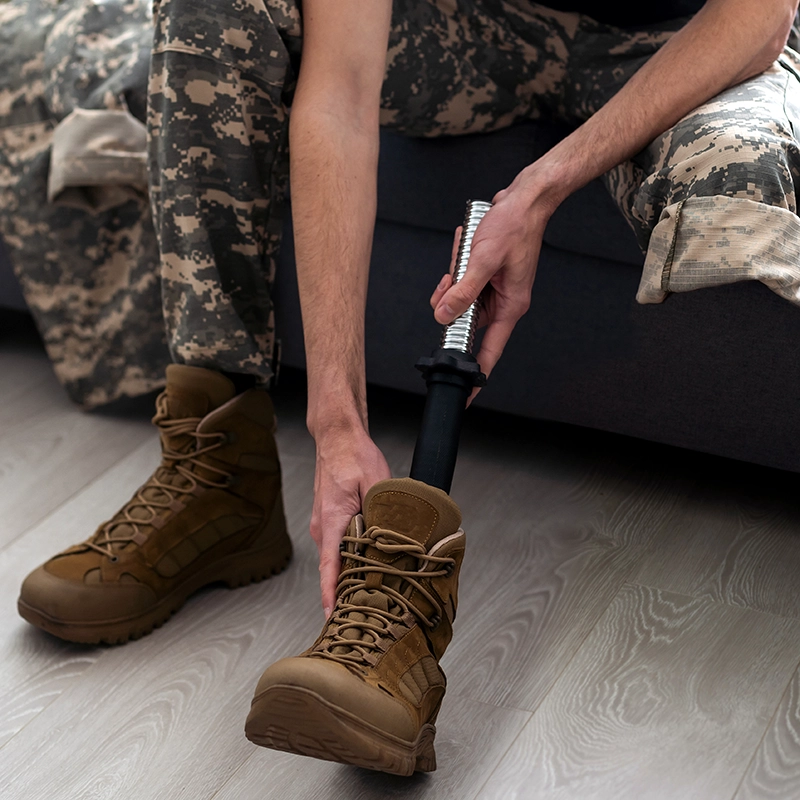
It’s more accurate to say that the roughly 1,700 US service members who lost limbs in the Middle East wars accelerated the pace at which new technologies reached the consumer market. Many of these veterans were injured by improvised explosive devices (IEDs), which often caused multiple amputations and complex wounds that standard prosthetic devices weren’t designed for. Most of these amputees were young, active twentysomethings with decades of life ahead of them, and they were well trained to take on physical and mental challenges. As a group, they constituted an ideal set of subjects to test—and expand—the limits of prosthetic device capabilities.
The government’s response began with the Defense Advanced Research Projects Agency’s Revolutionizing Prosthetics initiative. Launched in 2006, the program set a goal that many engineers considered impossible: develop a prosthetic arm that could match a biological limb’s characteristics (same size, same weight, waterproof, self-powered) and dexterity. Two separate teams were funded to pursue this objective. Johns Hopkins University’s Applied Physics Laboratory received more than $107 million to develop the Modular Prosthetic Limb, a device packed with roughly 25 microprocessors and 80 tactile sensors, with the ultimate goal of being controlled directly by brain signals. DEKA Research and Development, run by inventor Dean Kamen, pursued a parallel track focused on building a device that was robust, intuitive, and ready for clinical use—the device that would become known as the LUKE Arm, after the device worn by Luke Skywalker in Star Wars.
Iraq/Afghanistan veterans played a key role in testing and refining both devices. They often served as brainstorming partners to the designers, providing feedback and suggestions that were incorporated directly into later versions of the device. The LUKE Arm received FDA approval in less than eight years, an exceptionally rapid interval for such a complex medical product; the first two units, appropriately enough, were prescribed to veterans.
At the same time, researchers elsewhere in DARPA were experimenting heavily with TMR. This surgical technique rewires the nerves from a residual limb to new muscle sites in the abdomen, creating control points that allow amputees to control a prosthesis with brain commands. Combat veterans played crucial roles in TMR research, participating in studies that revealed the technique’s benefits for pain control and neuroma mitigation as well as prosthetic control. TMR is now widely available to civilian amputees.
And there’s more to come. Military funding has fueled tremendous progress in neuroprosthetics, which enable wearers to “feel” through their devices. That same work has opened new paths for treating phantom limb pain, by giving the nervous system the sensory input it has been seeking. Adjustable sockets, 3D-printed prosthetics, and other next-generation prosthetic technologies carry the fingerprints of research originally authorized to support veterans who lost limbs in Iraq and Afghanistan.
A central thread running throughout this history is that crisis creates commitment, and commitment creates progress. From James Hanger whittling a leg out of barrel staves to DARPA engineers programming mind-machine interfaces, the human cost of war has forced a reckoning—and a call to service that matches the soldiers’ own sense of duty. Combat-related limb loss has enabled millions of civilian amputees—people with diabetes, cancer, workplace injuries, and congenital limb differences—to walk, work, and live better. Those benefits are enjoyed not only by Americans but by people of all nations.
The other core theme is that the next burst of progress doesn’t have to wait for the next war. The pieces are already in place: research agencies, university partnerships, veteran-led advocacy organizations, and a prosthetics industry with the technical sophistication and financial incentive to keep innovating. The only thing missing is the sustained political will to fund that work during peacetime. Achieving that would be a supreme triumph for every American who’s gone off to war.
Opener Art: photocreo/envato.com; writerfantast/stock.adobe.com; Roman/stock.adobe.com