
When your lived experience with limb loss becomes part of your job, where do you draw the line?
By Annika Berlin
I’m standing in a conference space while people move around me. They’re mostly male, over 40, and nondisabled (or at least that’s my assumption at first glance), garbed in collared shirts and nice pants, drinks in hand. I’m here to talk about accessibility and the advanced technology that exists for disabled folks, two subjects I care deeply about and enjoy discussing.
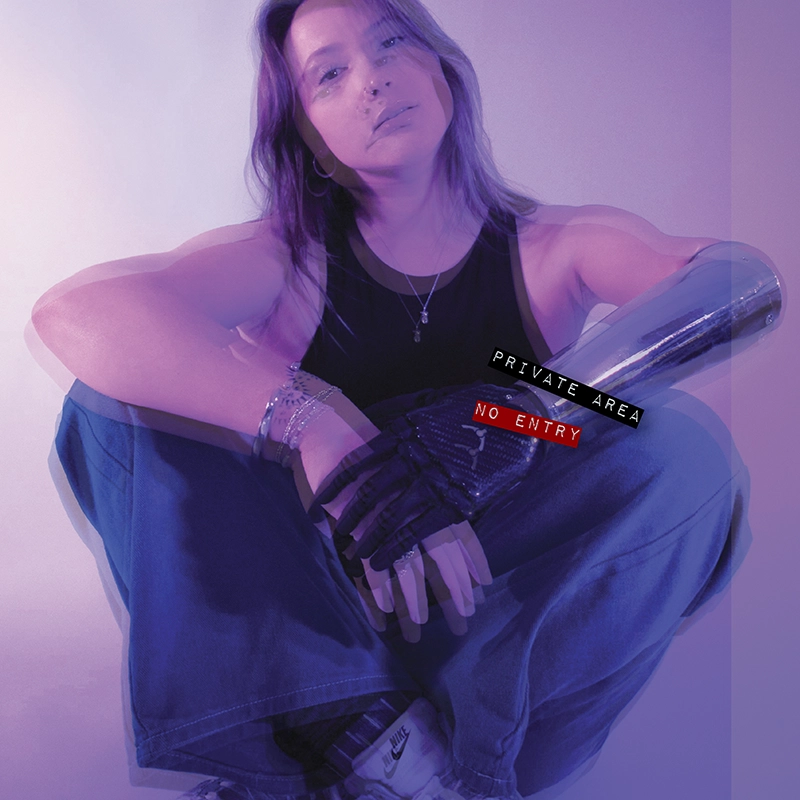
Today I’m wearing my bionic hand. It balances my weight, helps me with two-handed tasks, and sometimes can feel like armor in these spaces. But I’m beginning to understand there’s something else at play here. My bionic hand, whether I like it or not, broadcasts a message that says: “I’m okay! I’ve ‘overcome’ my disability. I now have two hands, Just like you—see?”
Someone approaches me and says, “So, you’re the hand model?” I brush the question off, introducing myself professionally. He begins asking questions: “What happened? How long have you worn it? Do you sleep with it on? Shower?” He starts grabbing the chrome shell of my arm, his hand inspecting up to the wrist. The pads of his fingers make little tap-tap-taps as he touches the outer shell of my prostheses, and a familiar feeling rises in my chest. He goes on: “I can’t believe you’re so confident. It’s really inspiring. I can imagine it must be hard?”
“No… yeah… I mean yes, sometimes,” I fumble, trying to remain professional and kind, but also to represent myself and my community accurately. I want to make him more aware that, for me, it hasn’t been hard physically, but sometimes it’s a struggle socially—in part because of the very feelings he’s evoking right now. He’s still touching my arm. Standing too close. His eyes make their way to my elbow, where my skin protrudes to hold the weight of the device. He pokes curiously, touching exposed pink skin. It causes no pain, but I become suddenly very aware of how exposed I am here. Other conference-goers pass by, double-taking my prosthesis. It’s as if every gaze in this room sends out little needles in my direction, pricking painlessly again and again: my skin, my arm, my body.
My chest is in a knot. I’m smiling and laughing, trying to stay composed, but it feels like I’m doing it all wrong. It’s the only strategy I have to brush off this appalling but common disrespect for boundaries that people seem to feel entitled to when it comes to a disabled person’s body.
My face is burning hot now, and it must be easily readable. I feel myself folding up, conforming to fit their disability narrative. An inspiration, was it? I incorporate that woman, the inspiration, into myself.
That happened a few years ago. But I keep coming back to the incident.
Since then, I’ve built a career in the orthotics and prosthetics space. I’ve talked to a lot of people in roles like mine: ambassadors, representatives, patient advocates, and other people who use prosthetic technology and represent the companies that make it. I represent the company that makes my bionic hand, and on the best days, this work feels like exactly what it should be. I get to promote technology I believe in, educate people about limb loss and disability, influence real conversations, and create change that I can actually see rippling outward. And I get paid to do it!?? That’s hard to beat.
I have had some of the proudest, most life-giving moments of my career in this work—moments that feel really aligned with what I care about. I’ve watched people’s understanding of disability shift in real time. I’ve had conversations that left both me and the other person a little more connected to the truth.
I don’t want to undersell any of that. It’s real and it’s good.
But there’s an undercurrent to this work that often goes unacknowledged, something that makes it feel fundamentally different when you’re a disabled person representing a product designed for disabled people. It can get sticky, even heavy, and it doesn’t really clock out. The conference lanyards come off, the trade show closes, I drive home and go about my business, but it still feels like I’m on duty.
It’s Saturday morning and I’m leaving Costco, rolling my cart of towering goods back to my car. A crockpot for the food I don’t make. Lanterns for the balcony I rarely hang out on. This is a balancing act that I know well: bags dangling from every joint, crease, and handle, my entire body weight leaning into the cart to keep everything in place. It doesn’t look pretty, I’m sure, but it’s efficient.
I see a guy approaching. He’s a bit older than me, tan and in gym shorts, walking in my direction from a few cars down. I am immediately very conscious that I am not wearing my bionic hand this morning. Although I am just as capable without it, I understand that without it the narrative shifts. I focus on demonstrating my competence: popping open my trunk with my right hand, steadying the cart with my foot, tossing bags into the trunk, and wrangling long boxes of outdoor furniture from the bottom of the cart. I really don’t need your help, see?
Except now that I’m aware he’s watching, everything goes to shit. I fail to stabilize the cart, and it rolls back just enough for me to fumble the corner of the box.
“Hey! Looks like you could use some help with that,” he says, lunging to grab the boxes.
He begins telling me about a friend from high school—a terrible accident, lost both legs, and was in the hospital for a while. “But now it’s like he’s completely turned his life around. Now whenever I see pictures of him, he’s climbing some crazy mountain or speaking at events. If he can do it, it really makes me think I have no excuses.”
All the big boxes are now resting in my trunk. He looks earnest, well-meaning, even moved as he reflects on what he imagines his friend’s life is like—and perhaps what he guesses mine might be.
“You must be so strong,” he says. This is meant to be a compliment. I should take it as a compliment. “Can I ask what happened?”
I imagine his question comes from a genuine curiosity. And in another time and place, I might be up for standing there in the parking lot, unpacking the whole tangled bundle with him. But here and now? His awe and intense interest feel like a stark mismatch for the reality that this is just another Saturday morning for me.
And truthfully? I feel a little angry that I owe a story or an explanation to everyone. And I feel angry that I get swept up in it and play along too often.
Instead, I say “No”—a word so foreign that I want to take it back the second it leaves my mouth. He looks hurt, and I feel awful. Here was an opportunity to teach someone about disability, to normalize it, to combat his misguided beliefs—and I didn’t take it because I’m angry?
He didn’t do anything awful. He was helping, and frankly, his help was kind and useful. He was much better at strategically loading up my trunk than I was. How is he supposed to know I’ve been so upset, so fed up with myself and other people’s pushy narratives? I am a part of the problem, I think as I drive home.
So what is it, exactly, that’s so heavy here? I spent a long time not having language for it. I found myself seriously Googling, reading, searching, hungry for anyone else’s writing on this, any words that could help me make sense of the tangle. The term I kept landing on was “cultural tax.” This certainly isn’t a new concept, but it fits.
The cultural tax is the toll you pay in energy, patience, and a piece of your own story every time somebody decides your disability is available for public consumption. It’s the stranger in the grocery line who wants your trauma narrative to liven up his Saturday errands. It’s the man at the conference who touches your prosthesis like it’s an exhibit. It’s the person at the yoga class next to you who says Wow, I have no excuses! when you finish a class. It’s the woman at the San Diego Zoo who stops you in front of the flamingos to ask if your arm is “like that Neuralink thing” and could her kids touch it. (True story.)
None of these people are villains. That’s part of what makes it so hard to talk about. The tax isn’t levied by cruelty. It’s levied by accumulation. One moment is fine. Two is manageable. But this isn’t a single encounter; it’s the texture of your entire life. And when it’s also the texture of your work, the meter runs a little faster.
Working in that kind of role—representing a prosthetics company as a prosthetic user —didn’t create this tax, but it sharpened my awareness of it and helped me see the mechanism. At work, part of what I was being paid for was to narrate my disability. To stand in front of rooms as the story of disability that technology fixes. Not because anyone told me to say it that way, but because this is the story our culture expects. It’s what sells. And in that, I inherently became the before-and-after. The overcome.
As someone who genuinely wanted to push back against these narratives, I found myself doing my best at every moment to share what I think of as the “both/and” part of the story: Yes, this technology is incredible—AND my body isn’t broken without it. I don’t need fixing.
This doesn’t eliminate the cultural tax, but it changes how I carry it. I’m learning—slowly and imperfectly—that most people mean well. I know that people are kind more often than they are not, and that curiosity can be a welcome part of this experience for me. I want to keep welcoming it as often as I can.
I also know it adds up. It is not one moment but the weight of all the moments, this cumulative expectation that you will always be available to explain yourself. And I’m learning that saying no is not the same as being the problem—that setting a boundary in a Costco parking lot doesn’t undo every bit of advocacy I’ve ever done. I’m learning that I can be a person who educates and a person who sometimes says, not today.
And I’m learning where the tax doesn’t reach.
Some weeks I go to the climbing gym. I lace up my climbing shoes, adjust my harness, tie in. I’m not particularly good, but I’ve got the basics down, and I climb alongside other adaptive folks—each with different access needs and methods, all sending it up the wall in different ways. Here, disability is community. Here, people’s stares and questions and suggestions don’t shrink me. Here, “You are so strong” is echoed often, but it feels good. It feels real. I know my strength, and so do they—and we all understand it’s not just because I got up in the morning and went to Costco.
These spaces remind me that disability is a living thing. It looks and feels different depending on where I am. It is layered, shifting. I see my experience with it flicker and blink—a light that reflects and bends. Sometimes it falls on me harshly, constricting and conforming; other times, it’s a flare that guides and connects, a signal of understanding. It’s not fixed to any one place, not confined, not something embedded within me. It exists in the spaces between me and others.
The cultural tax may be inescapable. If you’re living with a visible disability, the world will find you. At the trade show, at the airport, in front of the flamingos at the zoo, people will want your story. Some will touch your arm. They will tell you about their friend who lost both legs and now climbs mountains, and they will mean it as a gift. Sometimes it is a gift. Sometimes the encounter is genuine, and the connection is real, and you walk away feeling like something small but good just happened between two people.
But sometimes it’s not. And the work I’m doing now, the work under the work, is sorting through this. I’m learning to stay open, to trust in the kindness and genuineness of curiosity, without selling myself out or being complacent in a narrative I don’t believe in. I’m learning that I can carry this identity with pride, play the role in a constructive way, but still refuse to perform it on demand. I’m learning how to pay my experiences forward without feeling as if they’re being taken from me—as if I’m being taxed.
There are still times I bite my tongue in fear of saying the wrong thing or upsetting the wrong people. But I’m also learning to quiet the fear of “saying it wrong” or waiting until I find the perfect words. Having the temerity to get angry sometimes is okay. It’s part of the deal—even if I end up feeling ashamed that anger isn’t going to help solve the problem.
I don’t have this figured out. But I think the figuring is the thing. That doesn’t feel like a tax. It feels like an investment in the kind of world I want to be a part of.
Annika Berlin serves as Manager of Grassroots Advocacy for the Amputee Coalition, focused on So Every BODY Can Move. She was the 2025 NAAOP Breece Fellow.