
An Upper-Limb Amputee Navigates the World of Accessibility
By Melissa Bean
I’m a 1. left 2. upper-limb, 3. congenital amputee, who 4. occasionally wears a prosthetic – that’s four definitions for one limb difference. Every amputee is different, so whether you are a congenital or an acquired amputee, upper, lower, or multiple limb amputee, your experience is unique and your needs are specific.
Despite the huge range of ability and disability we amputees represent, standard accessibility accommodations that work for all of us do not exist. But I’m good at adapting, so I’ve put together my own guidelines and approaches to accessibility for my life with an upper-limb amputation.
I have a disabled parking placard. My doctor has seen me for chronic overuse injuries to my wrist, shoulder and back. These are all related to my limb difference and make it difficult for me to carry heavy items and push loaded grocery carts. I use my disabled parking placard when spaces seem readily available, and when I know I’ll be moving large items, or a quantity of items, from a store or other business to my car.
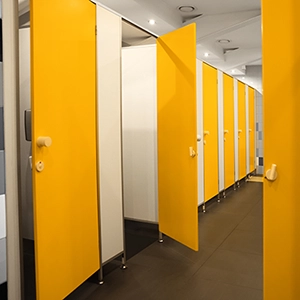
I use disability bathroom stalls in public restrooms. I look around first, but I go into the disabled stall whenever possible because it’s easier for me. I don’t go ahead of someone in a wheelchair or using a walker, someone with a caregiver, or someone whose toddler needs a diaper change. Most Americans with Disabilities Act requirements for public bathrooms address turning radius for wheelchairs, signage, grab bars, and height of fixtures such as sinks and soap dispensers. I haven’t found any evidence that a coat hook is an ADA requirement, but in my experience, they are most likely to be located and in working order in the disability stall. I’m counting on that hook because something I don’t do in a public bathroom is put my personal items on the floor. I don’t even let the cuffs of my pants touch the floor if I can help it. I need somewhere to hang up my purse, coat, and shopping bags. When I’m going into a disability bathroom stall, I look around BEFORE I sit. Toilet paper dispensers can be installed in front, to the left, to the right and sometimes slightly behind toilets. If I’m not going to be able to reach the dispenser from the toilet, I get my paper before I start my business.
I know washing with soap and water is best, but I can’t always do it effectively in a public bathroom, so I carry hand sanitizer in my purse. Washing up is often the trickiest part of the public restroom. I love automatic soap dispensers, faucets and paper towel dispensers with sensors, but they are the exception, not the rule. I sometimes encounter faucets that only deliver a continuous stream of water if you push the handle continuously. I’m tall, so this has me positioned nearly head first into the sink with my nub on the faucet and my unaffected hand desperately trying to wash itself. I also run into soap dispensers with a long, thin spout that dribble their industrial strength soap three to five inches from the handle. Again, in order to dispense the soap into my one hand, I bend at the waist, drag my sleeves, and sometimes my hair, on the counter and use my nub to engage the dispenser. My children are grown, but when they were small, public bathrooms were a stressful and germy obstacle course – holding them up to the sink and helping them reach soap and water from faucets and dispensers I could barely use was overwhelming. I can’t count the number of times I’ve stood at the sink of a public bathroom and thought, “How am I going to do this?” Hand sanitizer.
I use the “open door” button. Doors in public spaces are heavy. Push or pull, I’m at a disadvantage, so I make use of this easy option. It means waiting patiently for the doors to swing themselves open, but I am OK with that.
I use the disabled line at the airport. This is a challenging one because, depending on who’s directing traffic at the start of the line I can be met with skeptical annoyance or overt support. One airport employee told me I shouldn’t be in that line, but she’d let me go just this once. Another said I could go through, but my 13-year-old daughter could not because I don’t need an attendant. It’s a mess, but I’m prepared with determination and an assertive personality. I also check the option for “disabled” when I purchase plane tickets.
I accept help with my groceries. Cashiers often offer, and if they don’t, I ask. It took me about 30 times to get over feeling guilty and weird receiving this kind of assistance, but it makes a huge difference for me. I have a limited number of tasks in my day before I reach a point of mental stress and physical pain.
I remember the phrase “reasonable accommodations.” Requesting help can be difficult, so I skip the feelings round and ask myself: Is what I’m asking for a reasonable accommodation? If yes, then I’m not going to hesitate or apologize. A reasonable accommodation isn’t special treatment; it’s equal access.
Every amputee is having a singular experience – but we are all offered the same accommodations. This ongoing misunderstanding is just another challenge amputees face on a daily basis. Sometimes, I feel like being an amputee is more about what’s in my head than what’s not at the end of my arm. Defining the accommodations I require and being ready to advocate for myself when needed eases my stress and makes the world a more comfortable place.