
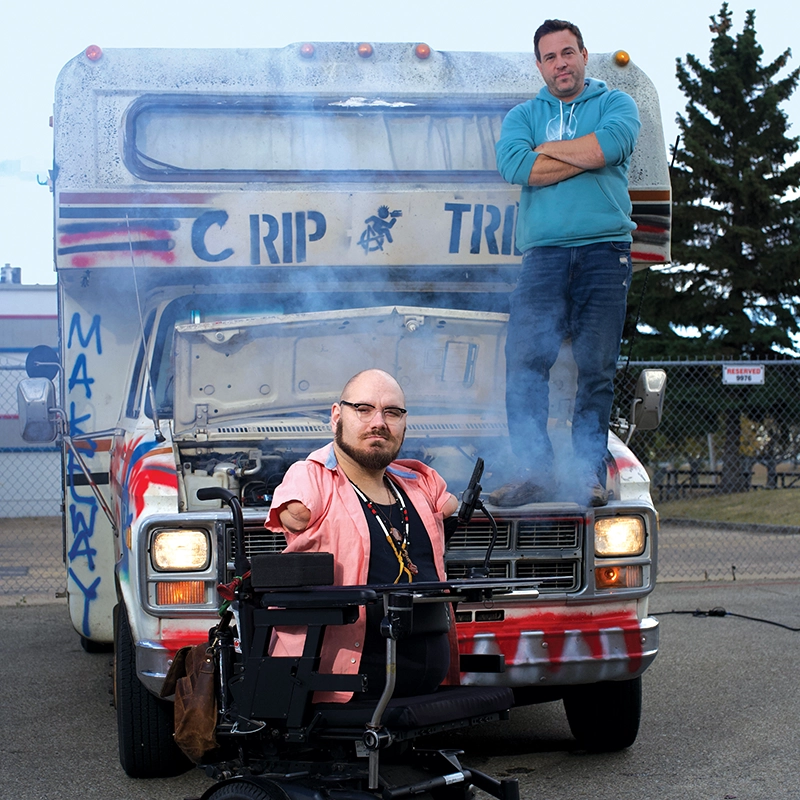
When we asked Daniel Ennett what sort of vibe he was shooting for with Crip Trip, his road-trip docuseries, he went straight to Hunter S. Thompson. “Fear and Loathing is probably my biggest influence,” he says, adding proudly: “And that’s because I’m a filthy degenerate.”
By which Ennett means: He’s an independent thinker in a world that rewards conformity; a disabled person (quadruple amputee) who insists on equality with nondisabled people; a truth-teller who refuses to go along politely with convenient lies; and a subversive storyteller who never lets good manners get in the way of a good time. Hunter S. would approve.
Like Thompson, Ennett tackles serious issues and forces his audience to wrestle with uncomfortable ideas. But his overriding objective with Crip Trip was to be entertaining. “The series is funny,” he says. “We knew we had to be entertaining first to keep people watching so they could digest this very important political message, which is that disabled people are pretty much screwed by the systems they have to interact with. Whether you need full-time care, or you want full-time work, or you’re getting punished for working at all, you get denied the resources you need.”
The six-part Crip Trip follows Ennett and his longtime friend, Frederick Kroestch, as they drive across North America in a 40-year-old van. On their way from western Canada to the Great Lakes, across the US border and into New York City, they expose the massive holes in the social safety net that not only engulf disabled people but also swallow their families and friends. The two protagonists embody this dynamic onscreen, as Kroestch assumes the role of Ennett’s 24/7 caregiver. This unpaid labor places heavy demands on both Emmett and Kroestch—who was himself still recovering from a stroke he sustained mere months before filming began. “We wanted to make it a trial by fire for Fred, so that we could show just how hard full-time care work is,” Ennett says.
The series is available via Accessible Media Inc., the same Canadian platform that hosts Christa Couture’s Postcards From…., which we featured in our March issue. Like Couture’s series, Crip Trip is only available to American viewers via the use of a VPN—which is completely legal and completely free. We recommend Proton VPN. You can also see snippets from the series on YouTube, or check out the Crip Trip podcast.
Amplitude talked with Ennett last month to learn more about Crip Trip; excerpts from our conversation follow below.
There’s a scene in Episode 1 where you’re on a Zoom with a bunch of people from the Alberta health bureaucracy. Was that an appeal, or an initial hearing?
So that was a first-level appeal. They initially told me they would cover five hours of care per day, and my mom was supposed to do all the rest. I was like, “Are you guys effing kidding me? She’s done this for 30 years, without getting paid for her labor, and it’s run her body into the ground. She has a double hip replacement and chronic pain and is hobbling around. She can’t do it.”
The primary issue is that the minute you put any kind of profit motive in people’s health, that leads to terrible, terrible outcomes. When I became disabled, my mother saw the standard of care the government would provide, and it was so low that she had to quit her job to take care of me. She was a single parent, but she couldn’t get on government benefits because she had savings, so she had to spend all of her savings before the government would provide any kind of benefits. She had to pay to do the labor they wouldn’t pay her to do.
These systems are built to burn you out before they help you. They want you to give up trying to advocate for yourself. So they have tons of mechanisms to make the processes very difficult and bureaucratic and long. You appeal once, and they tell you no or maybe give you an hour, and then you do it again. But they’re healthcare professionals who are going to toe the line of the healthcare bureaucracy. They stack this committee full of nondisabled people and then prattle on about what I need, but there are no disabled people there who actually use care work. And the absurdity is, they’re telling me how they’re being sound stewards of taxpayer resources, but they’re all getting paid hundreds of dollars an hour.
It struck me that your mom, your primary caregiver, is somewhat disabled herself, and then Fred, who becomes your main caregiver on the road trip, is newly recovered from a stroke. He’s somewhat disabled, too.
He had to teach himself how to walk again. His energy levels completely torpedoed. But what the series really shows is the mental toll it takes on him. It’s just not sustainable for anyone to do this 24 hours a day, every day. No single person can be a full-time care worker and have it be sustainable. And the other part of it is that I’m also caretaking for Fred, right? I do emotional labor, I make concessions. It’s very symbiotic, and that leads to a lot of conflict.
The nice thing about having Fred in that role is that he’s willing to ask the dumb questions and very freely vocalize about just how hard it is. Because we often praise family care workers and say, “Oh, good for them, they’re such a good person.” But at the end of the day, no one should have to do this without any support, because it is just too much work.
I think a lot of caregivers don’t give themselves permission to express any emotion other than saintliness and stoicism. It’s not always well accepted if people are honest about how hard this can be.
A lot of people who are just thrown into this role feel like they’re failing at it if they get burned out. They think it should be sustainable, and the systems reinforce that idea. It weighs on your consciousness. But one day this is all gonna fall apart. So many people with disabilities have familial care workers who are aging. That’s a very frequent story. And their parents are sometimes flat broke because they’re doing labor for the government.
In the US, anyway, it seems as if there’s more recognition of these issues than there used to be. Would you agree with that assessment? Do you think this is happening in Canada?
We were trying to make edgy content 10 years ago, but there was no appetite for it. We were trying to get away from inspiration porn, but that’s where broadcasters’ taste was. But after COVID, disability activists started finding each other and organizing. COVID made a bunch of things very obvious to the disability community, and these ideas started proliferating on social media, and advocates started to talk about how similar the problems with these systems are. It was angering as a disabled person to see all of these accessibility measures—which we’d been told for years were impossible—get instituted in, like, a week. Every institution that told us we could not work from home or do school from home, they all pivoted to online. And it worked, everything was fine. But when disabled people had asked employers to make those sorts of accommodations, we would just be fired. There was zero way it would happen. So the disability community really saw the hypocrisy.
Even within the disabled community, there are varying degrees of privilege. The disabled people we tend to pay the most attention to are the people who are functioning the best—Paralympians, people like that. No one wants to look at the messy cases, like a four-limb amputee in my case, or a quadriplegic who needs full-time care work? Because we’re a lot angrier. We’re a lot angrier with the system, because we get screwed by it the hardest. When the narratives get messy and complicated, that’s when people tend to tend to tune out. But that’s when it’s most important to listen.
Is there tension within the disability community between, say, a paraplegic and a quadriplegic, or between a below-knee amputee and a quad amputee?
We want to avoid creating that hierarchy. Everyone needs help, and the more time we spend fighting each other, the less time we spend fighting the people who are in control of the assets, which is the government or the insurance companies or the other people we should actually be directing our anger toward. But there’s definitely nuance that needs to be recognized. The experience of someone with neurodivergence or someone who is immunocompromised is very different from someone who needs full-time care work. They have different priorities. So there’s definitely some tension. But if we spend our time gatekeeping about whether or not you’re “disabled enough,” then we’re not focused on fighting the people that matter.