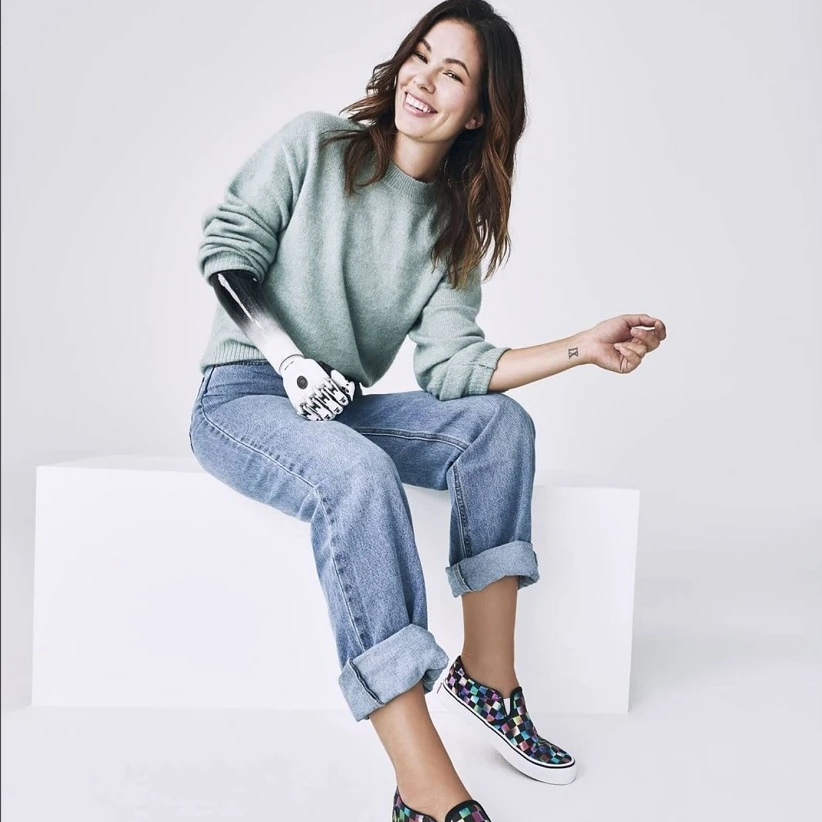
When Atropia won the Grand Jury Prize at Sundance last winter, nobody was more delighted than Shaholly Ayers. The film provided Ayers, a longtime disability advocate and model, with her first feature-film acting credit, fulfilling one of her long-term goals. “I’ve always wanted to get more into acting, because I really enjoy modeling and the creative side of that,” she says. “I wanted to dig a little deeper in myself.”
Last week, after a long delay, Atropia finally found a distributor and is scheduled make its way into theaters before year’s end. While Ayers doesn’t have a lot of screen time, she applauds the film as a step forward for disability representation in entertainment. “I’m really happy that they did cast authentically for this. And it wasn’t just for my role; there were multiple amputees in this film.”
At Atropia‘s world premiere in Park City, Ayers invited actor, filmmaker, and fellow disability advocate Melanie Waldman as her plus-one. And it’s a good thing, too, because Ayers got sidetracked en route to the theater and nearly missed the screening. Waldman (who knows her way around the film industry) was able to save her a seat in the special “cast and crew” section. Afterward, she and Ayers attended the Atropia afterparty together and spent some time talking about the production and the whole Sundance experience.
You can follow Waldman @whereswaldman and Ayers @shahol1. The conversation is edited for length and clarity.
MELANIE: This film went the distance with authentic casting. What meaning does that hold for you?
SHAHOLLY: I’ll speak for myself, but I do think that it’s a point of frustration for other members and the limb different/disability community. I think it’s a huge thing when big [nondisabled] actors play roles of people with disabilities. There are times when I think that it is good to cast authentic people with disabilities. It allows us to have an opportunity to grow in our field. So I’m really happy they cast authentically for this, and I know that they cared about it.
The director mentioned that the film crew visited the real-life Atropia location (a training site created by the US military). Did you film at the actual site?
No, we didn’t get to shoot at the Atropia site. We were at an outdoor set made to look like Afghanistan. I mean, it was so sandy out there. I have never had a stye before, but during the shoot I got the biggest stye in my eye. I was like, “I’m on camera!”
I didn’t notice the stye, so that’s the good news. But I did notice that you had on a Louis Vuitton bandana on at one point, out in the desert. Was the fashion angle discussed on the set at all?
We didn’t go into brands, but during the first day of fitting, we went through a bunch of different clothes. It was a few hours, actually, going through and figuring out, “Who is my character? Who is Maria? What does she wear?” I don’t want to call her a snob, but she has her own thing. She’s kind of out there, and so we wanted to bring that to life in her fashion.
Do you have any Sundance favorite films?
Little Miss Sunshine. I remember watching that way back in the day, and I loved that film. Another one that I really like is Get Out. There are films that you watch and forget about, but Get Out is one of those films where I think about it almost every day. And it just so happened, in the afterparty I was standing like maybe a foot away from Daniel Kaluuya [Get Out‘s lead actor]. So here’s this guy that’s been on my mind, on and off, for like a couple of years, and here he is standing right next to me. It was so surreal.
I didn’t like that venue, accessibility-wise. It wasn’t great. And apparently somebody else showed up as soon as I left, right?
Yeah, Bill Murray was there, which added another moment that will stick in my brain from this whole thing. He’s tall, by the way. He towered over all the people who were around, and he had this little orange beanie on. And I’m thinking, “My god, he’s like a beacon!” We were all trying to give each other courage to go talk to Bill Murray. We finally started walking over there, and all of sudden—you know the ugly lights they turn on at the end of the night? They turned on the lights that basically say, “You need to leave.” And he’s gone. He’s like a magical man.
Apparently the room was at its max capacity when I left. So I think when they let Bill Murray in, he basically took my spot.
Well, thank you for making my Bill Murray moment happen! Now I have a story thanks to you.
And you have a story about showing up late to your first red-carpet premiere. How did that happen?
So I think it’s hilarious. I booked my Airbnb, thinking it was right next to the theater. It’s like five minutes away. Perfect. And I got there 15 minutes early. I show up, and they tell me, “You’re in the wrong place. You’re in Salt Lake City. You need to be an hour away, in Park City.” There’s a theater with the same name.
Sundance and the volunteers there really were awesome. They let me into the screening, and it ended up being really great. I’m sad that I missed the red-carpet moment, but it’s kind of funny, in retrospect. And it was so nice of you to talk to everybody and make sure I got in.