
On the one-year anniversary of the accident that left Zach Monticello without his right arm, he turned on the evening news—and froze. On the screen, a dog with a missing forelimb was hopping down a hallway, tail wagging.
Right after his amputation, Monticello had told his wife: “If I ever find a three-legged dog, I would like to adopt it.” Maybe he sensed a kind of kinship waiting somewhere out there, another being learning to move through the world differently, just as he was. So when, exactly one year later, he saw her on the local news—a Rhodesian Ridgeback in need of someone willing to take a chance—it felt like destiny.
The station was airing a story about Maricopa Animal Safe Haven, a former jail in greater Phoenix that’s been repurposed to give abused and neglected animals the care they need to heal. Monticello watched the dog hop down the hallway beside a rescue volunteer, eyes bright, exuding happiness. Something about her personality struck Monticello immediately.
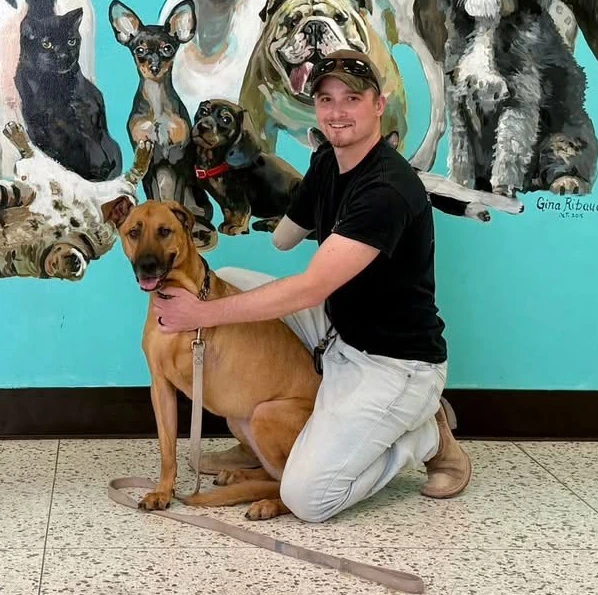
“I told my wife, ‘This is meant to be,’” recalls Monticello, 31. She initially protested that they already had three dogs; if they adopted another, she joked, “We’re gonna have more dogs than arms.” But two days later, after driving to Phoenix and meeting the pooch for the first time, he called his wife and told her: “There’s no way I can’t bring this dog home.’”
The animal had ended up at MASH after being shot, her leg so badly damaged that it needed amputation. Yet despite everything she’d endured, she radiated joy. “She doesn’t even seem to know she’s missing a leg,” Monticello says. On the drive home from the shelter, she rested her head on Monticello’s residual limb, and he knew immediately they were meant for each other.
Monticello named her Cleo. Since welcoming her into his home, his bond with his new companion has grown deeper than he anticipated. Cleo has helped him emerge from his darkest days after limb loss. In the year prior to adopting her, Monticello had endured 13 surgeries in 10 months, culminating in the loss of his job in law enforcement. “When it finally sunk in that I was going to lose my career, that hit me hard,” he says. “But having Cleo gives me purpose again.”
Above all, she’s helped Monticello discover new ways to practice what he found most rewarding about law enforcement: helping others. “She’s helped me be more proactive with things,” he says. “There’s a woman nearby who got into an accident almost identical to mine. Through a mutual friend, I was introduced to her and went to visit her in the hospital. It’s been really helpful for me—not only to help her, but to find ways to support others going through similar circumstances. Even in small ways, that’s really improved my mental well-being.”
For Monticello, each act of helping someone else feels like a quiet exchange of healing—one that Cleo started simply by being there. “Seeing another living being who, like me, is missing a limb—and yet she doesn’t even seem to know it,” he explains. “She’s got such a great temperament, great mannerisms, and is super respectful. People often look at these dogs and think that they’re going to be too big of a challenge. But Cleo is totally limitless.”
She’s more than a dog to Monticello; she’s proof that love and purpose can rebuild a life. Cleo embodies the spirit Mary Oliver described as “no small gift” in her celebrated poetry collection Dog Songs: “Because of the dog’s joyfulness, our own is increased.”
Monticello has experienced that firsthand. “She was just so happy and so appreciative that somebody wanted her,” Monticello says. “I feel like she knew that from the gate. And having another living being who has gone through the same things as me, somebody I can connect with and understand—even if we can’t communicate via words, that understanding of one another has helped me so much.”
Cleo gives Monticello a daily reminder of what it means to keep showing up, even when life looks different than expected. She also demonstrates that strength isn’t measured by what’s lost, but by what endures, and the ability to keep moving forward.
Monticello hopes that by sharing his story, more people will adopt a pet with a disability. “Unfortunately, these dogs are easily overlooked,” Monticello explains. “They bring so much joy. And they’re just looking for love, you know? She’s helped me find joy again. I love her more than anything.”