
By Kim Ousley
For people with limb loss and limb difference, having the right prosthesis can determine something as ordinary as getting safely in and out of a shower, or make it possible to return to the activities that keep them moving, healthy and connected to their lives.
In Connecticut, a group of amputees and advocates spent years working to make those devices more accessible.
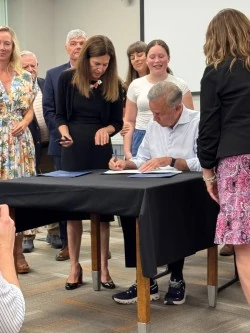
The So Every BODY Can Move Bill (HB 5374), Public Act 26-33, was passed in Connecticut on May 28, 2026, and Gov. Ned Lamont signed the bill during a ceremony at the University of Hartford on July 14, 2026. The bill expands insurance coverage for activity-specific devices, helping ensure individuals have access to the specialized prosthetics they need for recreation and everyday life.
Co-founders Herb Kolodny and Brenda Novak of the Connecticut Amputee Network started the process of getting the bill in front of the appropriate government officials in 2018. Then Lindi Mitsou, assistant professor of prosthetics and orthotics at the University of Hartford, came on board in 2024 to help advocate for the bill. Jeff Sargent, a fellow amputee of four years, also became a strong advocate and helped tremendously over the past year to see it through.
Kolodny, a Certified Peer Visitor and Certified Peer Visitor Trainer through the Amputee Coalition, shared the pitfalls and wins along the way. After going through his own cancer diagnosis that led to his amputation years ago, he became an avid advocate. He credits Novak, a fellow amputee, with helping him start the Connecticut Amputee Network. The two co-founders began implementing their plan to see the So Every BODY Can Move bill passed in their state.
Kolodny spoke about how he took a seven-month-long training program through Connecticut Partners in Policymaking, a program designed to help people advocate for themselves.
“This program prepared me for what I needed to do,” said Kolodny. “Then Brenda Novak came along and provided her years of marketing and public relations skills to what we were trying to do.”
Novak pointed out that this needed to be a “non-partisan” issue.
“To have these people (amputees) be able to return to work and pay their insurance premiums. That resonated and would reduce long-term health care costs overall and benefit everyone.”
She also shared the important data that vascular disease is the number one cause of amputations and that diabetes tends to coincide with this condition. If people can’t work and have a chronic condition, they may ultimately rely on Medicaid. Advocates argue that improving their overall health can help reduce lifetime health care costs for everyone.
Mitsou was looking for a way to volunteer when she heard about the So Every BODY Can Move movement. With a background in engineering and clinical practice, she brought her analytical skills and policy knowledge to the effort. There are different reasons why legislators might oppose a bill expanding insurance coverage, including concerns about cost.
“But the flip side of that is that when you allow someone to become active, you improve their health, so you reduce their lifetime healthcare costs,” said Mitsuo.
Studies from other states that have already passed similar legislation have shown improved health care outcomes without increases in insurance rates.
For Sargent, the issue was personal. He became an amputee four years ago and experienced barriers to insurance coverage almost immediately.
“I was told at the hospital that I would spend four days in the hospital and then 4 to 5 days in an inpatient rehab,” said Sargent. “My insurance provider denied my rehab despite multiple appeals.”
Insurance also denied a shower leg that would keep him from having to climb in and out of the tub.
Sargent goes on to say that after being introduced to Brenda, Lindi, and Herb, he learned of the House bill that was being proposed to change insurance company policies.
“This is where my journey of advocacy really began.”
He met with his local representative and began speaking about the initiative with his friends and family, too. All four advocates also met with many in-person support groups throughout the state to share what they were doing.
Sargent said Novak contacted him when the House vote was taking place.
“I got to watch it live on CTTV when it passed unanimously!”
Mitsou invited Sargent to Gov. Lamont’s bill-signing ceremony on July 14, 2026, a moment that brought together years of advocacy by people who understood firsthand what greater access to prosthetic care could mean.
To learn more about the So Every BODY Can Move initiative for all 50 United States, visit the So Every BODY Can Move website and click on your state to see where it is in the process. Fifteen states have now passed the bill, and the goal is to have 28 states on board by the 2028 Paralympic Games.