
WORDS Mary Elizabeth Frandson
“Poetry acts as an introduction to what my soul desires and feels.” –Estacion
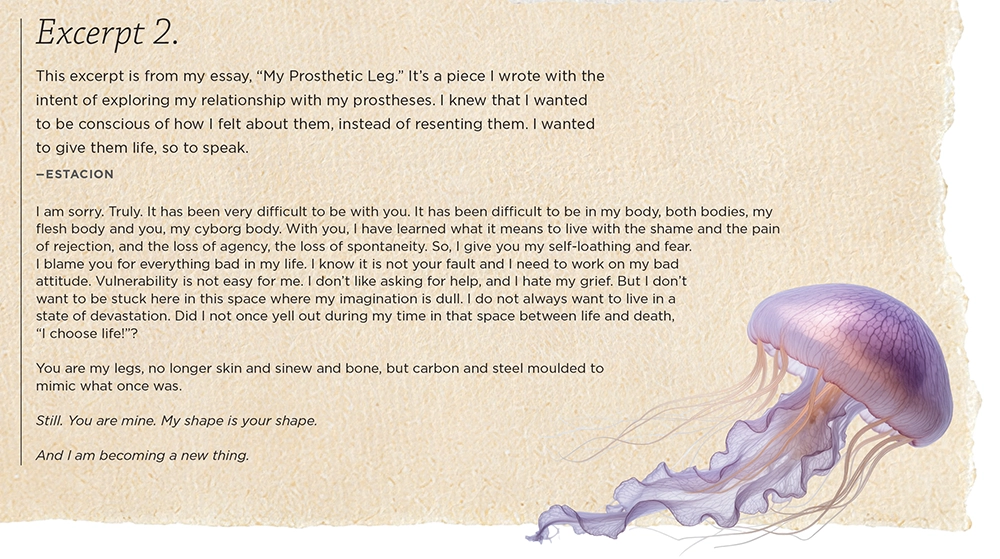
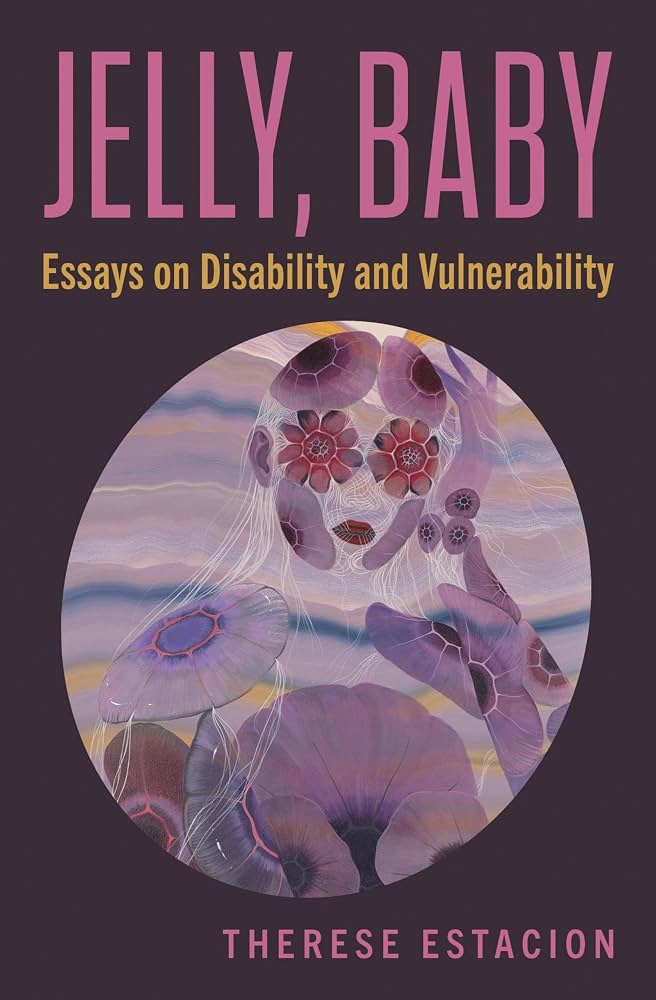
Therese Estacion’s forthcoming collection, Jelly, Baby: Essays on Disability and Vulnerability, refuses silence. Across six lyrical essays, Estacion explores disability, grief, rage, vulnerability, and the lingering impact of ableism with an honesty that is at once poetic, political, and deeply intimate. Rather than offering readers a sanitized narrative of resilience or overcoming, she allows contradiction, fury, tenderness, and longing to coexist on the page.
Estacion is also the author of Phantompains (Book*hug Press), a finalist for the 2021 Indies Foreword Reviews and the 2021 CLMP Firecracker Award, which explored her Filipinx heritage and physical disability through poetry. In addition to her literary work, she has served as a guest editor for ARC Poetry Magazine and Feels Zine, curated Smutburger’s 2023–2024 series, and worked as an assessor for both the Ontario Arts Council and Canada Council for the Arts. She is currently training as a psychotherapist.
Estacion once said poetry acts “as an introduction to what my soul desires and feels, and to give voice or words to that desire.” That sensibility pulses throughout Jelly, Baby, which confronts ableism and vulnerability head-on while making space for a more complex and expansive understanding of disabled interiority.
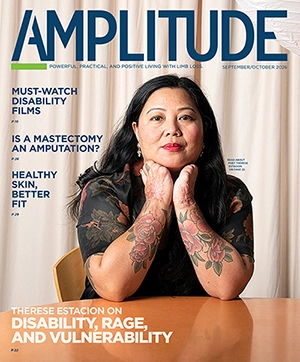
Amplitude spoke with Estacion about disabled rage, Filipinx folklore, being perceived in public spaces, and why she resisted giving readers a neat resolution.
One of the most striking things about Jelly, Baby is its refusal to soften disabled rage for non-disabled readers. Was it important to you to resist the expectation that disabled writers remain palatable or inspirational?
It was important to me to tell the truth, even if it made people uncomfortable or myself uncomfortable. I don’t feel inspirational or palatable. I know I am generally a friendly and approachable person, but I’ve also experienced so much ableism in the past ten years that when I started writing the book, I realized I had been harboring bitterness and rage. My personality had changed. I didn’t feel like the easy-going, spontaneous, grateful person I was before I got sick. Although, I feel like she is coming back to me more and more these days.
You write about the aswang—a shape-shifting, monstrous figure from Filipinx folklore often associated with violence, fear, and hunger—in a way that transforms it into a vehicle for disabled rage and grief. What did the aswang allow you to express that realism alone could not?
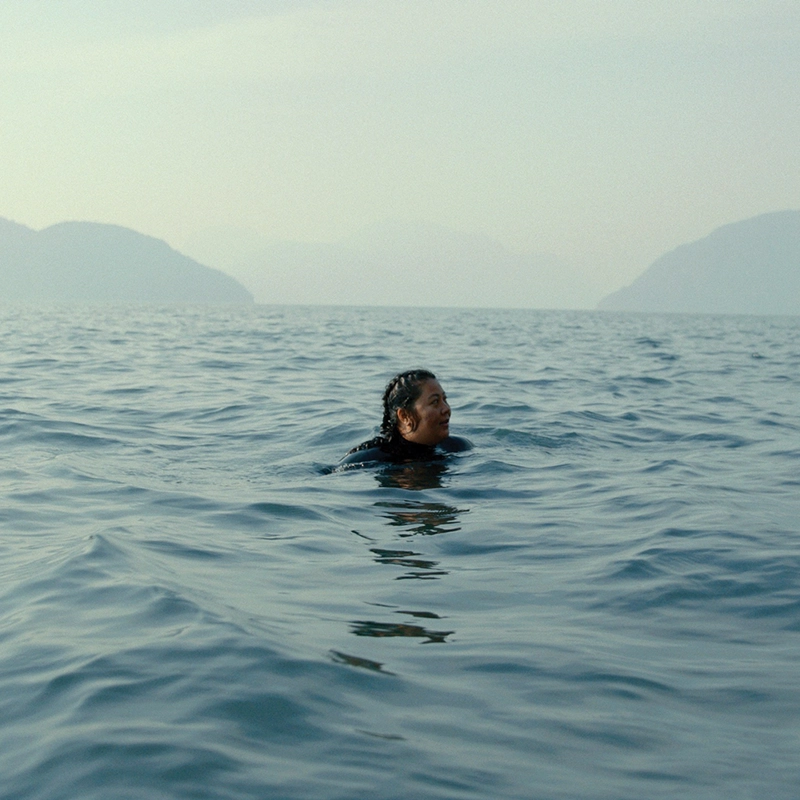
I love writing about the aswang in general. She’s become a personal symbol for me, and she’s helped me sublimate my rage and grief and longing, my questions about eroticism and the disabled body, my own sense of the erotic. She’s given me a real opportunity to share parts of my cultural history, the folk tales told everywhere across the archipelago. She’s given me the opportunity to reinvent and make claim to something larger than me that exists inside of me.
There’s a line in a recent review of Jelly, Baby in Quill and Quire describing your work as “written by and for disabled people,” with nondisabled readers as a secondary audience. Did you consciously write toward disabled readers while creating this collection?
With my first book, Phantompains, I primarily wrote about the events that led up to my illness and shortly after—all my time in the hospital, how I became an amputee, and what that was like. In a way, I wanted to retell what happened to me so I could preserve it and, also, I needed something to create or else I was going to lose my mind, which can be an inevitable thing that can happen when one encounters severe trauma.
With this book, I wanted to share how messed up ableism was and how much it has messed me up as an amputee, but also the lives of all the disabled people I know (either personally or within the wider disabled community). I wanted to write so I could be a part of all the activism that is out there, to resist staying afraid and keeping silent.
Several essays confront the way disabled bodies are observed, questioned, or forced to explain themselves in public spaces. How has constantly being perceived shaped your relationship with your own body and inner life?
There’s a saying, which I am sure I am butchering, that says something like, “Once an object is perceived by an onlooker, it ceases to remain the same.” I sometimes think about myself as an object, as someone who is looked at, and someone who is seen. Being looked at can feel violating and, at times, has brought on paranoia. [It’s the feeling of] not knowing why someone is looking at you or catching someone looking and staring at your prosthesis or amputations while you are relaxing or doing day-to-day mundane things, and trying to smile at them, but instead of smiling back they look away. Or when you feel like your body is public property, it can feel incredibly discombobulating and heartbreaking. For some reason, disabled people are not afforded the same type of privacy able-bodied people are given when we are in public. This has filled me with a lot of hatred—for my own body and for the person looking at me as if I am “other.”
Then, there’s the other type of looking, the one akin to witnessing. That feels holy and healing.
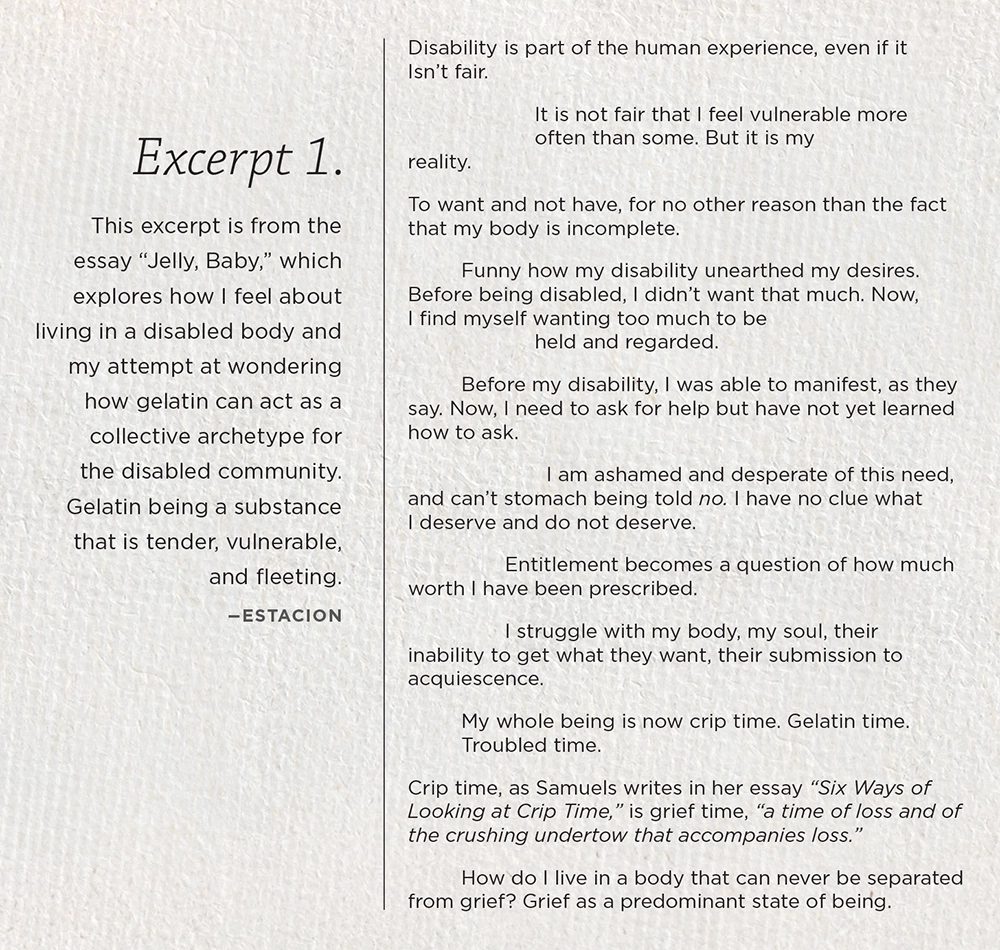
You resist the trope of overcoming disability and instead leave readers with something much more unresolved and human: “Perhaps we will begin to dream.… Let us continue.” What does this choice mean for you?
There is no overcoming disability. It is a part of the human experience. What can be overcome are the limitations placed by ableism; the tragedy of being told no or you’re worthless, or that you are alone and no one cares because you are disabled. The tragedy of being infantilized and rejected. Denied basic human rights. We are often made to feel that we don’t have the choice to survive and seek joy or peace or comfort or community, resistance and rest, to play, even if it means we can only make this choice moment to moment. To know you’re alive and have a choice can be a powerful thing that helps one continue. Perhaps, by writing this book, I was hoping that the conversation between myself and others, disabled or abled, can continue.
What does tenderness toward yourself look like now, compared to when you first began writing about disability? Has writing this book taught you something about yourself that you didn’t expect?
I know I am not alone in this affliction, but I do think I am the hardest on myself. Even thinking about tenderness can feel corny to me at times, even though I secretly crave it. I think just realizing that I am prone to believing that my desire for tenderness won’t be rejected has been a big step for me. I remember, while I was training to be a psychotherapist, our lecturers really espoused curiosity. This made me so angry since I think to be curious is such an achievement. A lot of us have never been encouraged or taught how to be curious. In some cases, curiosity was punished. I feel the same way about tenderness. When you are not encouraged or taught about tenderness, when that is something you rarely receive or it is something that is mocked, then tenderness becomes a very foreign and elusive thing. I have been overcome by my own grief when thinking about how much I want tenderness and how little my experience has been with that at times. Tenderness from others, tenderness from myself. For now, I continue to feel shy about my tenderness and my need for it.