There’s a particular way a kid can love a game.
The feel of the ball in their hands. The sound of cleats hitting turf. Running a route with friends and knowing exactly where they’re supposed to be. For 13-year-old Dylan Reems, that game has always been football.
And on a recent Saturday in Georgia, he found himself playing it again.
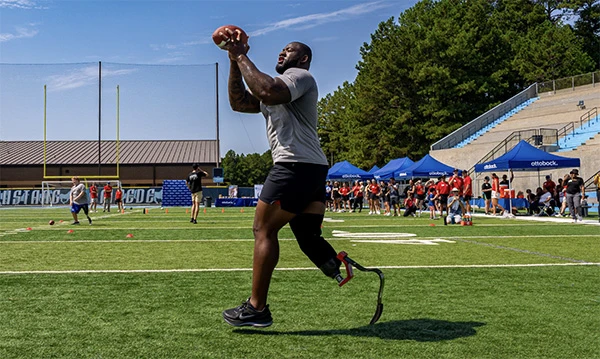
Reems was one of 23 participants who gathered in Norcross on September 19 for the inaugural Adaptive Sports Day, where people with limb loss worked with prosthetists and coaches before taking part in adaptive movement activities and on-field football drills.
For Reems, who lost his leg after a motorcycle crash with his father in 2025, the day carried a particular weight. He had feared that becoming an amputee meant his football days were behind him.
“Now I’m out here playing football and back out here having fun with my friends again,” Reems told reporters.
The Atlanta Falcons named Ottobock the team’s first Official Adaptive Mobility Partner. The partnership aims to expand opportunities for people with limb loss to participate in sport and movement by bringing together prosthetic technology, clinical expertise, and hands-on programming.
Ottobock clinicians provided 16 prosthetic fittings, adjustments, and clinical consultations before participants moved into adaptive movement activities and eventually onto the football field. For some, the progression offered a chance to explore movement with a prosthesis for the first time.
For KD Hill, it represented something else. The former Ole Miss defensive tackle lost his left leg below the knee following a 2023 automobile accident, just as he was pursuing a professional football career. Adaptive Sports Day marked the first time Hill had stepped onto a football field since his amputation. This time, he was wearing an athletic prosthesis.
Hill ran drills. He caught passes. Traces of the Ole Miss defensive tackle showed in those movements. Hill had spent years learning to explode off the line, change direction, chase down a ball carrier, and trust his body to respond. And while on this field, some of those movements may have looked a little different, he was learning what speed, balance, and agility could feel like with a prosthesis. The instincts were still there: the quickness, the competitiveness, the feel for the game.
Former Falcons wide receiver Michael Haynes helped lead the football portion of the event, while four-time Paralympian Jarryd Wallace also joined participants in the day’s activities.
Behind those moments on the field was the clinical work required to get participants there. Lucas Crisanti, a clinical specialist and Global Running Clinic coach, was among those helping connect prosthetic fitting and technical support with movement.
“Movement and sport are fundamental human rights,” Crisanti said when the partnership was announced. “Prosthetic users deserve the opportunity to participate, pursue their goals, and experience the physical, mental, and social benefits that sport provides.”
For Reems, the significance of that first day might be considerably simpler.
He got to be 13 years old again, out on a football field with his friends, playing the game he loves.