
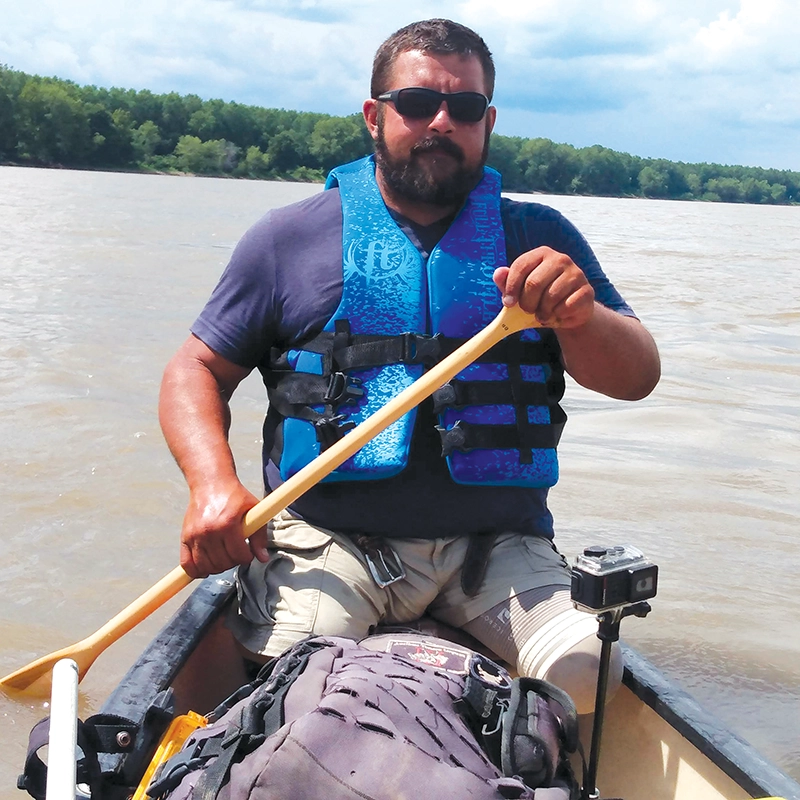
In May 2020, bilateral amputee Nate Denofre set out from Lake Itasca with a bold goal: paddle the entire 2,300-mile Mississippi River to the Gulf of Mexico. What followed was anything but smooth. Alongside his wife, Christa, Denofre battled freezing temperatures, beaver dams, illness, and violent storms.
At one point, a squall near Lock 12 in Iowa swept away their GoPro and SD cards—two months of footage, gone. Then came the River Angels: strangers who tracked the camera down and returned it. That spirit of generosity would come to define the journey.
Now, five years later, Nate and Christa revisit that journey in their book Love Many, Trust Few, and Always Paddle Your Own Canoe.
“That phrase really does feel like a life philosophy,” Nate said. “I remember saying it a few times while we were paddling down the river.”
For Christa, the book was its own expedition. “I wrote the book over about five years,” she said. The book includes over 100 illustrations and historical details from stops along the river.
One turning point came in Mississippi. Their tent broke, mosquitoes swarmed, and temperatures climbed past 90 degrees before 10 a.m.
“We were sleeping under these indoor-outdoor blankets just trying to survive the bugs,” Christa said. “We got into a tiff in the canoe,” she laughs.
Then things got worse.
“My $7,000 prosthetic foot snapped,” Nate said.
Soon after, help arrived. “A Baptist preacher picked us up…we got lots of tacos and Jesus, and I felt a lot better the next day,” Nate said. “That’s why they call them River Angels.”
That moment changed everything. Nate had envisioned the expedition as unsupported—a test of independence.
“I didn’t want anyone to help me,” he said. “I’ve gone almost 50 years without legs. That mentality—the need to prove I don’t need help—it’s not always a good thing.”
By the time they launched, the journey had already shifted. Nate and Christa had only met months earlier—engaged within three months, married three weeks later.
“I told him I could either stay home and worry about him, or I could come with,” Christa said. “That was my honeymoon.”
Over 115 days, the river tested their endurance and their relationship.
“I learned that I could depend on him,” Christa said. “People might assume that because he’s an amputee, I would have to take care of him, but that wasn’t the case at all.”
For Nate, the challenge became something different entirely.
“Being with someone else means there are infinite possibilities—good and bad—that can happen,” he said. “I was more worried about safety.”
That tension showed up in Minnesota at Lake Winnibigoshish.
“It was so windy—24 miles per hour,” Christa said. “I said, ‘I think we need to take the south side of the lake.’ But Nate’s chromosomes overwhelmed my vote.”
“I admitted very quickly that I should’ve listened to you,” Nate laughed.
Looking back, neither would change much.
“I would have told myself not to be so scared, and maybe packed a lot less,” Christa said.
“I wouldn’t change anything,” Nate said. “This journey was my gift to unwrap…knowing we were soon going to find out how small we—and all of our worries—really are.”
For readers, their message is simple but expansive.
“We argued and squabbled like every other couple, but we always depended on each other,” Christa said. “And the people we met along the river were so wonderful—River Angels all the way.”
Nate sees the journey as universal.
“It isn’t really any bigger or different than when a person with disabilities is wearing a new limb for the first time,” he said. “What one person can do, another can do—no matter their abilities.”
And if the river offered one enduring truth?
“Never be afraid to take the first step,” Christa said. “The next one may be the one that gets you where you’re going.”
“If you want something badly enough,” Nate added, “anything is possible. Don’t give up.”