
When Amie Donathan talks about soccer, she begins with love.
“Soccer is my first love,” Donathan said.
This past summer, that love carried the 21-year-old member of the US Women’s National Amputee Soccer Team to Santa Cruz, Bolivia, where she wasn’t just competing—she was helping coach nearly three dozen women from ten South American countries at South America’s first women’s amputee soccer training camp.
At first glance, the scene looked familiar: women sprinting toward the goal, working through corner kicks, and dribbling around defenders beneath the bright Bolivian sky.
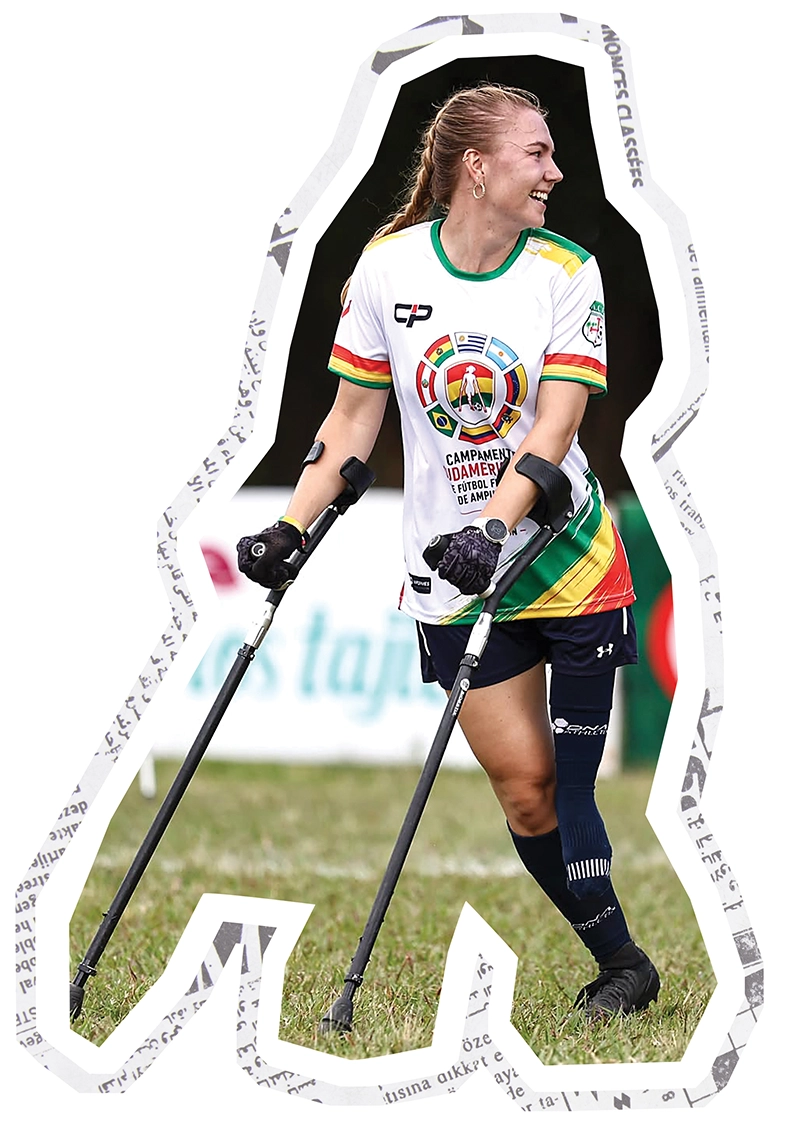
Only after the whistle blew did a different kind of scene emerge. Goalkeepers defended the net with a single arm. Outfield players accelerated on forearm crutches, relying on balance, speed, and precision instead of prosthetic limbs.
For Donathan, the week represented something far greater than a training camp. Years earlier, she had nearly given up on soccer altogether. Born with proximal femoral focal deficiency—without a left femur or hip—Donathan spent much of her childhood playing sports with a prosthetic leg. Golf eventually became her focus. Soccer, she thought, was behind her.
Then a coach discovered a photo of her playing soccer on a prosthetic leg in a hospital post and reached out through social media with an unexpected invitation: What if she tried amputee soccer?
Playing on crutches without a prosthesis was an entirely different sport.
“The thing that I had to work on the most was… the use of the crutches,” Donathan recalled in an interview with GOAL. Learning to dribble, cut, turn, and pass while swinging through on forearm crutches took months of practice. But just eight months after trying the sport, she earned an invitation to the US national team tryouts. “To have the dream come back,” she said, “was kind of surreal.”
By the inaugural Women’s Amputee Football World Cup in 2024, Donathan had become one of the United States’ leading players, scoring four goals during the tournament as the Americans advanced to the championship match before falling to host nation Colombia in a penalty shootout.
Her journey is becoming less unusual. Throughout the summer of 2026, women’s amputee soccer reached several important milestones, signaling continued growth around the world. The Bolivia camp, organized by the World Amputee Football Federation, brought together athletes from across South America to learn the sport, refine their skills, and continue building national programs ahead of the 2027 Women’s Amputee Football World Cup in Poland.
Amputee soccer is played seven-a-side on a reduced field. Outfield players have lower-limb amputations and compete without prostheses, and goalkeepers have upper-limb amputations. Players use forearm crutches for mobility but cannot intentionally touch the ball with them. Matches are played in two 25-minute halves with rolling substitutions and no offside rule. What emerges is a fast, technical, and remarkably physical version of the world’s most popular sport.
For many participants, however, the greatest takeaway wasn’t tactical. Filomena Luna, a 50-year-old mother of six from Bolivia, lost her leg to an infection when she was 11 years old. Before attending the camp, she had never imagined representing her country through sports.
“This practicing and training has helped me improve tremendously,” Luna told the Associated Press. “Soccer is an escape for me.” Her story captures what this summer represented.
For decades, men have competed internationally in amputee soccer. The women’s game, by comparison, held its first World Cup only two years ago. Now, more countries are creating national programs, more athletes are finding opportunities to compete, and more women are discovering a sport they never knew existed.
Fans interested in following the sport can find match highlights, tournament updates, and player stories through the World Amputee Football Federation and US Amputee Soccer, both of which regularly share competitions, clinics, and opportunities for new players to get involved.
As the adaptive sports community looks toward the 2027 Women’s Amputee Football World Cup, the legacy of this summer won’t be measured only by the matches that were played. It will be measured by the women who returned home believing they belonged on a soccer field—and by the girls who may discover the sport because they saw someone like Amie Donathan already there.