

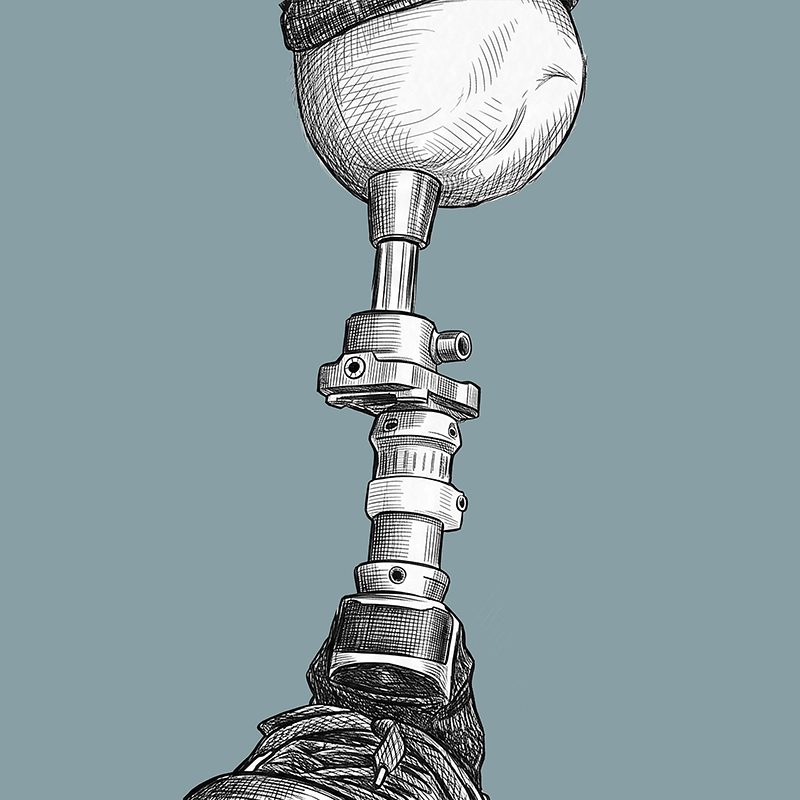
Seven years ago, bone-anchored prosthetic devices were a rarity. Today, they’re reshaping lower-limb care.
For many lower-limb amputees, it was something they might read about in a research paper or hear discussed at a conference—a promising but highly specialized procedure available only through a handful of surgeons and medical centers worldwide. For many, it still felt experimental.
Today, that picture looks markedly different.
Instead of relying on a socket to suspend a prosthesis, osseointegration uses a titanium implant placed directly into the remaining bone. An external prosthesis attaches to the implant through a small opening in the skin, eliminating the socket altogether.
Although the concept dates back decades—the first lower-limb osseointegration surgery was performed in 1990—the pace of advancement has accelerated significantly over the last several years.
Today, multiple implant systems, including OPRA, OPL, ILP, ITAP, POP, and several newer designs, are either commercially available or under active clinical investigation around the world. Surgeons have refined implantation techniques, rehabilitation protocols have matured, and some systems now offer single-stage procedures instead of the two-stage surgeries once considered standard.
As importantly, researchers now have substantially more clinical data than they did only a few years ago.
A new review published in the Journal of Orthopaedic Surgery and Research suggests osseointegration has reached an important turning point. While socket prostheses remain the standard of care, bone-anchored prosthetic systems are becoming increasingly available, with expanding surgical options, improved implant technology, and a growing body of evidence demonstrating meaningful benefits for many amputees.
Rather than evaluating a single implant, the review compared the major osseointegration systems currently in use or under development. Despite differences in design and surgical approach, one finding emerged consistently: People receiving bone-anchored prostheses generally reported improved comfort, greater mobility, longer prosthesis wear time, and better overall quality of life compared with traditional socket users.
Many of those improvements come from removing the socket itself. Without a rigid socket compressing soft tissue, users often experience fewer skin problems, greater hip range of motion, and a more natural transfer of weight through the skeleton. Some recipients also report osseoperception—an enhanced ability to sense the ground through vibrations transmitted directly through the implant.
That doesn’t mean osseointegration is appropriate for everyone.
Because the implant passes through the skin, infection remains one of the procedure’s greatest challenges. Mechanical complications—including fractures around the implant or hardware failure—can also occur. Researchers emphasized that careful patient selection, experienced surgical teams, and long-term follow-up remain critical to successful outcomes.
Even so, those risks are being addressed alongside continued technological advances.
New implant surfaces are being engineered to encourage stronger bone integration while reducing bacterial growth. Researchers are also developing personalized implants and sophisticated neuromusculoskeletal interfaces that may one day allow amputees to control prosthetic limbs more naturally while receiving sensory feedback.
The authors noted that larger, long-term studies are still needed before osseointegration could be considered the standard treatment for most lower-limb amputees.
Yet perhaps the biggest takeaway isn’t what may happen in the future—it’s how much has already changed.
Only a few years ago, osseointegration was viewed by many as an uncommon, highly specialized procedure. Today, it’s becoming an increasingly familiar option in conversations between amputees and their care teams. While socket prostheses will continue to serve millions of people worldwide, bone-anchored prostheses have clearly moved beyond the experimental fringe—and their growing presence suggests they’re poised to become an increasingly important part of lower-limb rehabilitation.
The study, “Lower limb osseointegrated prosthetics: Are we standing on the edge of a new era?” was published in the Journal of Orthopaedic Surgery and Research.