

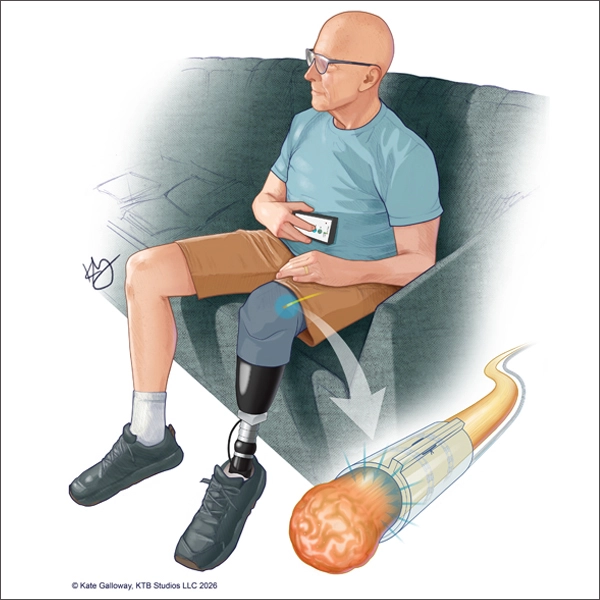
Every evening when Jeff Pullen removed his prosthesis, he experienced an attack of severe phantom limb pain. “I’ve had pain before but it eventually went away. This is something that I knew was going to happen every single day.” Despite using various prescription pain medicines, nothing helped.
Jeff was not alone: Studies have shown that 43 percent of amputees with phantom limb pain have tried four or more different treatments for pain. For Jeff, the anticipation of pain caused daily fear and anxiety. “There were times I actually slept with my leg on,” he says. Eventually, Jeff answered a recruitment ad for the QUEST study, a clinical trial testing a new medical device designed to treat chronic post-amputation pain. The data from QUEST led to FDA approval of the Altius Direct Electrical Nerve Stimulation System.
Altius is an implanted medical device that works by helping to prevent pain signals emanating from the residual limb or phantom limb, so the sensation of pain is not experienced. The device applies high-frequency electrical stimulation directly to the terminal end of amputated nerves that carry pain information from the leg to the spinal cord. Previous studies have shown this electrical stimulation prevents the propagation of pain signals along the nerve, resulting in what is known as “high-frequency nerve block.”
In QUEST, significant pain relief and reduced opioid use was observed across the 164 study participants over 12 months of follow-up. For Jeff, Altius has completely reduced his pain and helped him stop using pain medication. “I was not a particularly pleasant or patient person before I got rid of this pain unless I took massive doses of gabapentin and oxycodone or oxymorphone. I’ve been completely opioid-free and gabapentinoid-free for years now and don’t care to go back.”
At the molecular level, Altius therapy inhibits transmission of pain signals the same way as the numbing medicine lidocaine. Therefore, doctors can perform a straightforward lidocaine injection on the target nerve to help determine whether Altius therapy is likely to work well for a specific individual. If a lidocaine injection provides significant pain relief when a patient is actively experiencing phantom or residual limb pain, it is likely Altius can help reduce that pain also.
Unlike implanted nerve stimulation devices that are always active, Altius is activated by the patient as needed using a remote controller. Therapy settings are tailored for the individual during interactive device programming sessions with therapy delivered for 30 minutes. Jeff, a retired prosthetist, realized the quick change in negative pressure when he removed his prosthesis was triggering his pain. “I learned over time to activate it [Altius] up to five to ten minutes before I actually took my prosthesis off. Very effective,” he says. He also notes the security of knowing he can activate it whenever needed: “You know, it’s right there. If I get attacked by the pain, I know within five to ten minutes after activating it ought to dissipate.”
Altius is indicated as an aid in the management of chronic intractable phantom and residual lower-limb post-amputation pain in adult amputees. Altius is contraindicated for patients who are unable to operate the system or unsuitable for the Altius implant surgery. Consult your doctor; outcomes vary. For safety and risk information and clinical results visit neurosmedical.com.