

How a shark attack deepened the person Paul de Gelder already was.
WORDS Chloe Valentine
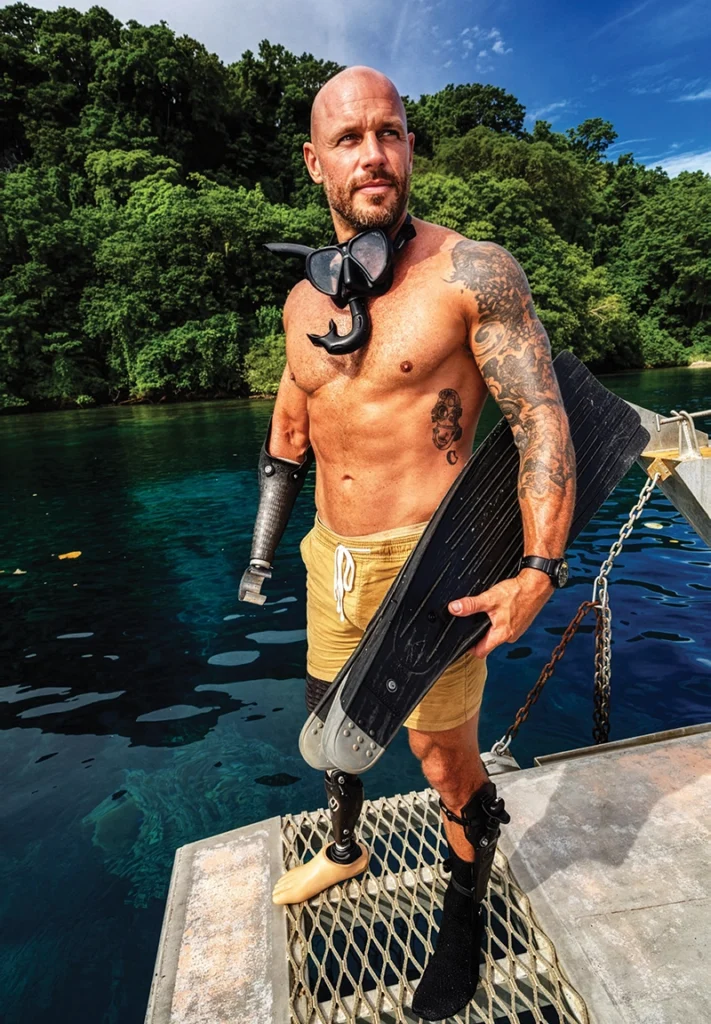
Shark Week star, author, and former Australian Army paratrooper and Navy diver Paul de Gelder has always been drawn to risk and adventure.
“I hand feed tiger sharks, parachute, snowboard—I do all that stuff. And I tell you what, I have nearly died more times trying to hop in and out of the shower,” he jokes.
After a bull shark attack took de Gelder’s hand and leg, adapting became a quest of its own. Amplitude chatted with him recently, and rather than solely revisiting the shark attack story he’s told countless times, de Gelder spoke candidly about prosthetic maintenance and aesthetics, the everyday realities of being an amputee, Shark Week, vulnerability, and what people still misunderstand about both sharks and transformation itself.
“I’ve tested a whole bunch of these prosthetics and I feel like I’m the best person to test them, but possibly the worst at the same time. Because I will tell you the truth, but that’s not always what companies want to hear. I’m very direct and I’m very blunt, and I’ll tell you exactly what I think,” de Gelder says. And that goes for everything, including what they look like, a topic that often gets put on the back burner when it comes to prosthetic design.
We swapped opinions on the rather thoughtless appearances some of these designs have, such as the Taska hand, which offers some fantastic features but has a thumb that sticks out at the most awkward angle, as de Gelder points out. “We want something that looks like a hand that will function to a certain degree so that it’s useful. Other than that, we don’t expect too much,” he remarks.
Nonetheless, when it comes to setbacks, de Gelder finds it helpful to distance himself from the situation. “I think back to my deployments with the United Nations and the Army and the thing is that there are actual third-world countries, and people that are struggling there. And that’s when I tell myself to stop complaining. It’s nice to be able to have that perspective.”
Read the rest of our conversation below.
You mentioned that there’s no better time in history to be an amputee, but at the same time, it sounds like prosthetic technology still has a long way to go. What frustrates you the most about what’s currently out there?
“I thought prosthetics were going to evolve a lot faster,” de Gelder says. “I thought they were going to have spatial awareness and AI integration and all this crazy stuff, and it just never really happened.”
He explains that many upper-limb devices still feel unintuitive despite their futuristic appearances, and that constant maintenance remains one of the least visible parts of living with prostheses. “Stuff breaks all the time,” he notes, adding that he always has at least two prosthesis parts being repaired at any given time.
We talked a lot about prosthetic aesthetics such as the robot hand versus trying to make something look perfectly human. Why do you prefer leaning into less realistic-looking limbs?
“If I’m going to have a robot hand, it might as well look like a cool robot hand. I don’t even go with an aesthetically human glove on mine.”
He said some prostheses fall into an uncanny valley where they look realistic enough, but just not enough to really resemble a human body. For de Gelder, the appeal of more visibly mechanical prostheses is partly practical, noting that the covers intended to resemble skin come at a high cost and break easily.
“Those painted gloves that look real are even more expensive and more delicate,” he points out.
de Gelder also prefers embracing the more bionic look, especially when it comes to lower limbs, where options to make a prosthesis resemble a natural limb are limited. “When it comes to my leg, there’s no cover to make it look like a human leg, so I might as well just rock blatantly, obviously robot limbs.
Did the attack actually change you, or did it just make you more of who you already were?
“I had all this heart for adventure but nowhere to direct it as a young kid.”
Prior to joining the Army, de Gelder described drifting through various jobs, even becoming a rapper while searching for direction. Then the Army ended up being the turning point that not only led to his shark attack, but to the adventurous life he’d always imagined.
“It did accentuate my better qualities. I was already kind of tough, being able to get through the life that I had. But then the shark attack forced me to take on a whole new level of determination and self-belief. It was a rough way of redefining your path, but it’s pretty cool,” he says.
At one point, you said that sometimes having an amputation is not that bad. What do you think people misunderstand about adaptation after limb loss?
“Yeah, it’s not that bad. The bad bit about it is losing parts of who you thought you were. There’s going to be things that you probably can’t do or can’t do as well as you did before. The good thing about that is it forces you to try new things. So instead of wallowing about what you’ve lost, you find ways to fill those holes with new things.”
You have become one of the most recognizable faces of Shark Week. What’s something viewers probably don’t realize about how those shows get made?
“I see myself as the conduit between the actual experts and the audience. The scientists are the ones with all the knowledge. My job is to help translate that into something people can actually connect with.”
He says part of that also means resisting the urge to over-prepare before shoots.
“Going in, I actually prefer not knowing absolutely everything. That way my curiosity is genuine, and I’m asking the same questions viewers at home would probably ask.”
According to de Gelder, who authored Shark: Why We Need to Save the World’s Most Misunderstood Predator, which focuses on shark conservation and the important role they play in Earth’s ecosystem, Shark Week productions also involve far more unpredictability than viewers realize, especially when working with wild animals.
“You can plan as much as you want, but at the end of the day, you’re still dealing with sharks.”
Do you think sharks perceive limb-different divers differently than nonamputee divers?
“I don’t think so at all, but I know what you’re talking about because it’s funny how dogs and babies especially seem to notice it…. But with sharks I’ve not noticed a change with or without prosthetics, and I’ve dived both ways.”
In that vein, de Gelder notes he has wondered whether other predators perceive physical vulnerability differently. He recalls working at Steve Irwin’s zoo during a demonstration involving a cheetah where the handlers warned him the animal might test him more because of the slight limp in his gait.
After all these years working around sharks, what do you think people still misunderstand about them?
“I think the people who’ve learned about sharks or watch Shark Week understand that sharks aren’t trying to eat people.”
Even so, de Gelder emphasizes that the notion that sharks are intentionally seeking out humans for food still remains one of the most prevalent misconceptions. He explains that attacks usually happen in situations where being mistaken for prey may be more likely.
“Most attacks happen due to poor visibility or because you’ve injected yourself in the circle of life by spearfishing or swimming near someone fishing…. But a lot of sharks do have quite good vision, and they know the difference between what they’re hunting and what you are, as long as they can see you.”
You have spent years speaking publicly about your life and experiences. What keeps you wanting to share that with people?
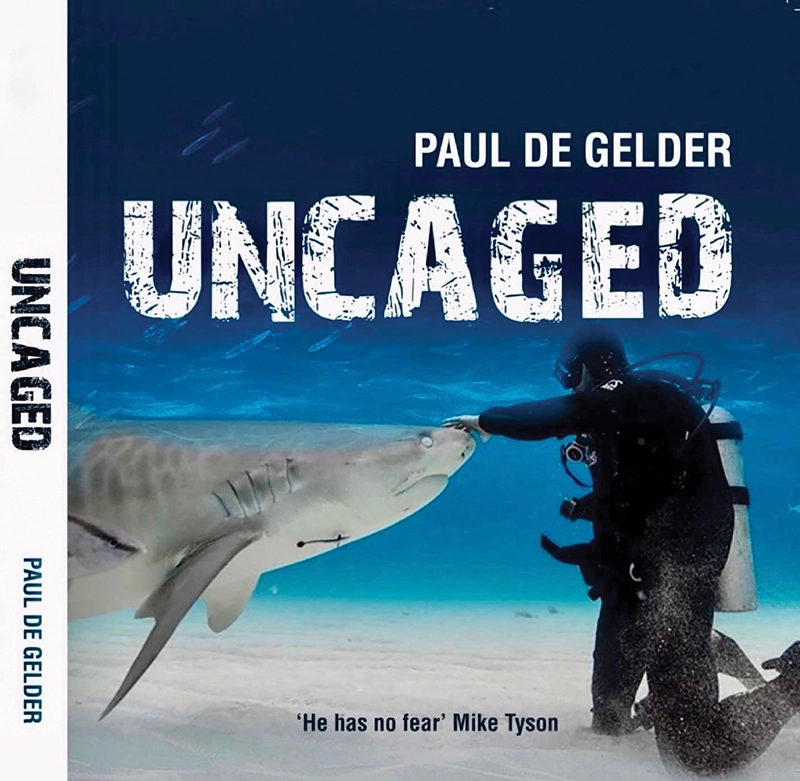
“One of my books, called Uncaged, is about my life’s journey, including getting bullied in school, being a train wreck, going through depression, self-harming, and finding my way into the military. It talks about how I developed a really good and happy life against all odds, such as losing limbs and having to begin again at age 35 when the Navy was all I knew. So I wrote the book to try and help people understand that it doesn’t matter how old you are or what situation you were brought up in,” de Gelder says.
One of the core messages behind de Gelder’s work is the importance of mindset.
As he says, “The sort of life you live depends on the quality of person you are and the quality of the thoughts that you tell yourself.”
Uncaged image by Michael Dornelias (deceased).