

Researchers Strive to Eliminate Disability With Bionics
By Stephanie Zultanky

In a March 2014 TED Talk, Hugh Herr, PhD, associate professor of media arts and sciences at the Massachusetts Institute of Technology (MIT) and head of the Biomechatronics research group at MIT’s Media Lab, issued a challenge to the human race—to end disability. He said this goal is not far off.
A bilateral below-knee amputee since 1982, Herr has spent the past 30 years working to ensure that he was never disabled by his limb loss.
“At that time, I didn’t view my body as broken,” he said in his TED Talk. “I reasoned that a human being can never be ‘broken.’ Technology is broken. Technology is inadequate. This simple but powerful idea was a call to arms, to advance technology for the elimination of my own disability and, ultimately, the disability of others.”
Herr continues to improve technology, refusing to settle for what currently exists. His research group at MIT has developed gait-adaptive knee prostheses for people with above-knee amputations. He also founded a company now known as BionX Medical Technologies, Bedford, Massachusetts, and developed the BiOM Ankle, currently the only powered ankle-foot prosthesis on the market, which has been the inspiration for improved devices across the spectrum of orthotics and prosthetics.
Back to Life
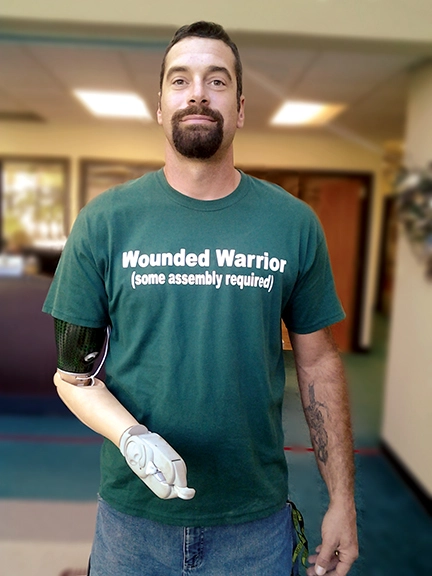
controlled by Coapt technology.
Image courtesy of Glen Lehman.
The biggest problem with being an amputee is the fatigue, according to Sgt. 1st Class (Ret.) Glen Lehman, who lost his right arm above the elbow when two grenades hit his Humvee in Baghdad, Iraq, in November 2008. Using an upper-limb prosthesis is taxing—not just physically, but mentally as well.
With a traditional prosthesis, it’s hard for an amputee to control the weight of the arm, to reach out and grab things, and to pick things up from the floor. Lehman’s myoelectric prosthesis uses four sensors attached to the muscles on his residual limb to control his elbow, wrist, and hand.
In 2014, Lehman was fitted with the Coapt Complete Control system, which uses eight-sensor pattern recognition technology to enhance the control of advanced upper-limb prosthetic devices. Because it uses his phantom sensation to operate the prosthesis, he says “it feels like my arm.”
The Complete Control system has reduced the time it takes him to do everyday tasks from one or two minutes to only 15 seconds. “It gets the amputee back to life faster,” he says.
Previously, Lehman volunteered as a subject for targeted muscle reinnervation research conducted by Todd Kuiken, MD, PhD, in which the bicep and tricep nerves in his arm were split to enable an increase in the number of sensors attached to a myoelectric prosthesis. The Complete Control system doesn’t require reinnervation, however; it can be installed with any myoelectric system.
It took him only a minute to train his arm with the system when he was fitted at Walter Reed National Military Medical Center, Bethesda, Maryland, where he served as a demonstration of the technology.
“I’ve rotated the tires on my car [with this system] and it was easy,” he says. “A prosthetic arm is a great device—to be able to have control of it is great.”
Powered by Intent
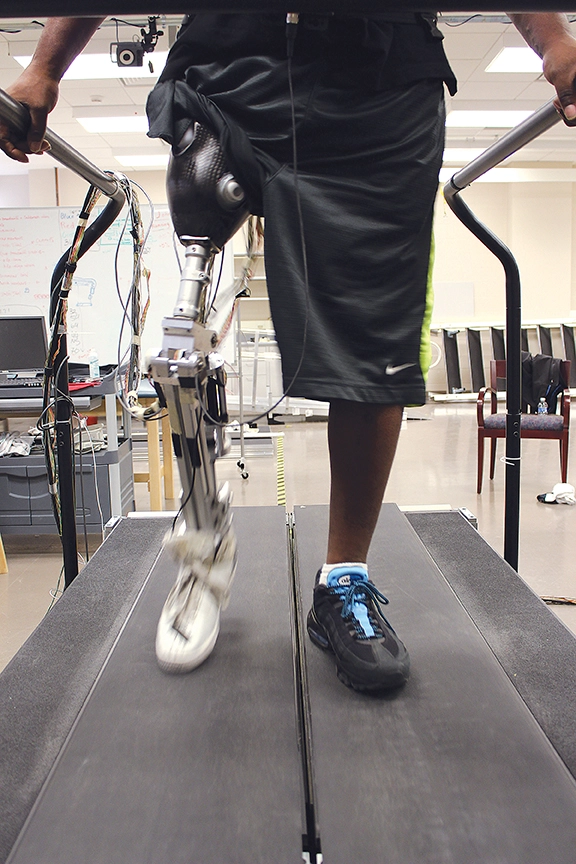
prosthesis at the Neuromuscular Rehabilitation Engineering
Laboratory at NC State. Image courtesy of Neuromuscular
Rehabilitation Engineering Laboratory, UNC-Chapel Hill/NC
State Joint Department of Biomedical Engineering
For lower-limb amputees, the ability to take one step right after another without thinking about the movement can be a vast improvement. Ascending or descending stairs with a traditional passive prosthesis, for example, requires an amputee to step first with the sound leg and then bring the prosthesis to meet it. Changes in terrain, direction, or load often cause instability in the prosthesis, and therefore the user.
Terry Karpowicz, a sculptor who works on large-scale sculptures of granite and steel, thought his career was over when he became an above-knee amputee 40 years ago after a motorcycle accident. He went through “a gradual process of self-discovery” and continued his work, even taking some inspiration from what he calls “a love affair”—the marriage of his prosthesis and residual limb.
Karpowicz explains that the biggest difference between previous prosthetic devices he’s had and his current powered prosthesis lies in who’s controlling whom. “All the other legs I’ve had up until this point, I had to ask them to follow me. I had to pull them along with me,” he says. “The powered leg takes the lead.
“I want to say it reads your mind, but it reads your muscle impulses,” Karpowicz says.
The freedom this ability affords is about more than mechanics. Karpowicz says he looks forward to the day he can walk out of the Rehabilitation Institute of Chicago (RIC) lab wearing the powered prosthesis. “I just want to wear it every day, knowing that it’s going to be underneath me when I need it,” he says. “I don’t want to be dragging a prosthetic around the rest of my life. I want it to say, ‘Let’s go.’”
Multiple Joint Coordination
Currently available bionic devices employ technology that far surpasses that of traditional passive devices. But it’s not advanced enough, according to Robert Gregg, PhD, assistant professor of bioengineering and mechanical engineering at the University of Texas at Dallas (UT Dallas), who thinks there’s more to be done.
The control software for above-knee robotic legs is not very advanced, and the devices currently on the market contain only a single joint that’s powered, Gregg says.

Manufacturers have not yet been able to release multi-joint devices because powering multiple joints presents some major challenges, namely coordinating them so they work together and creating a prosthesis that is able to adapt to different environments, Gregg says. “If you have just a powered ankle, and the ground slope changes, at least there’s still a knee that might be able to take care of that; but if we have two joints that aren’t adapting, that becomes much more treacherous for the patient,” he says.
Gregg’s team is building a new prosthetic leg to serve as an open-ended research platform that the team can easily reprogram to try out different control algorithms. This device is equipped with quality motors and a plethora of sensors necessary for the various types of control being tested.
“The point of this research platform is for us to figure out the fundamental control principles that are needed for these multi-joint, powered legs—the best [controls]—so eventually we can send the patient home with a leg that would be designed specifically for home use,” Gregg says. “We’re focusing on the basic science, and then eventually that’ll turn into translational science.”
Across Terrains
Another pertinent issue for amputees is their ability to traverse various terrains. While an amputee might be well versed in walking on flat ground, he or she might have trouble with inclining or declining surfaces. Another amputee may find it a daily struggle to descend the stairs from the bedroom each morning and to ascend them again each night.
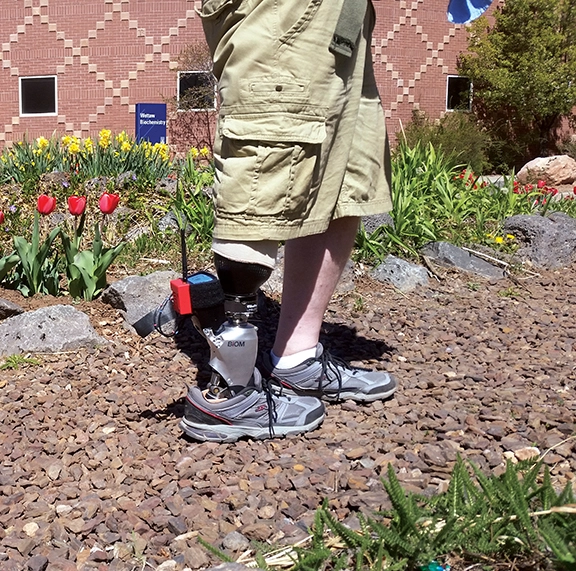
Image courtesy of Uzma Tahir.
He (Helen) Huang, PhD, associate professor in the joint biomedical engineering program at North Carolina State University (NC State) and the University of North Carolina at Chapel Hill (UNC-Chapel Hill), has created a powered device for lower-limb amputees, as well as an algorithm that identifies the amputee’s muscle signal to understand the person’s intent. “[It sees] what they want to do in the next step and allows the person to go ahead and just switch, seamlessly, without doing any tricks,” she says.
Now Huang’s lab is taking this a step further with a study on errors in these devices. Any error in the prosthetic device could cause the patient to fall and risk injury, and then the person might no longer trust or use the device. “The robustness of the lower-limb device is very important to ensure,” she says. “We don’t see a lot of research on that area, so now we’re tackling quite a challenging problem.”
The goal for this research is to determine the effect on the person if the control of the device fails. Huang designed the algorithm to allow people to move smoothly across different areas of terrain; for the second part of the experiment, her team is working on determining errors in decoding the person’s intent. They have found that, although some errors go undetected by the amputee, other errors are critical, especially those that compromise the person’s safety. These include decoding, operation, and internal control errors. Initially, the team worked to fix all errors on the device—to completely eliminate any trace of a problem, without the amputee even noticing. They reasoned, however, that it is important for the users of the device to learn how to recover. Huang says that she believes that safely traversing different types of terrains involves a significant amount of patient training as well as smartly engineered devices.
Huang hopes that a more reliable powered prosthesis will bring more function, reduce joint pain, increase patients’ activities of daily living, and instill confidence in their ability to stand up from sitting, to walk, or even to dance.
Personal Bionics
Kiisa Nishikawa, PhD, head of the research team at Northern Arizona University’s (NAU’s) Center for Bioengineering Innovation, has brought her background in organismal biology into the prosthetic realm to develop bionic prosthetic devices that are inspired by amphibians.

under development at UT Dallas.
Image courtesy of Kurt Mansor, UT Dallas.
“For many years I studied how frogs and toads catch bugs using projectile tongues. They do it so fast that there’s no time for online sensory feedback control of the behavior,” Nishikawa says. “It turns out that the active properties of the muscles are really important in controlling fast movements.”
Her team took that information and set out to determine “how muscle properties actively contribute to control of movement, even in time periods that are too short for the brain to [react].” Adding an activated spring element into muscle models, they theorized, would allow muscle models to capture the muscle’s ability to change its stiffness instantly when interacting with the environment, without requiring sensory feedback or active intervention from the brain. This type of controller would enable a prosthetic device to behave like a real muscle.
Currently available powered devices use engineering-based algorithms but are missing this biological component. Nishikawa’s team has tested this new muscle model in the BiOM Ankle, with positive results. “We’ve been able to show that with minimal sensing, and with basically no change in the parameters of our model, a person can walk across a level surface at variable speed and then ascend stairs and walk level without requiring change in any of the model parameters, and without requiring any change in the activation of the muscles,” she says. “Just the changing environment and the reaction of the virtual muscles with that changing environment handles that transition from one activity to another, completely smoothly, just like intact human muscles would.”
Next, they’ll be testing the algorithm with the device on other surfaces, including gravel, artificial turf, and other soft ground.
With these and other research teams across the spectrum of orthotics and prosthetics striving to perfect bionic devices, our “broken technology” may soon be fixed, and we may come closer than ever to realizing the dream of eliminating disability.