
WORDS Karyn Sader
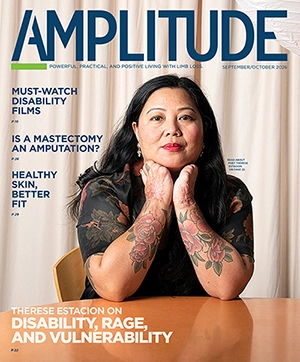
As a professional immersed in the world of O&P and a woman with a bilateral mastectomy, I didn’t consider myself an amputee. Was I wrong?
When I had abilateral mastectomy over a decade ago, it never occurred to me to call myself an amputee. Full disclosure, I wasn’t calling myself much of anything back then except unlucky. A lump I hadn’t felt appeared on an annual mammogram. At first I wasn’t concerned. I was only 42. No one in my family had ever had breast cancer—not my mother, not either of my grandmothers or my great-grandmothers, nor a whole slew of aunts and cousins. Heart disease was my family’s ailment, not breast cancer. I assumed the lump was benign.
I assumed wrong. After a biopsy and MRI, a very pleasant nurse called me while I was driving to pick up my kids from daycare. “You might want to pull over before we talk,” she suggested, before telling me the lump was malignant. I had Stage 2 breast cancer.
After consulting with an oncologist, a general surgeon, and a plastic surgeon, I made the decision to have both breasts removed—one medically and the other cosmetically—because I was positive that having a single breast would be more challenging than having none. The thought of single boobing my way through the rest of my life seemed more horrifying than going without any. I also chose not to have reconstruction. I knew women who’d had reconstruction, and all of them complained about the pain, numbness, the way the artificial breasts didn’t look or feel real.
I’d never been well-endowed, and after breastfeeding two kids, my bra size shrunk from a respectable 32B to 32A. While I certainly wasn’t excited or happy to lose my breasts, I also didn’t feel as if I needed them to be whole. “I am not my boobs,” was my standard response to anyone who asked why I hadn’t elected for reconstruction.
The following year passed in a blur of surgery, many months of chemo, and then several more months of radiation. I adjusted to not only the lack of breasts but also lack of hair. My husband and I had full-time jobs, two young children, and no family within 1,000 miles. It became all about managing nausea, discovering creative head attire, putting one foot in front of the other, and just getting through it. And we did get through it. I got through it.
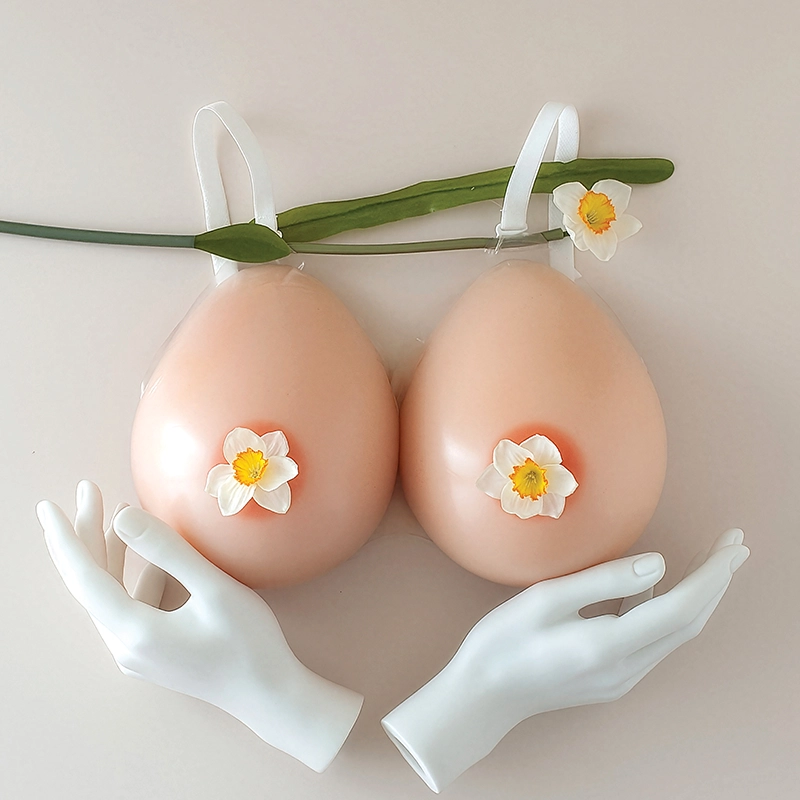
Fast forward two years. I once again had hair on my head, and the stick-straight locks I was born with did not grow back curly as often happens after treatment. My scars itched, although parts of my chest and the area under my left arm—where surgeons removed 11 lymph nodes—were still numb. The nausea was a distant memory, and the radiation burns had healed. My kids emerged from the ordeal without obvious PTSD. I had adapted to life without breasts: soft fabric puffs stuffed into bra insert pockets for everyday use and silicone breast prostheses for swimming.
I began working as an art director at The O&P EDGE, Amplitude’s sister magazine for the prosthetics and orthotics industry. In addition to designing the editorial pages of the magazine, the creative department placed advertisements displaying the full spectrum of prosthetic and orthotic products into each issue. I’d quickly become immersed in the world of artificial fingers, arms, legs, knees, ankles, toes, and the innovative brands that created these products. But I’d never seen an ad for Amoena.
I was familiar with the brand Amoena because they are a prominent breast care manufacturer and the developer of the first silicone breast prosthesis. Anyone who has had a mastectomy has heard of Amoena. The swim breast prosthesis I own has an Amoena stamp. But, after I’d been at The O&P EDGE for about a year, when Amoena submitted an advertisement for publication, it didn’t seem right. I couldn’t reconcile where it belonged among the limb and finger replacements from Naked Prosthetics, Össur, and Ottobock. The prosthetic facilities and professionals who read our magazine fitted people for limbs. I’d never heard of an O&P facility that fitted women for prosthetic breasts.
When I was fitted for a breast form several months after my surgery, I went to the lingerie department at Nordstrom. The store offers a specialized Breast Surgery & Care Program featuring certified prosthesis fitters who provide free, private consultations. They assist with sizing, insurance guidance, breast form selection, and they offer complimentary pocketing on any Nordstrom bra purchase. Getting fitted for a breast form at Nordstrom didn’t feel clinical. I was shopping!
Not a single person on my care team suggested I seek care at a prosthetic facility. Those were for amputees, and I had never considered myself an amputee. It had never occurred to me to call myself an amputee.
When I asked our sales rep about the ad, she confirmed that Amoena had appeared in magazine in the past, and that of course prosthetic facilities fitted women who had had mastectomies. She said this with raised eyebrows and a tone that implied this was something I should have known.
“But I’ve had a bilateral mastectomy, and I would never go to a prosthetic facility to get fitted. I don’t consider myself an amputee,” I insisted, as if my personal perspective somehow made Amoena’s ad submission invalid. “I don’t know anyone who’s had a mastectomy that was fitted at a prosthetic facility. Everyone goes to Nordstrom. Why would they advertise in The O&P EDGE?”
She nodded and shrugged, “Well, it’s a thing. O&P facilities do fittings for prosthetic breasts all the time. Amoena advertises with us. And I know plenty of women without breasts who call themselves amputees.”
I felt sideswiped. Like there was this belief that existed that I’d totally been missing. Did other breastless women truly think of themselves as amputees? Did other women really walk into a prosthetic facility where they were fitted for a breast alongside soldiers who had lost limbs in war? Is a woman whose breast was removed because of cancer the same as a person who has lost a functional limb? A functional, vital limb like a hand or a foot or an arm that before amputation enabled them to exist comfortably in an ableist society?
Personally, I thought they weren’t the same at all. I worked in the prosthetics industry and read stories every day of the challenges amputees faced. How their lives were changed forever. Breast removal caused me pain and some adjustment, but it didn’t change how I walked or ate or worked or played. It didn’t affect the way I moved within the world. And for the most part, unless I was naked, it didn’t change the way I looked.
Every year, usually in October because it’s Breast Cancer Awareness Month and pink ribbons are ubiquitous, but also because the mammogram that resulted in my mastectomy was in October, I replay that conversation with Kim. And every year around this time I question again how a woman with a mastectomy could be considered an amputee. Since my start at this company, we launched and grew Amplitude, and the experience of interacting more directly with amputees has only strengthened my personal belief that we aren’t the same. This year, heading into Breast Cancer Awareness Month, I decided to dig a little deeper.
I Googled “amputee,” and the results were entirely inconclusive. Like so much in life, it depends on who you ask. Dictionary.com and Merriam-Webster fall in the limb camp, effectively eliminating the idea that breastless women are amputees. The Cleveland Clinic, Wikipedia, and John Hopkins Medicine are broader, more inclusive, and define anyone missing a body part as an amputee. A breast is definitely a body part.
Discussion boards such as Reddit and Quora returned results that skewed heavily in favor of women with mastectomies being amputees. But the comments were almost all from women who’d had a breast removed. There were very few comments from upper- and lower-limb amputees. Those I did find disagreed that their breastless peers should be included in the amputee community.
Author Nancy Stordhaul, a blogger who wrote the books Cancer Was Not a Gift & It Didn’t Make Me a Better Person, and Emerging: Stories from the Other Side of a Cancer Diagnosis, argues that the word mastectomy is entirely inadequate, too minimizing for a life-altering surgery.
I reached out to several women I knew who’d had a mastectomy and asked if they would call themselves an amputee. Every single person answered yes. Lisa Baratto-Riley, a high school friend I recently reconnected with, had a breast removed five years ago. “Absolutely. I am an amputee,” she said without hesitation. “I lost a body part. I lost a part of who I am, and I am never getting it back.”
And with those words I realized that for all the differences between an amputation and a mastectomy, it’s the similarities that actually matter. Because the type of advertisement that crosses my desk doesn’t carry the weight of definition. Because no matter where a woman gets fitted for a breast or an arm or a leg, no matter what the dictionaries, or message boards, or bloggers and authors say, no matter what the surgeons, or prosthetists, or other medical professionals call it, an amputation and a mastectomy are both a loss. They both remove a piece of self. And while having a bilateral mastectomy has never made me feel incomplete, or not whole, I can acknowledge it was a loss.
How that loss affects each person, how we grieve loss, is deeply personal. There is no neat and tidy way to experience loss. Ultimately, it doesn’t really matter what it’s called, what moniker we adopt. What’s important is that we give ourselves, and each other, the grace to experience loss in whatever way we choose.