
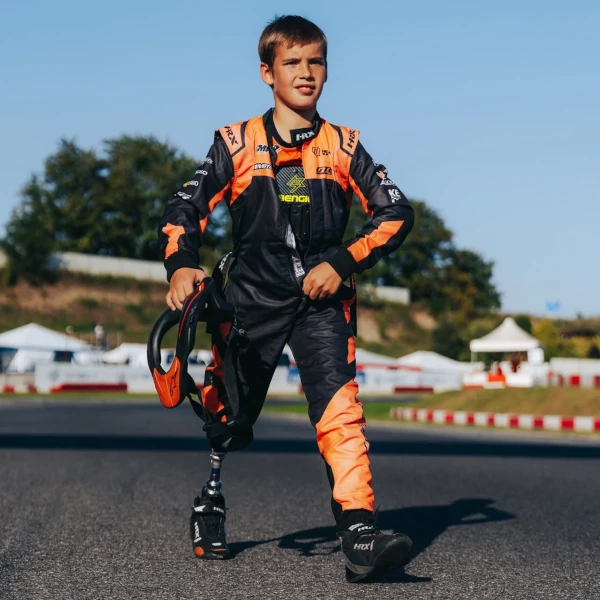
Pedro Cueto isn’t your average kid. The 10-year-old Coloradan is the only adaptive driver on the international go-karting circuit, and he’s one of the top young competitors in the sport. He already has his sights set on becoming the first amputee to drive in Formula 1.
The young racer has been revving his engines since day one, sleeping with Hot Wheels in his crib. As a toddler, when Pedro had a stomachache, he’d tell his parents: “My engine hurts.” Racing isn’t just a pastime; it’s his language.
But life threw him some hairpin curves. At six years old, Pedro was diagnosed with Ewing’s Sarcoma. He fought through chemo, multiple surgeries, and a massive limb-salvage operation as his karting career was getting started, but Pedro refused to put on the brakes. He continued to show up at the grid with more grit than anyone around him.
In 2023, the year before his amputation, Pedro won the Colorado State Karting Championship. Last November, just three days before surgeons removed his right leg above the knee, he competed at SuperNats (the Super Bowl of karting) in Las Vegas against kids from all over the country. He was back behind the wheel in less than three months, driving an adaptive vehicle with hand controls. This summer he debuted on the prestigious World Series of Karting circuit. A few days ago, he notched his first podium finish as an amputee, taking third place in a race at Italy’s famed Cremona racetrack.
As if that weren’t enough to keep a 10-year-old busy, Pedro is also the subject of an award-winning documentary, Power of a Dream, that premiered last month. Directed by Brendan Bowers, the film was named Best Documentary Short at this year’s San Diego Movie Awards festival.
We caught up with Pedro and his mom, Laetitia, last week to talk about his favorite tracks, pushups between rounds of Mario Kart, Lando vs. Verstappen, his documentary, and the thrill of chasing a dream. You can follow Pedro on Instagram @pedrocueto52.
The conversation has been edited for clarity and length. All answers are Pedro’s, except where indicated.
What’s the most exciting part about racing for you?
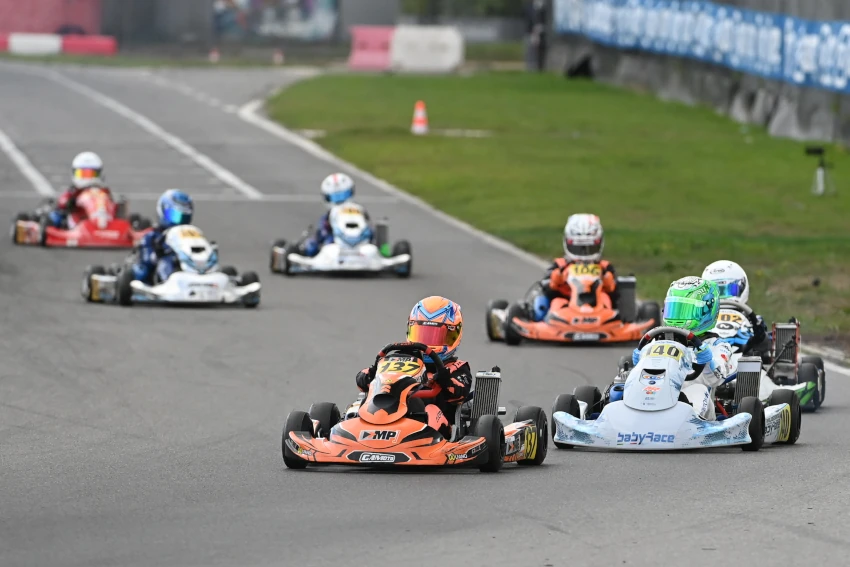
I definitely like the speed. I love the adrenaline and passing people. It’s always been my favorite.
How fast are you going out there?
Around 60 miles an hour. (His fastest time: about 72 mph.)
When you think of all the things you’ve achieved so far, do you have a favorite moment, something that you’re most proud of?
After I got my leg amputated, I got straight back into go-karting. That was a very special moment for me.
Once you got the hand controls installed in your car, how did that change your style of driving?
I think I’ve become a more aggressive driver, but I think that’s just because I have more experience now than before.
LAETITIA: It takes a lot of strength and skill to steer one-handed at high speeds.
I’ve heard that you train at the gym and even do CrossFit to help prepare for races. What do your workouts look like?
It’s always different—squats, push-ups, all kinds of things. I was doing one of these races and my coach told my parents, “He’s not driving the go-kart, the go-kart is driving him.” So I started working out really hard and getting stronger and stronger.
Do you have any pre-race rituals? Do you listen to music to get fired up? Do you have a favorite snack?
Yes, I’m working with a performance coach, and we work on reflexes with the lights, then we also do some stretches. He gives me a pep talk, and I always have a little bit of dry fruit before I go out, because it gives me a lot of sugar, so I’m all hyped up.
What’s an example of something your coach says to you in these pep talks?
He would ask me, like, “Alright, what did you struggle with in last session? How are you going to fix it now?” He watches all my sessions and shows me what to do.
LAETITIA: And you’ve been working with him a lot on mindset and pressure.
What’s a challenge you face when it comes to mindset?
Maybe when they show a penalty, I start thinking, “Oh no, why am I gonna get a penalty? What’s going on?” And I start breaking too late, breaking too early, messing up the corner.
LAETITIA: This was a situation that we had last weekend. I know what he’s talking about. When they’re karting, they do multiple laps, but when you cross over where the start and finish line is, they have an electronic board. He had gotten slightly out of position. He had been doing amazing. He was gaining and headed for the lead, and then, as he crossed that mark, he saw that his cart number flashed on the board, and he was under investigation. He got flustered. That’s the situation he’s referring to, and that was a lesson.
If you find yourself in a similar situation, what would your coach tell you to do?
Just act like it never happened. If you get a penalty, that only means that you should improve, so the penalty doesn’t hurt you as much. I learn along the way about how to be an even better driver or a stronger driver. When I put on my helmet, it protects my head—and I like to think it blocks out any negative thoughts, like “This is too hard” or “I can’t do it.” Nothing gets in there.
Let’s shift gears for a second and talk about your racing heroes. If you could meet either Verstappen or Lando in person, who’s your guy?
That’s really, really difficult. Both are amazing drivers, and I would love to meet both. I’d probably say Verstappen right now. He’s one of the best drivers in a very long time. He was in a race a week ago, and he beat everybody by a minute.
What do you think makes a good racer?
Practice, experience, working out…a good mindset.
Laetitia, tell me about the documentary. How did you get connected with Brendan?
LAETITIA: Honestly, it was a total surprise. We were at SuperNats last year, and Pedro was a rookie driver on that grid. We’d just started preparing for his amputation, which would happen three days after the race, and it was a really emotional time. But Pedro said, “I want to race,” and we thought, let’s do it. His coach told us, “He may not have the most experience, but he’s the hardest-working kid I know.”
So there we were at the track, and I ran into this man with a camera. He said he was filming a documentary called “The Power of a Dream” and was stopping moms to ask a few questions. I asked if he knew Pedro’s story, and he said no. When I told him about Pedro—how this race was our big celebration before his amputation—he just stopped and said, “I’m dropping my project. We’re making this film about Pedro.”
Everything shifted right there. It became this passion project for Brendan, who’s been incredible—completely self-funding, getting it into film festivals, and really believing in Pedro’s story. The first episode won Best Documentary Short at the San Diego Film Festival, and now he’s coming back to film part two at this year’s SuperNats [in November], after the one-year anniversary of Pedro’s amputation.
Pedro, what’s it been like seeing your story on screen?
It’s so cool! I love media stuff. Whenever people ask for interviews, I’m like, “Yeah! Ask away!”
LAETITIA: He’s always wanted to be a Formula 1 driver, so this feels like living history for him. It means sthe world.
What would it mean to you to become the first amputee Formula 1 driver someday?
It would mean everything, racing alongside all those legends. There’s a picture of Kimi Antonelli—he’s a Formula 1 driver now, and he’s only 19. When he was my age, there’s a picture of him giving Lewis Hamilton a high five. Now he’s racing against him! I think that’s so cool. I’m going to a Formula 1 race in October, and I always think that could be me one day.
If you were talking to another kid who’s going through something difficult—maybe their own rehab or treatment—and they’re having one of those moments where they feel like giving up, what would you say to them?
Don’t give up. Even if you have one leg, one arm, whatever’s going on—it doesn’t mean you have to stop everything and sit on the couch all day. Keep going. You can work out, you can still walk, you can still lift weights, you can still chase your dreams.