
As a young girl growing up near Nashville International Airport, Inara Grubb would stop to watch airplanes pass over her house. She’d look up, wave, and wonder what it might be like to be in the sky. Little did she know that one day she’d find herself alone in the cockpit, bringing an airplane in for her first solo landing.
It was a future that Grubb, who was born with a limb difference, never imagined for herself.
“I never entertained the possibility that I could be a pilot,” Grubb says. “It has such a high barrier to entry, especially if you have a disability.”
When she got to junior high, Grubb wasn’t mapping out a future in aviation. She was trying to finish an assignment for her personal finance class. Students were asked to choose a career, research it, and build a financial plan around the life it might provide. Grubb just wanted something that sounded cool, so she chose the career of a pilot. It fit the bill for something out of the ordinary, but the more she researched, the more she realized that becoming a pilot was something she was interested in.
When Grubb toured Middle Tennessee State University (MTSU) while considering colleges, her guide began talking about the university’s aerospace program, and as interested as Grubb was in the program, flying professionally still felt like a distant possibility for someone with a limb difference.
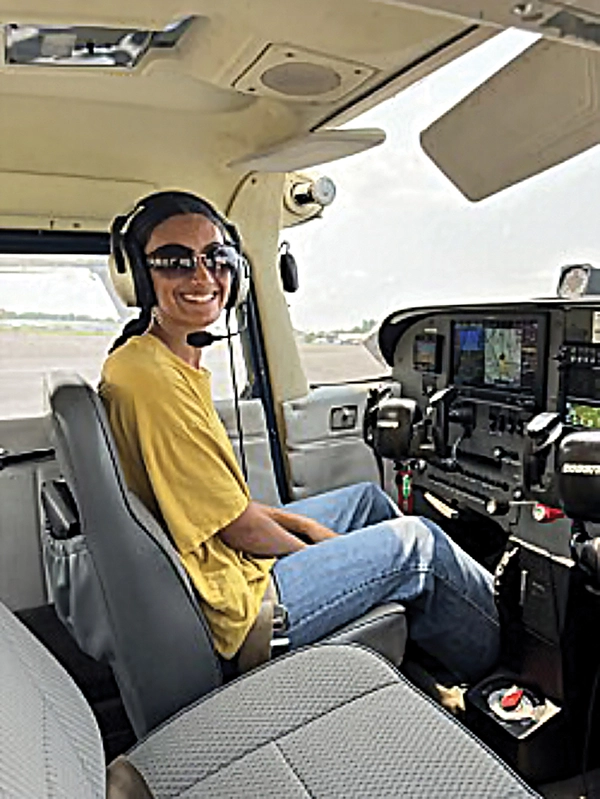
“It just seemed so out of reach,” she says. But she enrolled anyway. And now, as an aerospace student at MTSU, Grubb is working toward her private pilot certificate and, eventually, a career as a professional pilot. This summer, she crossed one of
aviation’s defining thresholds: her first solo flight.
She didn’t exactly volunteer for it. During a lesson at Murfreesboro Municipal Airport, Grubb noticed her instructor behaving a little out of the ordinary when they were up in the air. Instead of their usual touch-and-go landings, he had her taxi back after each one. He was unusually quiet. Then he told her, “I’m getting out of the airplane.”
“I was like, ‘No, you’re not!’” Grubb recalls, laughing.
He agreed to one more lap. And then, he got out, leaving Grubb alone. As she guided the plane off the runway, she remembered feeling nervous, but once airborne, her experience in the cockpit started to feel different.
Grubb immediately lit up. “It was really quiet,” she says. “It was so beautiful.”
After her first solo landing, apprehension gave way to something more akin to the recognition that this was something she was meant to be doing. The milestone carried particular weight because landing has been among the most demanding parts of her training. Grubb quickly learned how much has to happen at once: managing altitude and airspeed, judging the approach angle, reading peripheral visual cues, and timing the flare that brings the aircraft onto the runway.
Even the dimensions of a runway can complicate what the eye perceives. When Grubb began training at a larger airport in Smyrna, Tennessee, its wider runway initially created the impression that she was approaching too low. She had to learn to reconcile what she saw with what her instruments and training told her.
Her limb difference, meanwhile, has required relatively few modifications. “I’ve adapted to my surroundings just because I’ve been born with a limb difference,” she says.
In the cockpit, she uses the aircraft’s trim control to reduce pressure on the yoke when needed. During preflight checks, an adaptation can be as simple as using a cloth for additional grip on a tight oil cap.
For aspiring pilots with disabilities, several programs are working to make the path into aviation more accessible. The Experimental Aircraft Association (EAA) offers Adapt to Fly scholarships for flight training, along with camperships for young people with disabilities attending its Air Academy. Able Flight at Southern Illinois University offers scholarships that include flight instruction, ground school, adaptive aircraft, housing, and other support toward earning a sport pilot certificate. Grubb’s own training has been supported by scholarships from EAA and The Ninety-Nines.
Roughly halfway through training for her private pilot certificate, Grubb also just completed her first towered solo flight at Smyrna airport. Beyond that are an instrument rating, more certifications, and the hours of training required for a professional career.
Grubb knows exactly where she would like those hours to lead.
Years after standing beneath the flight path near her Nashville home and waving at airplanes overhead, Grubb has her sights set on flying charter operations and, perhaps one day, a Gulfstream.