
The words we use for our limb differences carry more meaning than what’s in the dictionary.
By Jennifer Latham Robinson | Images by Jennifer Latham Robinson
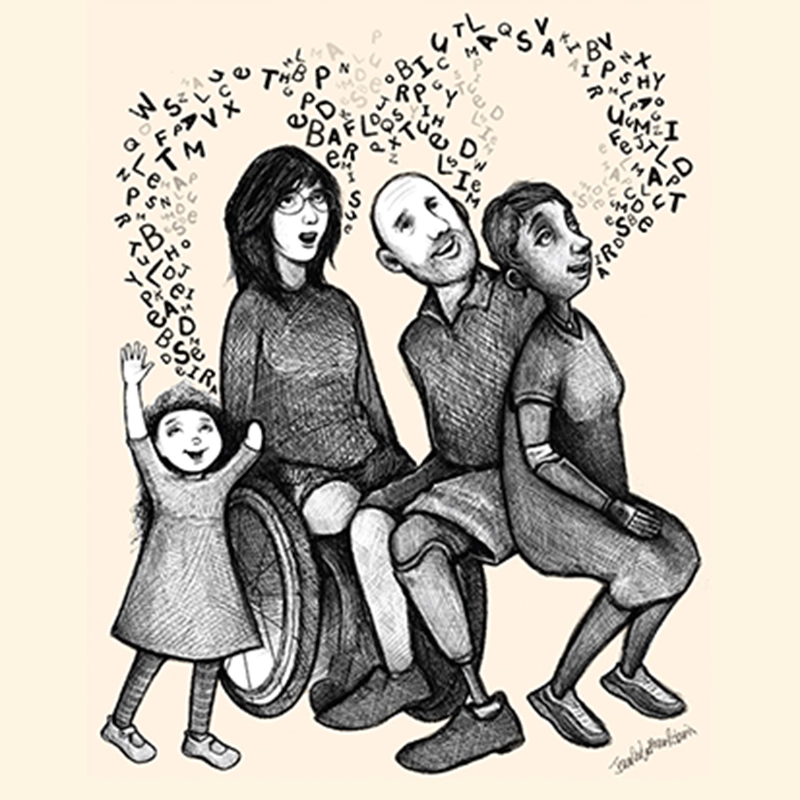
Language shapes how we understand ourselves, each other, and the world around us. Words carry weight– not just in meaning, but in history, intent, and emotional impact. When we talk about the words we use to describe our bodies, especially in the context of limb difference or limb loss, the conversation naturally deepens.
Feelings often influence the words we choose, and the words we choose can, in turn, shape our feelings. Words and emotions can be hard to separate. Even for those of us who are intentional about using inclusive language, getting it right isn’t always easy.
I was ruminating on this one sleepless night recently, the glow of my phone cutting through the darkness as I scrolled aimlessly across the internet. I ended up on a Facebook Group page for amputees, and since language was already on my mind, I posted a series of questions: “Which do you prefer: stump or residual limb? Patient or client? Person with limb difference or amputee?”
Without thinking much more, I clicked post.
In hindsight, I can see the flaw in how I phrased the questions. I set them up as either/or answers, but that’s just not how it works. The words we use to describe our bodies are ours, whatever they are, and we might use different words in different situations. How we feel about those words can shift over time, too.
That realization dawned on me when I began receiving responses. Some were already waiting when I got up the next morning, and they kept pinging in through the day, into the evening, and on into the next day. Because I am both a person with limb difference and a prosthetics professional, I decided to track the responses and enter them into a spreadsheet. Another vote for “I hate the word stump” in column 5. Another “residual limb” in column 3. The answers continued to flow in, until eventually I stopped tallying and just read. It was too nuanced for numbers.
The Facebook comments proved that people’s feelings about words are incredibly diverse, and they’re more complex than the binary choices I offered in my post. While each word pairing sparked some discussion, one term stood out as the undisputed heavyweight champion of controversy: stump.
Curious about why this particular word struck such a chord, I started digging into its roots. According to the Online Etymology Dictionary, stump originated in the 13th century from the Middle Low German word stumpe, referring to the trunk that’s left over after a tree falls. By the 14th century, it was being used to describe the part of a limb that remains after amputation. It’s related to the Proto-Germanic root stubb, a linguistic ancestor to the word stub, which frequently appears in the modern prosthetics world.
So that’s where the word comes from and how its meaning evolved. But what does it mean to us today? And how does it make us feel?
Stump vs. Residual Limb: The Name Game
“I HATE the word stump,” a woman named Elizabeth commented on my Facebook post. “I like to use residual limb. The word stump makes me think I won’t be able to use my limb. My limb is obviously smaller now, but I still use it. A stump seems useless, while residual limb seems like a limb that still works.”
Elizabeth’s feelings were echoed by many people, often in ALL CAPS. But not everyone who has a visceral negative response to stump defaults to residual limb as the alternative. One commenter, named Joe, said: “I absolutely hate the term stump. With a passion. I refer to it as my residual limb to professionals, but call it my half-leg to others, including on my Facebook feed.”
As the Facebook responses piled up, it became clear that personifying the limb with a capitalized proper noun was far more popular than the clinical-sounding residual limb. A commenter named Christi wrote: “I started a ‘Name the Stump’ contest with my family after my sister insisted that we needed something better than stump. Some of the names we considered were Veronica Q McStubbins, Stumfanie von Kneeingham, Legolas of Gonleg, and Stubby McStumpington. We settled on Stumpantha B. McGoningham, but we usually just go with Stumpantha. My mom really hated including any version of stump in the name, so it started a very healing conversation for us all. Celebrating my new self with a name for my new part was a great moment in my amputation journey.”
Humor seems to go along with the use of a proper name. “I prefer to call my leg Peg instead of the medical term stump,” joked a commenter named Dawn. Another respondent, Brian, explained that after a below-knee amputation, his wife named the residual limb Stanley. But when a subsequent revision surgery made him an above-knee amputee, “the question was raised: What will we call it now? My son-in-law wasted no time stating: ‘Stan. You shortened your leg, so shorten the name. Problem solved.’ By the way, the name of the prosthetic leg ended up being Ollie. If you remember the Stan and Ollie show [Laurel and Hardy], this kinda makes sense.”
I’ve always had a name for my own residual limb: Toe-Toe. My family and I have called it that ever since I can remember. I was born with a left femur half the typical length, some missing soft tissue, and no hip joint. On my right side, I was born without a femur, hip joint, or tibia, and I had a small, partially formed foot that didn’t function. At around two years old, I had the small foot amputated. We have no photographs of my tiny foot, with its missing toes. I’ve only seen one x-ray of it, which was retrieved from my archived medical chart at the Shriners Hospital. I always imagined someone had to blow the dust and cobwebs off my records before mailing that image, like some ancient artifact pulled from the back corner of a museum basement.
As the various opinions piled up in my Facebook comments section, I started to wonder what my parents called my limb before we all settled on Toe-Toe. When they discussed it with my doctors and nurses during my care, before I was old enough to talk myself, did they use stump, residual limb, or something else? I FaceTimed my parents and asked them. My dad’s eyes searched the room as he tried to recall; finally, he murmured, “I seem to think I just called it your leg.” My mother shook her head vehemently: “No, no, I think we called it her ‘little leg.’” My dad finally laughed, “You know, I don’t know what we called it other than Toe-Toe.”
Naming our limbs is a way to take ownership over our bodies, which can be very impactful when we have little control over our limb loss or limb difference. A proper noun name gives the whole situation a peppering of humor and humanity. It’s a small act, but it can shift the dynamic, turning something clinical or traumatic into something personal, even affectionate. Sometimes it’s not just about naming a limb; it’s about reclaiming the narrative.
That may be why many people in the Facebook conversation preferred stump: They wanted to reclaim authority over the word. After all, it’s we who give words their power—and we, the people with the stumps, should feel free to use whatever term feels right for us.
“Try explaining to your grandchild the word residual limb,” wrote a commenter named Dan. “Now stump, it’s like a tree that’s been cut down. They get it. It becomes routine. I find doctors have more problems with it than the people I associate with. My grand girls are the best test, and we all agree.” Echoing that sentiment, another contributor wrote: “I use words like stump and disabled frequently, not to offend anyone—they are just easy common words that people understand.”
“For me the term residual limb means something that is left over,” offered Julie. “In the hospital after my amputation, we were encouraged to name our stump to bond with it. I call mine Sassy. I try to have a sense of humor about my amputation, and residual limb just doesn’t sit right with me.” Jen chimed in: “I was not OK with [stump] at first, but after about two months of being offended, I decided that I would be fine with it. I was at a doctor’s appointment, and my dad was with me. The nurse and I were talking about my stump, and [my dad] didn’t like it. I told him I was fine with it.”
Stump never quite suited my Toe-Toe’s personality, but the word is growing on me. Why not embrace a word that has been so central to the limb loss experience? Why not reclaim it and make it our own? Perhaps there’s a generational element at play in how stump is used, or even a regional one. It’s clear that many individuals and organizations use the term with humor, nostalgia, and even a kind of kitschy charm. Language evolves, and maybe it’s time we let this word evolve with us.
Context Matters
Now that we’ve spent some quality time with the word stump, let’s pivot to its more formal alternative. Like it or not, residual limb is the favorite in medical circles and professional literature. It’s in clinical progress notes, prescriptions, and even medical insurance policy guidelines–the gold standard, according to the International Organization for Standardization (ISO).
A global group made up of national organizations that create and agree on standards used around the world, ISO issues publications on all sorts of arcana. One such publication, ISO 8548-3:2025, focuses specifically on how to describe the anatomy following upper-limb amputation. “In line with changes in ISO 8549-4,” the document reads, “the remaining part of the limb is referred to using the preferred term ‘residual limb’, or residuum, as opposed to ‘stump.’”
Interestingly, most of the people who voted residual limb in the comments to my Facebook post did so without much elaboration—a sharp contrast to the long, often amusing explanations that many stump voters shared. I wonder if the neutrality of the term residual limb helps take the edge off, removing some of the emotional charge that other words might carry. It’s a clinical, impersonal description that doesn’t require any context.
I’m a bit of a chameleon when it comes to the words I use. I adjust my language depending on who I’m speaking with. As a medical professional in the prosthetic industry, I usually lean heavily on residual limb when talking with other medical professionals and documenting in a chart. In conversations with people we see at our clinic, I give them the space to describe themselves and then try to mirror that. At home, it’s still Toe-Toe. And out in public, I use whatever word seems to fit the circumstances.
When my children were very young, my limb difference drew curious looks at the community pool in our neighborhood. I was keenly aware that my children paid close attention to my tone and word choice when other kids asked about my limb difference. What might seem like a simple interaction carried layers: my own feelings, my children’s feelings, and the feelings of strangers, all converging in a single moment. When a young person asked, I simply said I was born with “part of a leg”—but my friendliness, openness, and optimistic tone carried more meaning than the actual words. My children became so accustomed to these interactions that they eventually started answering for me, often tossing out the word “prosthesis” to their pre-K peers.
Accepting innocent questions from children can lead to wonderful exchanges, moments bubbling over with education and advocacy. That’s not to say we’re always in the right headspace for such intimate encounters in public. But the desire to help others understand us feels like a pretty universal human experience. Explaining our bodies in ways children can grasp isn’t always easy, but it sure feels good when a kid listens, accepts, and leaves the exchange with a little more empathy and a bit more knowledge for the next time they meet someone with a visible disability.
For many amputees, words take a backseat to how we are treated. A kind gesture, a respectful approach, or a simple acknowledgment can carry more weight than the specific words used. While some of us recoil at outdated or clinical terms, others find comfort in the warmth of human interaction, regardless of the vocabulary. “What I do notice, and what I feel is more important, is that when I am out in public, people are very, very caring,” wrote a Facebook commenter named Terry. Another, named Jeff, said: “To tell you the truth, I never noticed. Words are words and mean nothing, so I would not even give it a second thought.”
A half-hour after I FaceTimed with my parents, they called me back. They were still laughing, debating, trying to remember the origins of Toe-Toe, and betting on whose memory was more accurate. “Were you talking about your ‘artificial leg’ or your ‘leg-leg’?” my dad asked between laughs. “Is this with regards to your stump?” He was confused, and now I was getting confused. But my mom was more certain than ever. It suddenly came back to her, she said. She knew the answer to my question: “I called it your ‘little toe’ after your surgery, and then you changed it to Toe-Toe!”
We were all laughing by then. I realized that, in the end, it isn’t about language. It’s about being heard. The sweetness of our forgetting and the fun of our remembering hung in the air, long after the call ended.
Jennifer Latham Robinson is an author, illustrator, podcaster, and artist. Learn more about her creative work at jenniferlathamrobinson.com.