

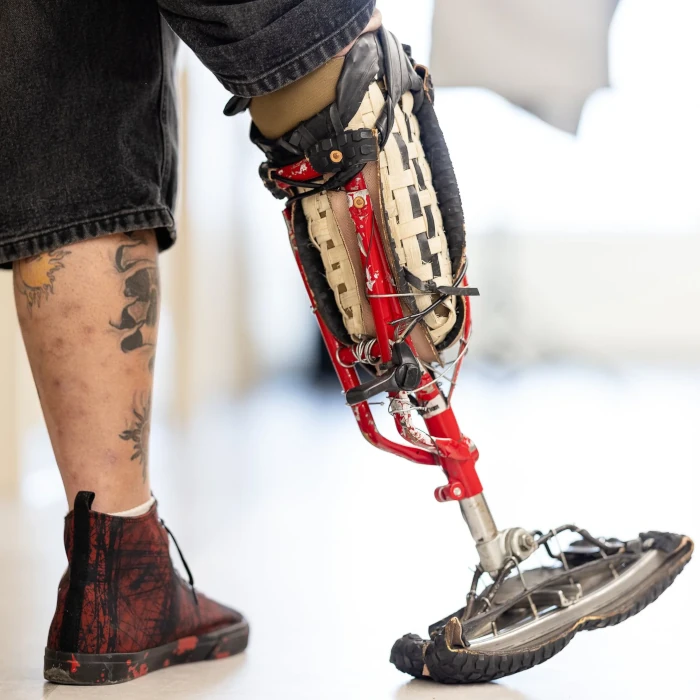
In a world where up to 90 percent of amputees will never receive a prosthetic device, every innovation matters. So when prosthetist Ben Hogan came across an article in 2014 about an African individual who had constructed a prosthetic leg from plaster and bicycle parts, it sparked his imagination.
“After reading that article, I had an idea for the basic framework in my mind,” says Hogan, a former bicycle mechanic. He immediately built a prototype, but he was still in O&P residency at that time and lacked the expertise to refine the concept. “I wanted to master the craft of prosthetics before I tried to reinvent the wheel,” Hogan says. “So I waited almost 10 years to build my next one. I’m glad I did, just so I could say I put in my 10,000 hours in prosthetics.”
By 2024, Hogan had worked with thousands of patients at Mary Free Bed Rehabilitation Hospital. He’d also learned more about the barriers to prosthetic access, both within the United States and in developing countries. The time was right to launch Project Bike Leg, Hogan’s initiative to create functional, low-cost prosthetic legs from recycled two-wheelers.
Unlike advanced prosthetic technology, bicycle components are affordable and accessible almost everywhere in the world. “I wanted to see if I could make a feasible, lightweight, functional and adjustable prosthesis that people could assemble with materials they already had on hand, no matter where they were,” Hogan says.
His hands-on experience as a mechanic gave him deep knowledge of bicycle parts’ strengths, weights, load capacities, and other properties. He tried experiments using everything from the bicycle frame to the tires, spokes, rims, and beyond. One concept used bicycle seats as prosthetic feet. Hogan’s patients tried his various prototypes and offered valuable feedback on what worked and what didn’t. Each iteration revealed new insights.
The exercise involved the same mental muscles Hogan used in his prosthetic practice. “Most of the time when you deliver a prosthesis, you’re pivoting,” he explains. “At some point, you’re either having to change the suspension or you’re having to change an alignment component. With the bike leg, it’s not very different. The takeaway is how similar it is to a standard prosthetic fitting.”
While developing the Bike Leg, Hogan found himself asking many of the same questions he considered when working on bicycles. Is my design strong enough to support body weight? Is it configured in a way that allows you to achieve balance? Does it optimize energy efficiency? Is there enough traction and shock absorption to navigate variable terrain smoothly?
Yet despite this overlap, Hogan says, most prosthetists aren’t used to thinking about building a leg on an improvised basis. “That’s why close to 90 percent of amputees worldwide don’t have access to a leg,” Hogan observes. “People in our position don’t want to look at the alternatives.”
By late 2024, Hogan had a technically sound design that could be easily built with ordinary bike parts and commonplace tools. The blueprints passed muster with the International Society for Prosthetics and Orthotics (ISPO), which accepted Hogan’s proposal to present his idea at the 2025 conference in Germany. He met amputee-serving nonprofit groups operating in Africa, Southeast Asia, Gaza, and Syria—teams facing military blockades, restricted imports, and threadbare infrastructure. After speaking with them, Hogan says, it became clear that the Bike Leg would be most impactful in war-torn regions where traditional supply chains are cut off.
On his website, Hogan has posted instructional videos to walk viewers through the process of building a Bike Leg from start to finish. “They act as a primary source of information sharing,” he explains. “Theoretically, all you would need is a bicycle frame and an internet connection. With those two resources, you could build the kind of adjustable, lightweight, durable prosthesis that you need.”
To test his theory, Hogan partnered with engineering students at the University of Michigan. After watching his tutorial, the students built their own Bike Leg — and, he laughs, “their version works better than mine.” The exercise supported one of Hogan’s core theories: that anyone, with or without an O&P background, can follow his instructions to create a functional, safe prosthetic leg.
Each bike leg currently takes Hogan about six hours to build, and the process itself is one of his greatest joys. “Making it with my own hands is probably the coolest thing. I like working with my hands. I enjoy the process as it’s right in front of me, letting it speak to me.” He laughs. “I know that probably sounds odd, but when you’re looking at something, it kind of speaks to you as to what it wants and what it needs.”
In the near term, Hogan hopes to pilot at least 100 devices, monitoring performance, failure points, adjustment frequency, and durability. Over the long run, he hopes to collaborate with health clinics in resource-limited settings, traveling to partner sites to demonstrate the process and train local clinicians. And he’s about to start work on an above-knee Bike Leg. “I have my patients cast and ready to go,” Hogan says. “I have the bike frame ready. I just need to throw myself at it.”
“I’m really proud to say that I’m attempting to do something about the disparity directly, utilizing what people already have on hand,” he adds. “It’ll be very fascinating to see where it goes.”