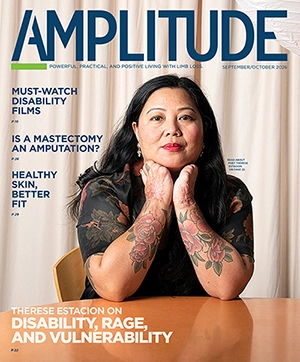
A few weeks after I joined Amplitude in 2020, I got a memorable education about limb loss from Paralympic long-jumper Lacey Henderson. It was mid-March 2020, just a few days after COVID brought the world to a screeching halt. Team USA had called off its media summit in advance of the 2020 Tokyo Games, which were suddenly in danger of cancellation. So I called Lacey, who graced the cover of that month’s Amplitude, to find out how US athletes were dealing with the uncertainty.
Her basic response was: Uncertainty? Hah.
“It really is kind of funny to see people’s response to being forced to stay at home and live like they or somebody they love is really sick,” said Lacey, who faced down cancer while still in elementary school. “Because for a lot of [amputees], we come from a world where this is our normal. People are like, ‘Oh that’s too hard, I can’t do it.’ If there’s one lesson we’re learning, it’s that anyone can get sick. Anyone can become disabled.”
In an instant, she showed me—a nondisabled person just beginning to learn about limb loss—the central flaw in mainstream narratives about disability. Far from being an exception to “normal” experience, disability was profoundly normal—an essential part of being human. Every story about limb loss was therefore a universal story with relevance for every reader, regardless of their limb count.
That principle has guided me ever since, and it has made the last six years the most fascinating and rewarding of my professional life. In hearing and telling stories about limb loss, I’ve learned a ton about people—hard stop. I wish I’d been introduced to the amputee community when I was 20 years younger and still had half a career to stay on this beat.
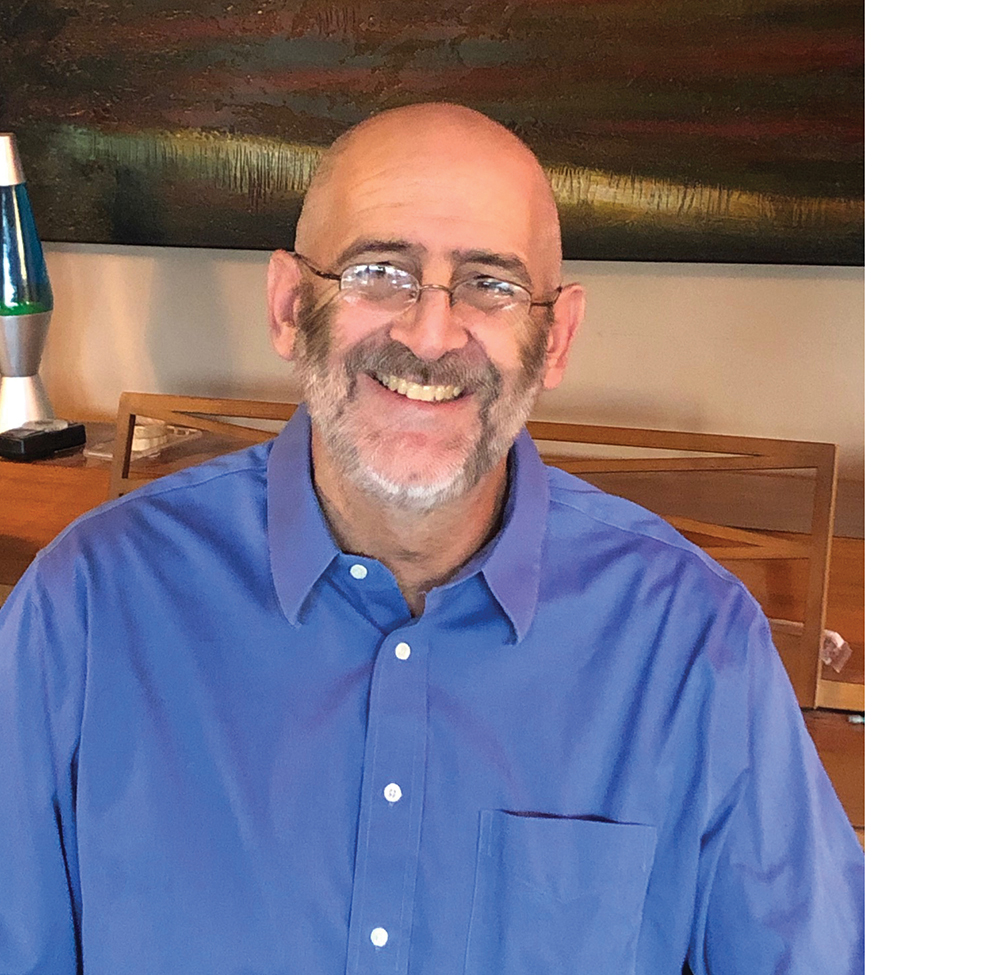
But at age 63, I no longer have the energy the job needs and deserves. So I’m transitioning out of my role as Amplitude’s editor. By the time the next print issue reaches you, I’ll be out to pasture….well, not entirely. There’s still a lot I want to learn, and lots of stories that need to be told. So I plan to keep doing those things—just at a less intense pace.
The chance to slow down and reflect was one of COVID’s silver linings, Lacey observed back in March 2020. “This may end up increasing people’s acceptance of disability,” she told me. “It can be a shock to find out that you have to change yourself to adapt to the environment. A lot of people haven’t had the opportunity for that to come across their lives. If we are given a gift out of all this, it will be the gift of perspective.”
I’ve received that gift many times over as Amplitude’s editor, and I’ll always be grateful for it. The stories you’ve shared in our pages—with me, and with each other—have helped me understand my own experience, identity, and humanity more deeply. These stories are more relevant and more necessary than ever. Amplitude and I will continue to tell them.