
By Abbey Smith
From tracking blood sugar and monitoring heart rates to recording vital signs and enabling virtual appointments, advanced medical technology is quickly redefining the doctor-patient relationship and the future of healthcare.
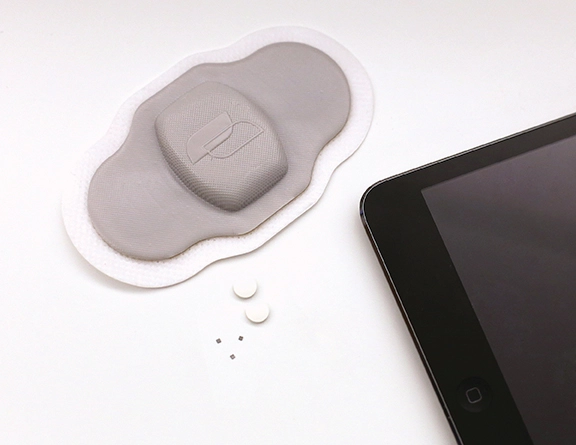
Mobile apps, wearable technologies, and online services are making healthcare more efficient, accessible, and affordable while helping to improve patient care. They’re also allowing patients to become more engaged with their health and more likely to manage their healthcare needs—which, as a result, means reduced healthcare costs overall.
There’s also a growing need for collecting quantitative medical data for preventive care and providing real-time feedback for course correction throughout treatment. Companies such as Seattle-based Stratos Product Development are developing digital health products, applications, and wearable devices to help meet this demand.
“We’re just scratching the surface when it comes to the types of information we can collect and how we can use that data to better understand patients, their medical conditions, and their healthcare needs,” says Blair Erbstoeszer, director of mechanical and manufacturing engineering at Stratos Product Development. “We’re constantly looking for new ways to engage users and enhance patient care.”
GOING MOBILE
Approximately two-thirds of Americans own smartphones, and 62 percent of those smartphone owners have used their phones to look up information about health conditions within the past year, according to the Pew Research Center. This is not surprising, considering there are hundreds of mobile applications that track a variety of health-related daily activities, including diet, exercise, sleep, and medication schedules. With consistent use, these types of apps may:
- Provide personalized information that allows users to track and analyze their health
- Identify patterns and find correlations between certain symptoms or behaviors and the actions that may be causing them (For example, a user might discover that • Allow users to better understand their health and manage chronic conditions, such as diabetes
- Allow users to easily share information with their physicians electronically or in person
One mobile app made especially for leg amputees is Ottobock’s free fitness app. Developed by physical and occupational therapists, it helps amputees achieve more mobility and make the most of their prostheses’ functionality through exercises designed to improve and maintain strength, endurance, balance, and coordination. The app also features three difficulty levels, a statistical display showing user progress, and the ability to set personal goals. Because the app is not tied to any specific product, it can be used independently from an amputee’s individual fitting.
“The Ottobock app has been an awesome reminder for how important core strength is not only in my athletic career, but also in my life as an amputee,” says Lacey Jai Henderson, a professional Paralympic track and field athlete and an Ottobock Americas ambassador. “Building core strength, stability, and balance as an amputee is great for a more naturalized gait and for preserving the rest of the body. The app’s exercises may appear simple at first, but coupled with your desired speed and endurance, they turn out to be great workouts!”
Henderson, whose right leg was amputated above the knee when she was 9 years old due to synovial sarcoma, downloaded the app several years ago and used it to maintain fitness during her off-season. Currently, she mostly uses the app when she’s on the road and unable to train with her coach, Dan Pfaff, at Altis in Phoenix. She says the app continues to help her build and maintain strength as she works toward her goal of standing on the podium at a major sporting event, such as the Paralympic Games.
“When I’m on the road with little resources and time, the app is an awesome way to get a quick workout for core, stability, and coordination,” says Henderson, whose career highlights include finishing fourth in the long jump and fifth in the 100m final during the 2013 IPC Athletics World Championships. “I also love how the app lets you play music from your device’s library. Listening to the songs that get you pumped gives you a good way to zone out and get a great workout.”
Henderson also recommends using a wearable device, such as a Fitbit, to track steps taken throughout the day, sleep patterns, calories, heart rate, and other fitness metrics. Many wearables can also be synced with social media accounts to challenge and cheer on friends.
“I can tell on the days I’m completely wiped out how many extra steps I’ve taken versus my rest or easy days,” Henderson says. “If I am experiencing fatigue at any given moment, I have the ability to check where I’ve been mobility-wise. These devices also are good for checking and evaluating your ability level when speaking with your prosthetist about future devices that might be appropriate for your needs and activity level. They’re a great way to show your progress!”
ENGAGING PATIENTS WITH TECHNOLOGY
Telemedicine offers medical support by allowing patients to communicate with their healthcare teams via video chat, text messaging, or other online platforms. It also removes many barriers that physicians face, such as having ample time to spend with patients, while providing more care options.
“My father was a general practitioner, and he commonly made house calls to visit and treat patients,” Erbstoeszer says. “And thanks to current technology, physicians and healthcare providers have more options for providing patient care—including the ability to make virtual house calls.”
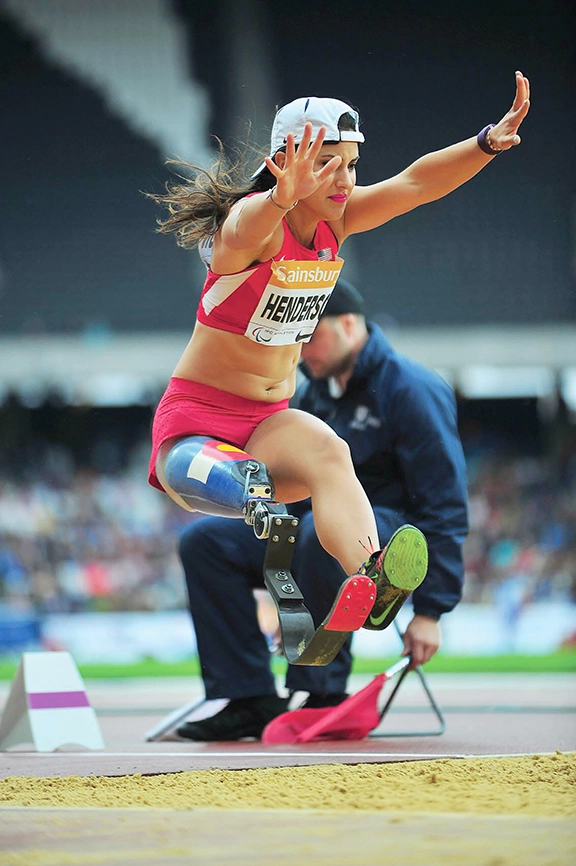
Image by hazpicsPhotography.co.uk.
For many amputees, telemedicine offers a quick and easy option for seeking medical advice without having to leave home. An amputee who is experiencing discomfort when wearing his or her prosthesis, for example, could skip an office appointment and discuss the issue with a physician or prosthetist using a mobile app or online service. This advantage is especially beneficial for amputees who can’t easily travel due to distance or mobility challenges, for those who are on tight schedules, and for those who don’t want to risk being exposed to other patients’ illnesses.
“These types of remote systems allow patients, especially the elderly or those with mobility issues, to limit unnecessary visits to the doctor while still allowing them to communicate with their healthcare teams,” says Linh Vu, co-creator of Mobile HealthLink, an award-winning remote health-monitoring system that allows physicians to monitor patients via a programmable smartwatch or tablet application.
For Vu, along with fellow Wichita State University biomedical engineering students Brandon Bartlett and Travis Vo, Mobile HealthLink began as a senior design class project. After being paired with Via Christi HOPE, a healthcare center for the elderly in Wichita, Kansas, the students worked with the organization’s chief operating officer and therapy director, Chris Deck, to improve its method of tracking patient health, which was being collected via e-mail surveys.
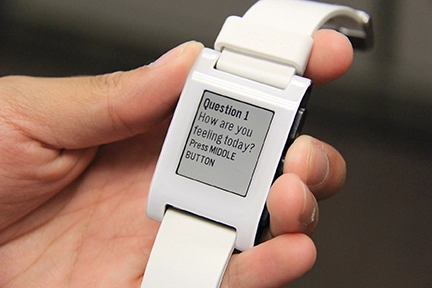
Within four months of starting their project, Vu, Bartlett, and Vo had developed Mobile HealthLink. The system allows physicians to enter a set of questions into the Mobile HealthLink website, which is customized for patients and their ailments. Patients then answer those questions by simply pressing a few buttons on their smartwatches or tablets. Physicians are alerted to the responses and can see overall trends that might merit follow-up appointments.
“If a doctor sees a potential issue with a patient, the doctor can easily ask follow-up questions to diagnose the issue and find a solution,” Vu says. “We also incorporated a system to remind patients to complete health-related surveys or prescribed tasks, such as an exercise regimen, at a certain time. This can be applied to taking medication as well.”
Currently, Mobile HealthLink is available for Pebble smartwatches and as a tablet application. Vu says they plan to expand the system with additional offerings, such as adding a glucose monitoring feature, and are looking for participants for clinical testing.
GETTING THE BEST OF BOTH WORLDS
As healthcare technology continues to advance and grow in popularity, it’s important to find the right combination of in-person and online healthcare. Many patients benefit from personal interaction with their physicians and healthcare providers, as it’s typically easier to build relationships and trust in person.
Finding the right wearable technology, app, or online service is just as important, but it may be overwhelming due to the large number of options available to consumers. Erbstoeszer recommends researching products online and talking with your healthcare team to find the product that best meets your needs. He also says that many companies need product trial participants to test devices and technologies, so ask your healthcare team about ways you might be able to partake in these trials.
FOR MORE INFORMATION
Ottobock’s fitness app — ottobock-group.com/en/fitness-app.html
Stratos Product Development — stratos.com
Mobile HealthLink Clinical Trial Program — Email lqvu@wichita.edu