
Whether it’s painting, cooking, gardening, or volunteering, hobbies provide opportunities for creative expression and to experience the world from new perspectives. Powerful things happen when creativity is unleashed, and for many amputees, hobbies can alleviate stress and anxiety, provide exercise, enhance fine motor skills, develop capacity in non-dominant hands or feet, prevent boredom, boost self-esteem, and even improve health.
“Scientists and physicians have found that knitting, for example, lowers heart rate and decreases stress,” explains Carrie Barron, MD, a physician, psychoanalyst, and writer who has been in private practice for the past 20 years. “Good things happen in quiet and calm self-states. When we improvise or play, pleasure centers are stimulated in the brain.”
Barron knows firsthand how creativity connects us to our inner selves and offers the satisfaction of accomplishment. She has devoted years to researching the therapeutic value of creativity and co-wrote The Creativity Cure: How To Build Happiness With Your Own Two Hands, which focuses on our fundamental need to create something using our minds and hands.
“Creativity is about a mindset, not a particular product, field, or fund of knowledge,” she says. “It can apply to anything because it’s about being open and flexible, and seeing things in new ways. If you make creativity a habit, you can experience a greater frequency of joyful moments.”
Hobbies for Keeping Active
As a child, Don Davis spent many summers with his grandmother, whose “garden of all gardens” inspired his lifelong passion for getting his hands dirty and watching things grow.
“Seeing the love she put into her garden made me want to mimic her,” Davis says. “She grew everything from beans and greens to squash and potatoes to melons and corn. She also had peach, apple, and fig trees, and a grape arbor.”
Now 68, Davis has been gardening for most of his life and hasn’t let much slow him down—including losing his right leg below the knee and his left leg above the knee in March 2001.
“Gardening brings the creative side out of me,” Davis says. “Trying to find ways to make it accessible with raised beds and self-watering planters just makes it that much more enjoyable.”
Davis is a believer in staying fit, so he finds ways to work with the physical aspects of gardening. Rather than use his wheelchair or modified tools when tending to his garden in Spartanburg, South Carolina, he usually removes his prosthetic legs and sits on the ground to plant, weed, or harvest. He has also adapted gardening methods to fit his physical abilities, like using a raised plant bed. Once, while cultivating his garden, he asked his kids to bring him his gardening tools and a piece of plastic pipe.
“Before they got the pipe, they asked me—with puzzled looks on their faces—why I needed the pipe,” Davis explains. “I told them to just watch and see. I stuck the pipe into the ground, placed a seed in it, and watched it roll to the bottom. The three of us smiled because I found a new way to plant my garden.”
Continuing his love for innovation, Davis recently helped the South Carolina School for the Deaf and the Blind celebrate Gardening Day by making wheelchair-accessible gardening tables and self-watering planters.
“What a thrill it was to be there,” says Davis, who has since been asked to teach several community groups about gardening. “The kids were so amazing and really into gardening.”
Davis is also passionate about volunteering and helping his community. He helped establish the EMRI Alliance, which helps people living with all types of disabilities, and is serving his third term as a co-chair for The Mayors of Spartanburg County Committee for People with Disabilities, where he helps ensure accessibility at locations throughout the community—including parks, auditoriums, and polling places. Over the years, he’s lobbied for fair insurance for amputees and received the 2008 Civil Justice Foundation Community Champion Award and a citation from the Pennsylvania House of Representatives in 2009.
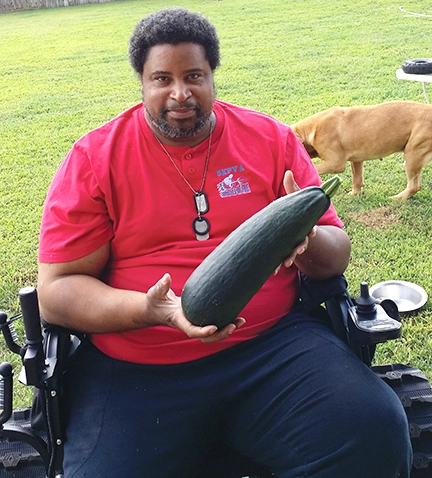
Image by Lasandra Anderson.
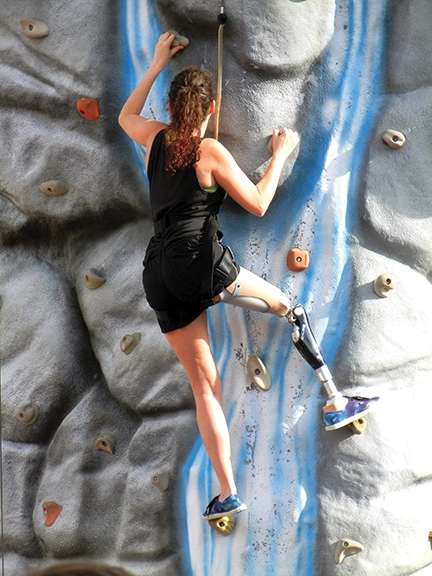
Davis has other active hobbies as well. He took up tennis about 11 years ago and is one of the few people in the country who have an above-knee and a below-knee amputation who can play standing. He also dabbles in scuba diving, horseback riding, cycling, sailing, water skiing, bowling, and wall climbing.
“Hobbies are important because they help keep my mind clear,” Davis says. “My advice to amputees who may be intimidated about the challenge of certain hobbies is that you have come through the biggest challenge in your life, why not have some fun?”
Hobbies for Exploring Creativity
Sheila May became a quadrilateral amputee in 2003, losing both hands and both legs below the knees due to meningococcemia. Then, in September 2010, she underwent a 12-hour surgery and received hand transplants at the University of Pittsburgh Medical Center. For her, creativity—often evocative of such pursuits as painting, drawing, and other traditional forms of artistic expression—has been influential in her recovery from these life changes.
“Even though I lack individual finger motions, I can truly say I am fairly independent,” May says. “I’ve gone back to work, drive with less adaptive devices, and frequently travel on my own.”
Embracing her creativity since childhood, May quickly realized the importance of expressing herself through art after becoming an amputee. That’s why she continues to push herself and pursue her favorite hobbies, including drawing, painting, writing, and cooking. She’s also an accomplished speaker and author who shares her experiences as an amputee in the hope of providing inspiration and education.
“I am absolutely grateful for having the ability to be creative and applying such traits in the things I do, such as cooking,” May says. “Like art, cooking has been very important to me. When I lost my hands, I found cooking difficult to pursue and I felt discouraged. Now, it’s something that I’m so proud of, even if some dishes don’t turn out the way I want.”
Hobbies for Helping Others
In January 2005, Air Force Staff Sgt. (Ret.) Timothy Anderson was riding his motorcycle when he was struck by a car. His right leg was severely injured and, after three years and multiple surgeries, his leg became infected and had to be amputated below the knee.
After the accident, Anderson began revisiting childhood memories of helping on his great-grandparents’ farm in Maryland.
“I’ve always wanted to follow in my great-grand-father’s footsteps,” he says. “I learned so much from him, and I remember the good times I had growing up on that farm.”
It’s this inspiration that led Anderson to create Heroes To Farmers—a community garden/farm in Warner Robins, Georgia, that uses the therapeutic benefits of farming to help veterans overcome challenges and reintegrate into civilian life. In addition to teaching veterans how to grow produce and raise farm animals, Anderson wants to offer seminars on holistic health and sustainability.
“As a farmer, I can still serve my country and my community,” says Anderson, who served in the military for 17 years. “I suffered a traumatic injury, and I’m still affected by depression, PTSD [post-traumatic stress disorder], and anxiety. While I wasn’t injured in combat, I have many friends who were, and I understand what they’re going through. That’s why it’s important for vets and their families to come to Heroes To Farmers—so we help one another through our own experiences.”
Anderson, 50, who usually relies on his prosthetic leg or wheelchair to get around, simply removes his prosthetic leg and crawls on the ground while he’s gardening, although he’s still trying to perfect his technique. He also uses an all-terrain wheelchair to easily access his garden.
In addition to farming, Anderson’s other hobby is raising Dogues de Bordeaux (also known as French Mastiffs). “I love this breed of dog,” says Anderson, who started raising them in 2011. “They are sweet, gentle giants and are so lovable. I just love their company.”
Finding the Right Hobby
Finding a hobby that lines up with your interests and abilities may be overwhelming, but Barron encourages exploring every possibility. She also emphasizes the importance of not being afraid to make mistakes, as they can reinforce problem-solving skills and help people better cope with new or difficult situations.
“Stick with a hobby for long enough to master basics unless you are sure from the start it’s not for you,” she says. “Trust instinct. Honor intuition. Keep trying till something works or clicks. Get help, support, and companions.”
Barron also points out that accepting limitations can actually be a source of strength, as you must find new ways to accomplish a task. Companies such as TRS and Texas Assistive Devices offer special prosthetic attachments to help amputees pursue many types of hobbies. There are devices for sports, music, carpentry, and many more.
“When you find something you can do or love to do, and you get into it, your whole life can change,” Barron says. “It’s not about achieving greatness, but finding the vitality within. Therein lies the beauty. When you find the gift in yourself—what you can do, make, or give, and your method for doing so—everyday life can be interesting and elevated.”
By Abbey Smith
FOR MORE INFORMATION
Carrie Barron, MD
www.carriebarronmd.com
Heroes To Farmers
www.heroestofarming.com
Sheila May’s blog
www.sheilamaya.blogspot.com
Texas Assistive Devices
www.n-abler.org