

Only the fittest survive in nature. So how, an evolutionary theorist asks, do so many animals prosper after limb loss?
By Larry Borowsky
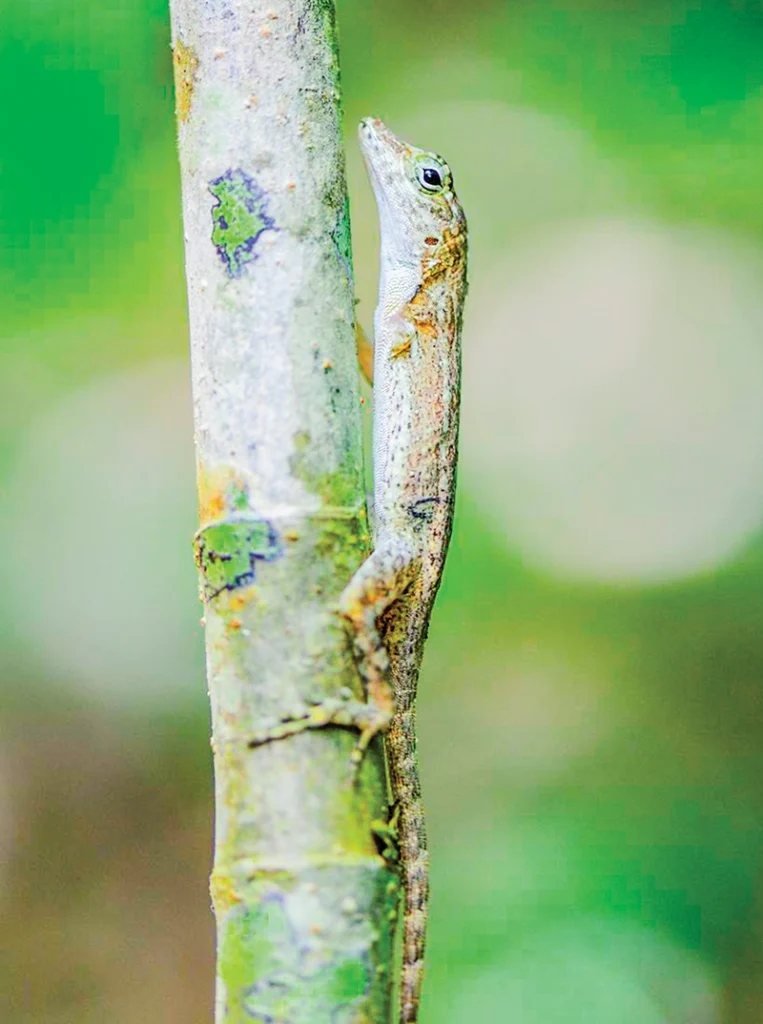
While chasing brown anole lizards in the Bahamas about 20 years ago, Jonathan Losos corralled a rather startling specimen. She was particularly elusive, he remembers—fast, nimble, and hard to capture, even for a world-class reptile wrangler. When Losos finally reeled her in, he found a tag indicating that he or a colleague had caught this individual the previous year.
He also discovered, to his great surprise, that one of the anole’s hind limbs was completely gone.
“She still had all four legs when we caught her the first time,” reports Losos, a nationally renowned evolutionary biologist. “Now she was missing one. The wound was healed over, so she’d survived for some time. And she was fat, sassy, and healthy.”
That evidence ran counter to Losos’s exhaustive body of knowledge about brown anoles. Decades’ worth of study had established a statistical correlation between limb length and survival rates. As little as half a millimeter in length can have a significant impact on an anole’s mobility, affecting its ability to forage, evade predators, and live long enough to pass on its genes. In evolutionary terms, limb length in anoles and related lizard species offers a textbook illustration of natural selection, the process by which a species’ anatomy evolves to fit its habitat over many generations.
“A lizard missing its entire hind leg should be at a huge disadvantage,” says Losos, a professor of biology at Washington University in St. Louis and director of the Living Earth Collaborative. “Yet it was obvious this lizard was doing okay. So it struck me as odd.”
The encounter made such an impression on Losos that he began taking notes when similar reports periodically surfaced in scientific journals and conversations with fellow researchers. “None of them were studying limb loss in lizards per se,” he says. “They were just good scientists who recorded everything they observed. So I started accumulating these records, and I kept telling people: ‘Someday I’m going to do something with this.’”
Someday finally arrived last fall, when Losos coauthored a paper about lizards with limb loss for The American Naturalist. Titled “Pirates of the Caribbean: Three-legged Lizards and the Study of Evolutionary Adaptation,” the study addresses this question: “If subtle differences in limb length between individuals can affect performance, survival, and reproduction, how can a lizard missing a substantial portion—or even the entirety—of a limb not only survive but even thrive?”
Losos and coauthor James Stroud don’t offer definitive answers, but they do propose some hypotheses about how animals can prosper with physical changes that would seem to make them radically less fit for survival. The authors’ theories about successful limb-loss adaptations in Anolis sagrei are strikingly congruent with the adaptive strategies we observe in Homo sapiens. And their survey raises some weighty questions about how evolution and natural selection operate. Perhaps, the authors argue, “the environment does not impose selection on organisms. Rather, organisms take an active role in defining how they interact with their environments and thus what selection pressures they experience.”
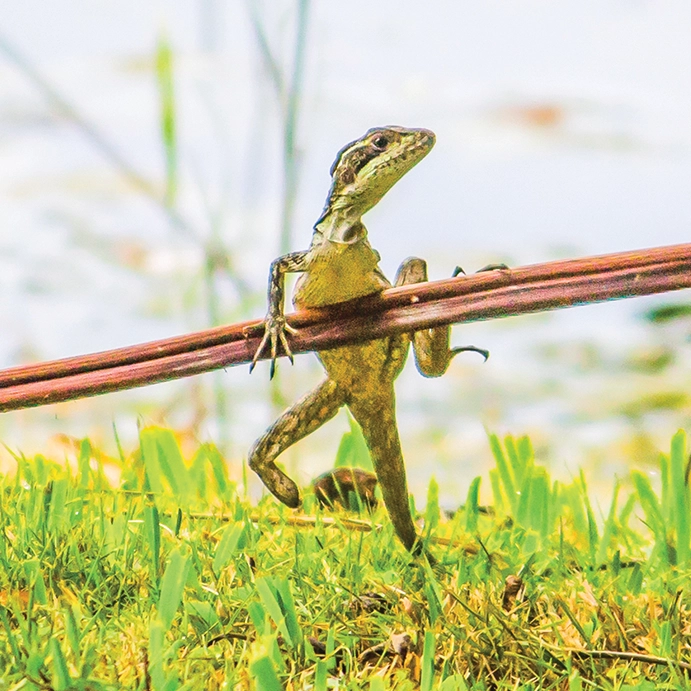
as well as their four-limbed peers.
“Pirates of the Caribbean” appears in the November 2025 edition of The American Naturalist. Amplitude asked Professor Losos (whom we have known since elementary school) what the study of limb loss in nature might reveal about adaptation in the Darwinian sense. Our conversation is edited for clarity and length.
Why is limb length such an influential trait for the brown anole and species like it?
When we compare among species, there is a very clear relationship between the diameter of the surface lizards use and how long their legs are. The reason these adaptations have evolved is that, when you actually run lizards on a racetrack to see how fast they run, the longer your legs, the faster you can go, because you can take longer strides. On a broad surface, like a tree trunk or the ground, speed confers an advantage. But on a narrow surface, like a twig, it’s shorter legs that are favored, because as they’re moving along on this little twig, it’s important that they don’t go toppling over.
We’ve been able to show through year-to-year studies that natural selection operates on these traits as we would expect. The length of a lizard’s limbs is a key attribute that affects how well they’re adapted to their environment, how long they survive, and therefore how successful they are reproductively.
And yet there are these three-legged lizards getting along just fine despite losing a crucial survival advantage. How does evolution account for that?
People who study biology in nature know that all kinds of crazy stuff happens. You see things all the time that just don’t fit with your conception of how animals normally function and survive. It’s only when you see these repeated patterns that you start saying, “This is not just an odd occurrence. It’s not just a one-off.”
The traditional under-standing of evolution is that you look at correlations between anatomy and survival: Natural selection shapes the anatomy to fit the environment. But there’s an alternative hypothesis, going back to the 1980s, which argues that natural selection doesn’t operate directly on anatomy. It operates on what organisms can do. And so we need to understand the functional consequences of variation in anatomy, and how those differences in function affect survival and reproduction. We have to put this performance category in between anatomy and survival.

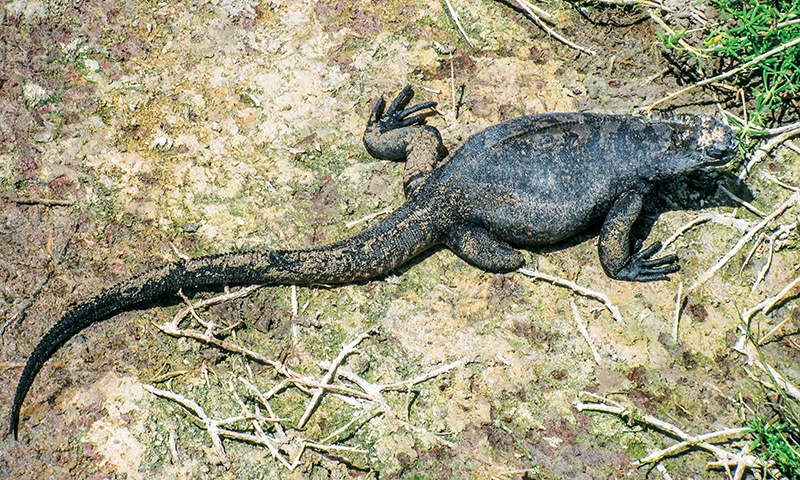
survived double limb loss.
It turns out that some of these lizards, even with pretty substantial limb impairments, can function just as well as a lizard with a normal length leg. They can run just as fast. That’s the biggest surprise to me in this paper, and it’s something I would not have predicted. I would have expected that they would have much slower sprinting speed. But there are cases where people were able to capture lizards and bring them to the lab and conduct high-tech studies of their movement to see how they actually compensate. These lizards were able to change their pattern of movement to compensate pretty completely for the loss of part or all their leg.
Is that considered to be a learned skill or an instinctive one?
We already know that animals modify their behavior based on [environmental] conditions. For example, when it’s cold, lizards are slower because, being cold-blooded, they just don’t function as well in lower temperatures. So it turns out that a cold lizard that’s threatened will often stand its ground and fight back and try to scare off a predator, whereas a warm lizard will just run away. So that’s a behavioral adaptation that has evolved to give an animal better odds of survival, depending on the circumstances.
But we wouldn’t think that losing a leg would occur frequently enough that evolution would give them the instructions, if you will, to change their behavior. So then the question is: How does an adult lizard with four limbs learn to move after losing a leg? How does it figure out how to hunt differently, to hide? How does it change its behavior? How does that happen?
And, of course, there’s an obvious bias in our data, which we point out a couple of times in the paper: We don’t know how often lizards lose a leg and then quickly starve or get eaten. That certainly must occur, but we don’t see those lizards. There wasn’t ever a clearly weakened or diminished specimen that surfaced, but we did have specimens in which the wound hadn’t healed yet. And we purposely did not include those in our survey, because if the wound hasn’t healed, then the lizard may die of an infection or blood loss. One of our criteria was that they had to have healed and survived the loss of the limb. But we don’t know how common that is. That’s one of the questions we would like to know more about.
Is there any feasible way to study this?
This isn’t a topic that you could intentionally go out and study very easily. These are very rare specimens. They’re infrequent enough that most people don’t see multiple examples. No one would contemplate doing an experiment and cutting off lizard legs just to see what happened. That’s unethical.
However, you could possibly do a study related to birth defects. We know of one researcher who hatched a lot of lizards out of eggs as part of an experiment, and he recorded two instances of limb difference. It would be interesting to compare the performance and the behavioral adaptations of an animal that is born with nonconforming limbs to the adaptations of one that acquires nonconformance.
Has limb loss been studied in any other species?
There is a scattering in the literature from various animals. There was just one recently with a lion that survived a long time while missing a leg, and the thought was that the pride looked after that lion. There’s speculation that this could be an adaptive behavior that evolved to care for an injured animal. You would think that the cost to all of the other pride members would outweigh any benefit. But prides are composed of related females, and so maybe if they look after Mary Lou, she’ll have more lion cubs, which contain some of their genes. So maybe it is an adaptive trait.
There was another paper I heard of where an elephant had lost its trunk. But the rest of the herd looked after it, and they ended up eating a lot of marshy reeds, because they’re easy for an eleplant to grab with its mouth. The whole herd changed its behavior so that one member could survive. That was another one of these curiosities that nobody was setting out specifically to study, but they came across it opportunistically and felt they needed to understand it.
Do you feel there is a benefit to studying disability in nature as a way of understanding evolution?
Absolutely there is, particularly in a field like evolution. This is not like physics or chemistry, where you can come up with a formula and do an experiment and answer the questions. We love to quote the famous mathematician Ian Malcolm, who, if you don’t recognize the name, is from Jurassic Park, the character that Jeff Goldblum played. He says at one point in the movie, “Life finds a way.” So there’s no single way. Evolution works in many different ways.
There are some people who see the natural world as very deterministic and structured by competition and leading the “fittest”—the individuals that are best adapted to the environment—to survive. Those people look to natural selection to explain everything. But there’s another view that says serendipity plays a role, and sometimes traits evolve not because they’re adaptive, but for other reasons, sometimes just due to random reasons.
What do you hope the scientific community will take away from this study and others like it?
When we see a three-legged lizard, it piques curiosity because it’s so unexpected: That lizard shouldn’t be here because it’s at such a disadvantage. But I don’t think it inspires many people to think very hard and ask: Maybe they’re not at a disadvantage. We know that individual animals vary in their capabilities. And we also know that, in many contexts, they compensate for capabilities that are diminished. So the question is not to look for a single way that evolution works, but to understand which of the many ways happen most commonly, and which are the more exceptional cases. Understanding the diversity of nature requires not only looking at the most common patterns but also looking at some of the extraordinary things that give you a more well-rounded perspective on what is possible.
And I have to point out that this paper was only possible because there are so many good, observant scientists out there. They saw something [i.e., a lizard with a missing limb], they had no reason to think it was anything significant, but they documented it anyway. That’s the key to being a good scientist, is not to prejudge anything. We have to be open to broader possibilities about how organisms deal with their condition, how they’re flexible, and how there can be lots of different outcomes. It’s not predetermined that certain adaptations are the “best.”
Life Hacks for Amputee Lizards
You’re a brown anole learning to live with limb loss. There’s no peer mentor, Facebook group, prosthetic clinic, or lifestyle magazine you can turn to for support. What’s a lizard to do?
Biomechanical Adaptations
“Lizards capable of altering their locomotor dynamics may be able to compensate for limb injuries and maintain suitable performance abilities,” Losos’s paper observes. Two adaptations that were observed for maintaining sprint speed include faster stride frequency and increased rate of body undulation, which enables each stride to cover more ground.
Behavioral Adaptations
“Lizards with limb loss may switch habitats or adopt behaviors—for example, more stalking or greater reliance on camouflage—that do not require rapid movements. Similarly, such lizards may spend more time near a refuge, such as a rock crevice or a burrow, which requires only a short dash to safety.”
Compensatory Traits
“It is possible that some three-legged lizards possess other traits whose benefits offset the detriment caused by limb impairment. For example, a lizard with exceptional eyesight may not need to run quickly to evade predators, minimizing the survival costs of limb loss.”