
by Alexandra Capellini
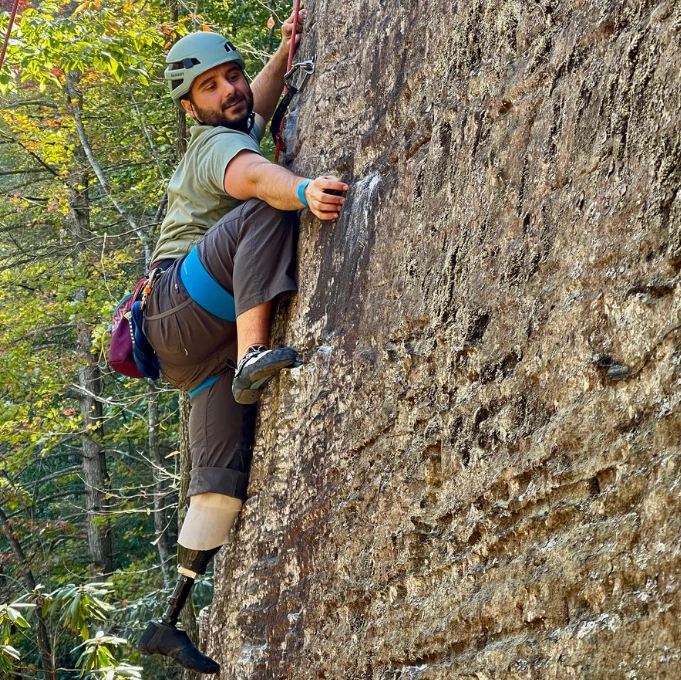
It’s early afternoon, beneath the sun overlooking the Red River Gorge of Kentucky, and there I stand, tightening a figure-8 knot. I tie the rope into my harness and arch my neck back as far as it can go. I can almost see the top of the rock I’m about to climb on one foot. I don’t have a plan for every single movement I will make up that rock—I’m still getting my bearings in outdoor climbing. But I am going to climb it.
I load my hands with chalk and signal to my belayer that I’m ready. (My belayer happens to be a super accomplished outdoor climber, Ethan Pringle.) It takes me two or three attempts to land the first leap, but I finally hold my position. And up I go! Maneuvering my left foot along the cracks and pitches of the rock, I shift my residual limb’s position to my advantage and keep going. My forearms feel the burn, and my fingers grow to appreciate whatever I can use as a hold. At one point, I have to unclip myself along the trajectory of the climb, and then prepare myself to be pulled sideways given the angle of the pitch. I debate what to do. I look down below, where ten people have gathered to watch me. My core tightens. Sweat creeps down my face. I extend my arms out wide to give this rock a hug that I can hold, and I stay the course. I am not going anywhere.
I am at the Adaptive Climbers Festival, a three-day outdoor climbing event for people with physical disabilities. Started in 2018, the ACF (held annually in Kentucky’s Red River Gorge) has grown steadily over the years. There are approximately 200 adaptive rock climbers with me for the 2025 festival. We are camping on the same site off Red River. Most of us are staying in tents, some of us in cabins. Most of us have brought prosthetics, crutches, walking sticks, or wheelchairs. Some of us have brought our own climbing equipment, but an impressive amount of it has been donated for our use.
The people gathered here vary widely in climbing experience. Some have never climbed before. Others, such as myself, are members of local adaptive climbing groups that practice in indoor settings, but are hoping to improve our outdoor skills. There are some competitive climbers who want to branch into regional, national, and international competition. Whatever our ability level, we share the same reason for being here: to learn from each other.
During the weekend, I participate in an open-climb session, getting beta (climbing guidance) from some of the best climbers in the country. I climb alongside wheelchair users, amputees, and people with visual or mobility impairments. Extensive efforts are made to make the mountains accessible. But the beauty of it all is in what each climber brings: our own willingness to adapt. Once we are tied in, we are on our own to find our way up that rock. It is adaptation in its purest form. For whatever arm or leg is not available to us, we find a way to work through that.
Later that weekend, I attend a climbing session tailored to lower-limb amputees. While there, a prosthetist suggests that I use a specialized climbing device. He swaps out my prosthetic knee and attaches a short rock-climbing foot, which I can use to bear weight on my residual limb while climbing. It is unlike anything else I have experienced—I typically only bear weight on my residual limb when walking in my prosthesis. But I trust the climbing guides and instructors, so I give it a try.
That’s the whole point of the ACF: trying new things, taking risks (with safety precautions), and testing our nerve and our physical limits. I challenge myself on each climb, whether it be leveraging a new position with clenched fists, extending my forearms just a bit further, flexing my hip just a bit higher, gripping with my fingertips just a bit firmer.
I am learning, as we all are, how to make this body work for me. That’s a mindset I’ll carry forward into my daily life, long after the festival has ended.
Alexandra Capellini is a resident physician at the University of Michigan Hospital in Ann Arbor.