
By Carolyn Cosmos
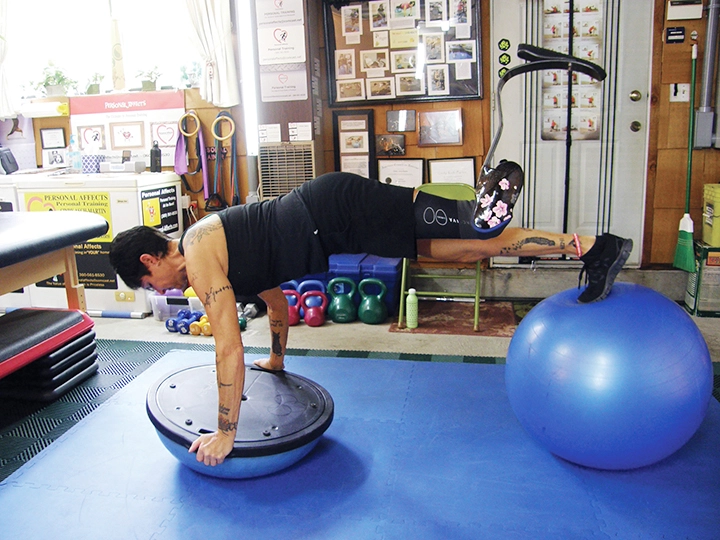
Photograph courtesy of Cindy Asch-Martin.
When Cindy Asch-Martin’s left leg was amputated below the knee in 2011 after years of pain, surgeries, and infection, she was relieved. “I no longer worried that my leg would kill me,” she says.
But she had new worries. A personal trainer and fitness coach with a business, Personal Affects (www.personal-affects.com), she asked herself, “When your job is physical and you have limb loss, how are you supposed to return to work?”
Mike Penketh had a darker response when his hands were shredded in a 1993 racing accident and amputations followed. He was an aerobatics expert and American Airlines captain who flew commercial Boeing airplanes for a living.
“I thought about ways I could commit suicide without harming anyone,” he wrote in his autobiography, Within My Grasp. Doctors had said he wouldn’t fly again. They called his insistence on it “delusional” and prescribed prosthetic hooks. Only his wife, Mary Ann, believed him, he says.
Ultimately, these two amputees not only overcame the perceptions of doubters, they fought their own fears and returned to the type of work they loved. They reimagined their careers and transformed their lives and the lives of others as teachers, role models, and advocates.
How did they do it? They followed their passions.
Their successes showcase amputees as “myth busters” who can get back to work—even in jobs that are not “desk jobs”—and support families, start businesses, or become active volunteers. Perhaps they do it with adaptations and accommodations, perhaps without.
It might not be easy, but nothing fuels such a struggle like passion and devotion. “Do what you love,” some say, “and the satisfaction and money will follow.”
Asch-Martin, for example, used her exercise savvy and doubled down on working out to speed her body’s recovery. In the process, she developed new training routines and fitness services for amputees and peppered her website with motivational videos and inspirational comments.
The former Canadian, who now lives in Washington state, also continued her networking and promotional work to grow her business. She used Craigslist, Facebook, yard signs, wove her professional life into her community work, offered free exercise sessions to seniors, and added writing gigs as an amputee advocate.
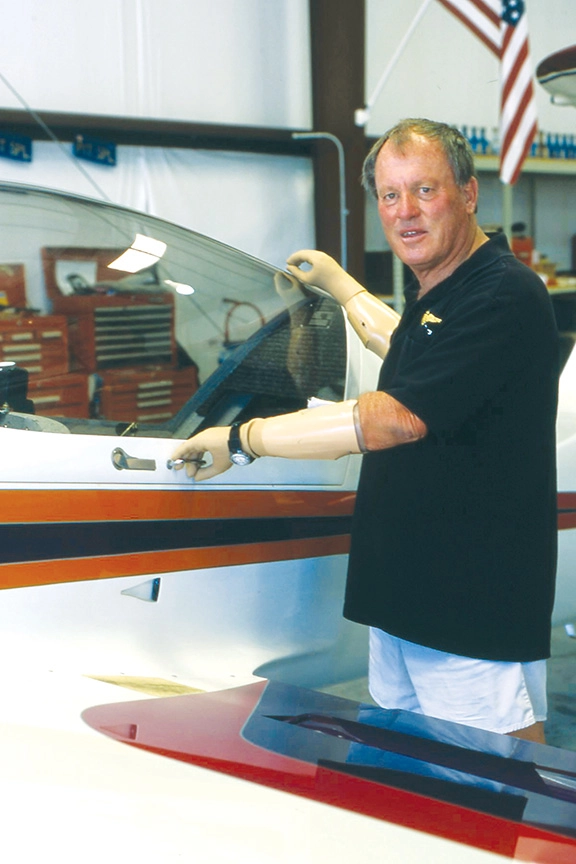
with myoelectrics. Photograph courtesy of Marti Smiley Childs.
She also had to deal with phantom limb pain, three revision surgeries, and 24 socket replacements along the way. “Work distraction is an amputee’s best friend,” she says.
“My amputation has made me even more aware of the value in what I do for a living,” she continues. As a result, her new goals include becoming a national motivator and teacher and continuing to improve the lives of people with disabilities.
Penketh’s life took similar leaps. He acquired sophisticated myoelectric hands in exchange for promoting them, became the first person certified to fly airplanes with myoelectrics, and got his pilot credentials back—but not the first-class medical clearance from the Federal Aviation Administration that’s required to command a commercial airliner.
Undaunted, Penketh, who is now retired from the Marine Corps and AirCal/American Airlines, bought an aerobatic airplane and competed in air shows, winning trophies. But it was a trip to South Africa for a convention that launched him into a new adventure.
He spoke at a school for children with disabilities, the Hope School in Johannesburg, and says that two little girls in the front row with huge smiles captured his heart. One had hands attached to her shoulders. The other had no legs.
When Penketh returned home to California, he contacted A Touch of Understanding (www.touchofunderstanding.org/home), a disability awareness group that aims to teach kids that a disability “isn’t funny or scary.” Penketh became a volunteer, and the organization became his new passion.
He developed its speakers forum and went into schools himself, eventually doing 1,500 presentations about disabilities to 45,000 mostly able-bodied children.
“Our kids are our future,” he says of his work teaching empathy and respect for those who are different.
“I never stop,” he muses, although he’s now semi-retired. “It makes me feel like I’ve accomplished something.”
Another man who found his vocation in finding his passion is Jason Green. Accomplishing something while making a living is what entrepreneur and positive rap artist Green is all about.
An amputee since age 9, when a lawnmower took his left leg below the knee, he creates furniture from “reclaimed, repurposed, recycled materials”—oak pallets and old wood such as fence posts. He sells his products through his company Rustic DECO (www.facebook.com/RusticDECO/info).
A year old, with more than 1,800 “likes” on Facebook, Rustic DECO grew out of Green’s longtime passion for woodworking. He’s promoted Rustic DECO through Craigslist, Facebook, and word of mouth, as well as through partnering and bartering. His first customer liked Green’s designs so much that he offered him a workshop in exchange for fix-up help.

of Rustic DECO/Jason Green.
Green’s business plans include using New York state tax breaks and grant allotments for entrepreneurs with disabilities.
“I’m building a brand and a prosthetic leg doesn’t give me any less of a chance,” he says.
The son of an entrepreneurial mom and an IBM fifth-level manager, Green grew up in a 27-room Victorian in New York State and helped with renovations. The family had 11 children—six adopted, including Jason. “When I was 14, I built my own room to my own design, using old furniture from the basement,” he says.
“We can make this world a better place by using our skills to recreate what is already here instead of throwing it away in a landfill…,” he writes on his Rustic DECO Facebook page. “There is a way to make this world a little cleaner and brighter, and I have found it with my labor of love,” he explains further via email.
Each of these amputees recognizes the challenges job seekers and entrepreneurs face and the extra effort required of those with disabilities. They have also demonstrated, however, that limb loss doesn’t necessarily have to relegate a person to unemployment or any low-level job that he or she can find. They—along with many other amputees who are police officers, firefighters, stuntmen, models, and actors—have proven that there is still the opportunity to follow one’s passion after limb loss.
Amputees who want to return to the workforce need to be determined and get support, says Asch-Martin. “Go to amputee groups. Don’t give up or bemoan your lack of skill. You can go to any employment office and get advice and skills training.” State Vocational Rehabilitation offices (http://1.usa.gov/1qdcBND) and Independent Living Centers (www.virtualcil.net/cils) in particular offer a wealth of services for people with disabilities.
If you want to start a business, Asch-Martin advises, “Find the cheapest possible way to do things, and put yourself out there.”
Green also touts networking and watching your spending. “Always use your money to make money,” he says. And when your limb hurts, he further advises, “Sit down and do marketing.” Use that downtime for creative thinking for your business, for research.
Making connections is an important part of networking and reaching potential customers, investors, or colleagues. In any new endeavor, making eye contact and making friends is important, Penketh says. When doing outreach, “I want people to look at me. I speak to them.” It works.
While it might take guts and grit to find and do the type of work you really aspire to, the joy it brings can be well worth the effort. Finding your passion is the first step. Once you’ve done that, make a plan and find out what all is available to help you succeed. Then give it all you’ve got. If you follow your passion, an exciting and successful career could be just around the corner.
FOR MORE INFORMATION
- Mike Penketh autobiography: Within My Grasp (www.editpros.com/bookshelf/within_grasp.html)
- Mike Penketh documentary: Out on a Limb Part I and Part 2 (www.youtube.com/watch?v=rSa_mfI6INQ and www.youtube.com/watch?v=g4iCgVOS8r4)
- Cindy Asch-Martin video: Can’t Is NOT a WORD! (www.youtube.com/watch?v=DbR2K3yi5dQ#t=52)
- Jason Green rap song: The World (http://bit.ly/1pGiBRb)
- Small Business Administration (SBA) Business Development Centers (www.sba.gov/tools/local-assistance/sbdcbusiness)
- SBA page for people with disabilities (www.sba.gov/content/people-with-disabilities)
- Job Accommodation Network (http://AskJAN.org)
- Amplitude’s Guide to Living With Limb Loss. Order your copy today at livingwithamplitude.com.