
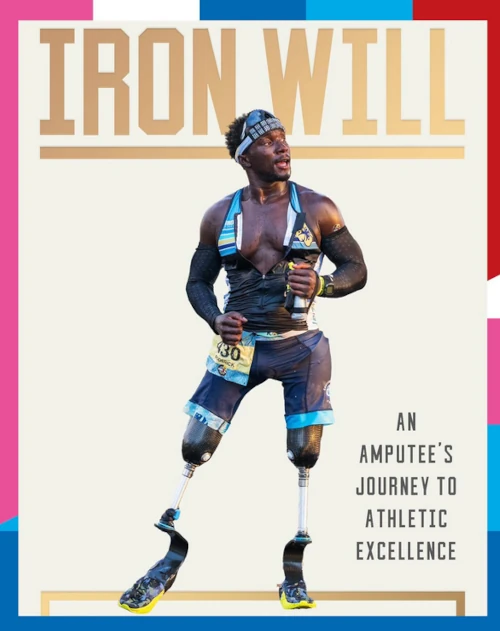
Roderick Sewell has lived what most would call an impossible story. Born without tibias in both legs, Sewell underwent bilateral above-knee amputation at just two years of age and grew up facing multiple obstacles, including childhood poverty and homelessness. Yet with his mother’s unwavering encouragement, Sewell learned how to walk, run, swim, and eventually soar on a global stage. In 2017 he won a bronze medal at the World Para Swimming Championships. Two years later, he became the first bilateral above-knee amputee to finish the Ironman World Championship.
Those experiences form the core of Sewell’s new memoir, Iron Will: An Amputee’s Journey to Athletic Excellence. The book is a natural extension of his current work as a coach, mentor, and powerful voice for marginalized athletes and people living with disabilities. Writing Iron Will gave him a new perspective on his own journey, from the sacrifices his mother made, to the water that became his sanctuary, to the importance of representation in sparking possibilities for people with disabilities. “If my younger self could see me today,” Sewell says, “he’d be in awe.”
Sewell sat down with Amplitude to talk about the book and reflect on some of its takeaways for readers with limb loss. Our conversation has been edited for readability and length. You can order a copy of Iron Will from Indie Bound.
Why is now the right time to share your story, and what was the catalyst for it?
I remember a time when my mom and I were staying in the shelters, and something happened. I can’t remember what it was. I was maybe 10, and I just saw her shoulders drop, her head drop, this sadness came over her. She looked at me and said, “I want you to remember all of this. I want you to write this stuff down, because you’re going to use this in the future. You’re going to tell your story in the future.” This is right after the time we saw The Pursuit of Happyness. We were in the middle of our worst when we went to see it, and my mom and I just made hard eye contact during some of those scenes. That’s when it clicked for her that I needed to remember all of this and write it down. I never took the time, but once COVID came around and I had just finished the Ironman, the world just stopped. I had a lot of time to myself and thought, “This is the time to get everything down.”
When you began to write your story, was there something you discovered about yourself, or a moment when you saw your story in a new way?
It was definitely a perspective of, “Wow, I’ve lived, you know?” I’ve got something I can tell my kids. That was exciting, especially because it’s unexpected for somebody like me. I know a lot of people who, when confronted with living with a disability, it stops them from living life.
That sense of having truly lived connects to one of the most powerful themes in your book: representation. For you, representation isn’t about just being seen; it’s about sparking that inspiration. You write, “If you can see a thing, you can be a thing.” What could your story offer to someone out there who is searching for a sense of possibility within themselves?
It’s something I’m personally dealing with, understanding that the mind, body, and soul have gone through so much just to get to this point, which has allowed me to appreciate the little things. I’ve had people walk up to me in tears over this book, and people telling me they would commit suicide if they had to live in my same situation. Hearing that, what I really hear is what people do not appreciate in their mind, body, and spirit. Somebody who would give up, that’s somebody whose mind, body, and spirit are not being catered to, whether it be by family, friends, an external source, or an internal source. Can they appreciate the life that they even have now to the point where, if they lost something, they would still want to live? For some people, it takes a loss to realize they do want to live and appreciate every part of life. Many people are living without the rights and resources we take for granted here. That’s a hard life, you know? And there are a lot of people whose rights or resources are now being taken away. I hope this book can ignite that fire within and remind people to take every opportunity to make something of their lives.
Your book opens on the day that you were born, the same day the Los Angeles riots erupted after the Rodney King verdict. You write: “I don’t know which is the bigger challenge to overcome, being a dark-skinned black man or a double amputee.” Do you feel the conversation around race and disability is shifting?
I think both conversations have gotten better, but if I had to choose, I’d say disability is the one with more room for discussion. Even for me, living with a disability, I don’t understand everybody and their struggles and what they’re going through. So I have to be brought to awareness about what it’s like for somebody who’s a little person, somebody who is paraplegic, and these are visible disabilities. The neural, invisible disabilities are a whole other thing. So I had to become aware that everybody has their own version of a hard day or struggle. And thankfully, it’s gone away from inspiration porn. It was going downhill for a while, but we’re moving more into discussions around, “This is what I need. These are the rights that I need,” which I love.
Now, when it comes to being black in America, I feel like there’s more of a grace if I say, “I have a hard time walking upstairs,” versus if I say, “Because of redlining, we’ve been forced to live in these conditions.” People are more willing to hear me on a physical problem than on a systemic issue. The grace is there for one and not always present for the other. I can come out and talk about my disability, and have somebody who will listen. But I don’t feel that same comfort when I, for example, say my grandmother was living as a sharecropper, and telling people this was not too long ago. So it’s tough, but that’s where the importance of community comes in. That’s where you can create space to have these conversations. And even if someone isn’t understanding of what you’re feeling, you’re not disowning your own emotions; you’re not pushing that to the side.
The discovery of swimming was a turning point for you, not just physically but emotionally. You writee: “In the water, I’m not disabled. When I’m competing, I’m strong, I’m powerful. Swimming has given me something I didn’t realize I would appreciate so much: a chance to connect with myself.” I’m wondering, did swimming give you a new identity, or did it bring out what was already inside of you?
That is a great question. I want to say it was always there. I didn’t get involved with adaptive sports until I was seven or eight years old, trying all these different sports, and then being exposed to the one I was most afraid of—swimming—and falling in love with it. I was terrified of the water, but once I was able to swim 25 yards by myself, that was it. I thought, Now I love this. Now I don’t want to get out.”
Everywhere I saw water, I’d go jumping in, and it would scare people because they assumed I didn’t know how to swim. They’d see me take my legs off and think, “Oh my God, what is he doing?” But then they’d realize I was just at peace, having fun. Swimming completely turned my life around. Even though I’m retired [from competitive swimming], I never let too much time go by without being in a pool or open water. It’s the way your body feels afterwards, the sense of accomplishment, and knowing you still have the whole day ahead of you. It’s something I want to do for the rest of my life. It’s changed my life completely.
As a coach, is there a piece of advice or lesson—maybe from your own training—that you often pass on to the athletes you work with?
I mentioned in the book how I felt at times as if the water was holding me. I feel like there’s this mentality that as soon as you jump in, the water’s taking you down without understanding that our emotions, our actions, are doing that. People start flailing out of fear instead of realizing the water will hold them. A friend of mine recently put it into perspective in a way that made me even more curious about what it means for me to get back into the water and why I was able to overcome my fear of it. She likened the water to going back to your mother’s womb. It’s automatic comfort and release. The water gives you everything you need to move forward; it’s holding you, not dragging you. It’s cradling you.
One of the most striking threads in your book is how the mirror shows up at two very different stages of your life. As a child, your mom would hold you up to the mirror and tell you how handsome and smart you were, instilling in you a sense of confidence you didn’t yet see for yourself. And in the weeks leading up to the Ironman, you created your own mirror ritual—smiling at yourself, visualizing the finish line, seeing your mom waiting there with open arms. When you look in the mirror now, what do you see looking back at you?
When I think about my younger self, I automatically smile. If my younger self could see me today, he’d be in awe. It makes me emotional to think about because I was looking for that example. If I saw a double above-knee amputee, a black male just like me, crushing it, I would have been very moved. I would’ve thought, “I can do anything.” That’s where the smile comes from. And when I think about accomplishments up to now, especially knowing my disadvantages, I can hold my head high.