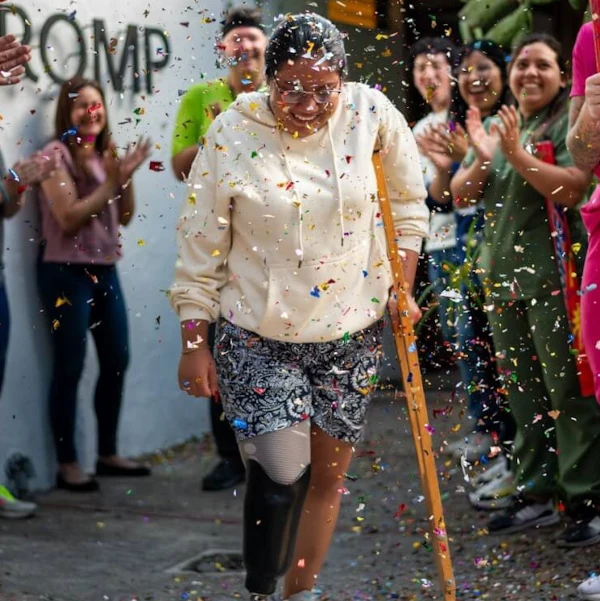
The Range of Motion Project’s annual contingent of Cotopaxi climbers will start up the hill in a couple of weeks. As always, the expedition (now in its 11th year) features some high-profile figures in the limb-loss community. If you haven’t picked out someone to support, here’s how to do it.
But Cotopaxi isn’t the only mountain ROMP is climbing these days. It’s not even the highest. The organization has spent much of this year mapping out some new long-range objectives. The effort has culminated in a new strategic plan that sets some ambitious goals for the limb-loss community—goals that are every bit as lofty, and as hard to reach, as a stratospheric Andean summit.
They all point toward a day in which every amputee—regardless of income, insurance, geographic location, or other circumstances—can get a high-quality prosthesis accompanied by comprehensive rehabilitative care. ROMP has been refining that model for 20-plus years in Ecuador, Guatemala, and the United States, with tremendous success. Under its new strategic vision, the organization wants to scale up that model and export it to countries around the world. And it has teed up a suite of concrete initiatives to start making it happen.
“Anesthesia made its debut 175 years ago,” says Jonathan Naber, who earlier this year succeeded co-founder Dave Krupa as ROMP’s executive director. “We look back and think, ‘How could anyone ever submit to an operation without anesthesia?’ Around that same time, physicians began washing their hands when delivering babies, and we look back and think: ‘How could a physician help a woman through childbirth without washing their hands?’ Both of these changes brought great improvements in people’s survival, comfort, and quality of life. If we look back from where we are in 2025, it’s hard to imagine how people ever lived without these things.
“I want us to look back on 2025 someday and think: ‘I remember when amputees couldn’t earn a living, support their families, or integrate into society because they didn’t have access to prosthetic care. How did people ever live without having that access?'”
That metaphor gave rise to the strategic plan’s campaign banner, “Immobility Is History.” It encompasses a suite of innovations designed to decentralize care delivery points, broaden distribution, and leverage digital technologies and community partners. All of those changes (and then some) will be necessary to serve the millions of amputees worldwide who currently don’t have access to adequate prosthetic care.
The core initiatives are set to roll out in early 2026, but the “Immobility Is History” messaging effort has already launched. Naber is hosting a round of stakeholder meetings this month to share details about the way forward, and to explain how you can get involved. The last of those takes place this coming Saturday, September 27. If you’re interested in attending, you can still register at this link.
We attended the September 20 meeting and followed up with Naber afterward to gain some clarity about “Immobility Is History.” Here’s a brief summary of the new summit ROMP has in view—and how it intends to get there.
Rapid Socket Technology
ROMP is partnering with Amparo to deploy an innovative socket-fabrication system that’s based on thermoforming. A well-developed technology that’s already in use across much of the world, thermoforming sharply reduces the socket-build timeline while expanding convenience and flexibility for patients. It has been used with success in Ukraine, Gaza, and other settings experiencing high demand for prosthetic care. It’s compatible with mobile clinics (see below), making it a good fit for rural communities and patients who lack access to transportation. “This is a proven system that’s already certified for market distribution,” Naber says. “It allows us to cast, fabricate, and deliver a socket in a couple of hours, instead of needing multiple visits over a period of weeks. It’s relatively inexpensive, and it can be used with multiple liners and suspension systems.
Another key advantage of thermoforming is that it enables a socket to be reshaped in response to changes in an individual’s residual limb. “You don’t have to get a new socket made to keep walking,” Naber says. “The prosthetist can literally heat it up, reform it, and you can keep going. That’s another way it creates a major efficiency.”
Mobile Clinics
Geographic and transportation barriers also create major bottlenecks in the delivery of prosthetic care. That’s especially true in ROMP’s Latin American service areas, but the organization has greatly reduced those impediments through the use of mobile clinics. “We send them out strategically to places where we have concentrations of patients, so we’re able to see clusters of patients in a single week, rather than trying to coordinate each of them coming to the central clinic, one by one, for multiple different appointments. It’s way more convenient for our patients, and it’s a much more efficient way for our care teams to work.”
Digital Technology
ROMP employs a holistic care model that doesn’t end with the delivery of a prosthesis. Naber explains. It’s not just about replacing a lost limb; it’s about reactivating the life narrative that was disrupted by amputation, including social connections, work opportunities, and individual identity. Along with their device, ROMP patients receive weeks of rehabilitative care that includes PT, OT, mental health counseling, and other services. They’re all essential to helping amputees adapt successfully to prosthesis use, but they’re also time- and labor-intensive activities that are difficult to scale up.
ROMP’s Movili App looms as a key tool in expanding the holistic care model to a larger number of patients. This intuitive, phone-friendly interface can be used by mobile clinicians, local health workers, family caregivers, and amputees themselves to ensure that consistent, effective, step-by-step protocols are followed at every phase. All data gets stored in the cloud, so that when the OT arrives for a visit, they can read the prior notes and instructions left by the mobile prosthetist, physical therapist, and so forth. The app can also be accessed by case managers at the central clinic, creating a seamless continuity of care over time and across geographic distance.
“We can pretty easily adapt the app and share it with other organizations that have patients around the world.” Naber says. “A lot of organizations worldwide are interested in bringing the app into their setting to empower their community health workers and their patients.” Could the app be used in US communities that lack convenient, consistent limb care? “Absolutely,” says Naber. “We’re interested in spreading the app and the model wherever it’s needed, whether it’s in rural Guatemala or Pakistan or South Africa or the United States.”
Prosthetic Recycling
It would be prohibitively expensive to provide each patient with a brand-new prosthesis. Therefore ROMP has long relied on recycled components donated by clinics and individual amputees in the United States, Canada, and other developed nations. It has built up an impressive operation, but Naber believes there’s a ton of untapped potential. “Part of it is just awareness,” says Naber. “We routinely run into people who don’t know they can recycle prosthetic components, don’t know how to do it, or think it’s not allowed at all. So we need to change mindsets regarding prosthetic recycling.”
At the same time, ROMP will start setting up a nationwide network of regional recycling centers. At present, most of its recycling volume runs through ROMP’s central collection and distribution point in Denver. A broader network will create more visibility for prosthetic recycling, while also cutting costs and increasing efficiencies.
Funding New Growth
Expanding prosthetic care on the level ROMP envisions will take a commensurate expansion in money and other resources. “It’s not just going to require an incremental increase,” Naber says. “We’re going to have to tap into resources we’ve never tapped in an effective way.” That includes mobilizing amputee populations in the developed world, especially those who are fortunate enough to receive good prosthetic care—and who know how impactful it is. “We’ll be creating ROMP chapters throughout the United States to empower advocates who are genuinely interested in helping,” says Naber. “We’ve already started working toward that. We’ll also be working to increase our corporate partnerships and social responsibility partnerships.” The company is planning events in Chicago, Philadelphia, Austin, and other cities to recruit volunteers and raise awareness. And no matter where you live, you can set up a monthly donation (as low as $15/month) to support ROMP services and programs.
“We’re trying to build a public health movement,” Naber says. It won’t happen overnight. But the long-range vision is to build a future in which immobility is a thing of the past.