
Last weekend, in a historic first, America’s top Paralympic athletes shared the stage with their nondisabled peers at the Outdoor & Para National Track and Field Championships. Held at Hayward Field in Eugene, Oregon—aka “Tracktown USA”—it was one of the nation’s largest showcases for disability sport in this century, and a compelling sneak preview for the 2028 Paralympics in Los Angeles.
It also marked the culmination of many years’ worth of advocacy by Paralympic athletes. Since the early 2000s, they have been lobbying to compete in venues that put their talents and their sports on full display. Throughout that time, they’ve shared training facilities, coaches, sports agents, and sponsors with their Olympic peers. But when national championships and Olympic/Paralympic trials roll around, the nondisabled athletes have been sent to big-league venues, while the disabled athletes have been shipped off to remote, subpar facilities.
Things began to change in 2023 when a group of Paralympians filed a formal grievance against the sport’s governing body. That produced significant upgrades for the 2024 US Para Nationals and Paralympic Trials, and it accelerated momentum toward unified governance over the nation’s Paralympic and Olympic track programs.
“This should have happened a long time ago,” Ezra Frech, one of Team USA’s brightest Paralympic stars, told Amplitude at Hayward Field last weekend. “But that’s water under the bridge. I’m glad it’s happening now. People are taking steps in the right direction to include Paralympics at the highest level of track and field, as it should be. Let’s make sure that we keep amplifying Paralympic track and field these next few years to LA and beyond.”
The weekend’s competitions determined who’ll represent Team USA in next month’s World Para Athletics Championships (see the roster). Here are five amputee athletes who stood out on a glorious weekend.
Derek Loccident
Earlier this year, without much fanfare, Loccident became just the second paraathlete to eclipse 8 meters in the long jump. He joined the legendary Marcus Rehm, who hasn’t lost a competition in more than a decade—and his pursuit of Rehm is already among the most compelling storylines of the upcoming Worlds. “I can’t consider it a rivalry until I beat him,” he told us. “This will be my third world championships in three years. I’ve gone against him three times already, and got second each time.” His best jump at the Nationals would have surpassed eight meters, but Loccident launched a foot or two before the end of the runway, resulting in an official mark of 7.90. “My goal going into this meet was an eight-meter jump, and that would have been the one,” he says. “It would have been around 8.30. But I knew before they even put [my distance] up that I took off behind the board.” To put this into perspective, 7.90 would have placed 7th—out of 16 competitors—in the able-bodied long jump last weekend.
Miguel Jimenez-Vergara
For our money, the single most entertaining event of last weekend was the men’s 5000 meter wheelchair race in classification T54. Vergara-Jimenez, a bilateral amputee who was seeking his first Worlds roster spot, jockeyed for position over 11 laps with four other world-class racers, including Paris gold medalist Daniel Romanchuk. He launched his final attack at the start of the bell lap, opening a gap on Romanchuk and leaving the rest of the field in his dust. They came down the stretch neck and neck, and Romanchuk took it at the wire by a tenth of a second. Unfortunately, none of the men’s T54 racers qualified for a Worlds roster spot. But Vergara-Jimenez wasn’t complaining. “I want there to be so many competitive racers in the US that it’s a six-man tie in the 5000, pushing it to the wire like we did just now,” he told us. We’re bullish on Vergara-Jimenez’s chances to make the Paralympics in 2028.
Arelle Middleton
A silver medalist in last summer’s Paralympics at just 16 years old, Middleton has added nearly a meter since then to her distance in the shotput. Her best throw last weekend traveled nearly 13 meters, a distance that would have easily won gold in Paris. Reclassified from F64 to F44, she’ll head to Worlds as the favorite to top the podium and a legitimate threat to set a world record.
Violet Hall
At last year’s Nationals, an unheralded high-school runner named Korban Best came from out of nowhere to earn a Worlds roster spot. This year, the same feat was performed by Hall, an all-state performer from Indiana. She stunned the crowd by outrunning five-time Paralympic medalist Brittni Mason in her signature event, the 200 meters. Her time of 25.47 ranks as one of the fastest anywhere in the world this season. Best went on to win silver last year at both the Worlds and the Paralympics. Can Hall repeat the feat?
Hunter Woodhall
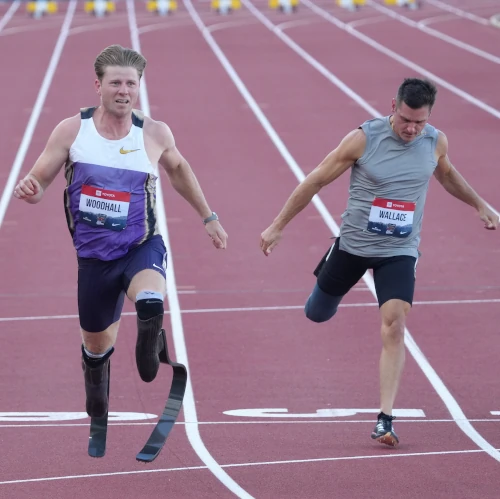
Although he couldn’t quite break his own world record in the 400 meters, Woodhall still gave the fans their money’s worth. He ran just a tick shy of his world record time in the 400, finishing at 45.79 seconds (.09 off the pace). He followed that up by taking a thrilling 100m race against a packed field that included three other Paralympic medalists, winning in a torrid 10.76 seconds—which would have been good for silver at the Paralympics last year. “Once I won in the Paralympics, it took a weight off,” he says. “Now it’s just like, Why am I doing this? And the answer is, because this is what I love to do, and this is what I’m passionate about. It’s so much less now about proving anything to anyone, and more about just seeing how far I can go and really enjoying the moment I’m in.”