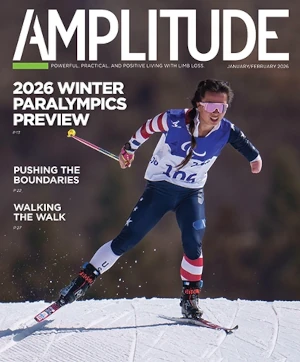

Whenever we publish a Paralympics special edition, once every two years, we hear a familiar chorus from some of our readers: “This doesn’t feel relevant to me.”
It’s an understandable response. Most amputees aren’t elite athletes, and many can’t engage in sports on even a casual basis, for reasons that include health complications, lack of nearby adaptive sports programs, and the prohibitive cost of athletic prosthetics.
As a result, many of you have told us stories about world-class competitors don’t address your own experience. Some of you have told us that such stories give a distorted impression of the amputee community, because they focus on people who are younger, healthier, more active, and more privileged than the average person with limb loss or limb difference. Others feel the Paralympics already get too much coverage, at the expense of other stories that deserve equal (or greater) attention.
If that’s where you’re coming from, we hear you. We acknowledge the truth in those critiques. But we also believe the Paralympics offer a unique opportunity to tell stories that need to be told.
First and foremost, the Paralympics depict limb loss in a light that most Americans have never seen. Millions of people will see amputees exhibiting speed, grace, strength, power, competitive fire, and—above all—joy. They’ll get to hear directly from amputees (both competitors and commentators) and find out that they’re normal people whose lives aren’t that different from those of people without disabilities. NBC will provide more than 250 hours of live coverage over its broadcast, cable, and streaming channels, reaching an aggregate audience of several million viewers. No other event offers a comparable opportunity to educate the public about limb loss and disability.
In addition, the Paralympics influence social attitudes about accessibility. Business and government leaders are slowly recognizing that investments to promote disabled people’s independence yield benefits for the whole community. The last decade has witnessed encouraging trends in insurance reform, adaptive fashion, disability employment, media representation, and assistive technology. All those developments have built upon the momentum generated by the Paralympic movement and, more broadly, the parasports movement.
At the end of the day, we view the Paralympics as way more than a sports story. We view it as an advocacy story—one with a huge audience and a global platform. While we appreciate the athletes’ achievements in the arena, we think their social and cultural impact is even greater.
Not everyone will agree with us on that, so we’ve made sure to balance our Paralympic content in this issue with articles about lots of other subjects, including AMI surgery, amputee prosthetists, 3D-printing, clinical trials, and legislative initiatives. So we hope you’ll find something to pique your interest, no matter how you feel about the Winter Games.