
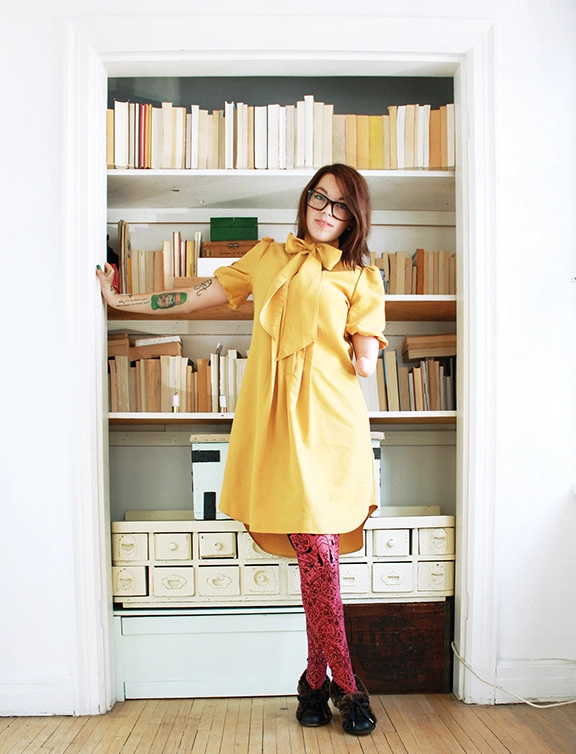
Image by Allison Andersen.
To someone facing a trauma or serious illness, becoming an amputee may feel like the end of everything familiar. To parents, imagining their child going through life missing one or more limbs seems like a worst-case scenario.
But amputation isn’t only about what was lost. Many amputees are able to realize what they have gained from their experience.
Nadine Richards, a congenital multiple amputee, says that she had a “pretty regular childhood.” She learned her own way of keeping up with her two older siblings.
“You just have to keep in mind that there are worse things,” Richards says. “You’re living, you’ve got people who love you, and there are people who will support you. If you can see that there is a light at the end of the tunnel, you’re going to succeed.”
Life-Changing Experience
A year and a half ago, when Adrian Grajeda was just 10 years old, a drunk driver crashed through his schoolyard fence during recess, sending metal debris into the back of Adrian’s leg as he tried to run away, virtually severing the limb. By the time he was airlifted to the hospital and then transferred to a children’s hospital an hour away, he had lost a great deal of blood. Although the doctors immediately began a blood transfusion and emergency surgery, they were forced to amputate his leg below the knee.
Despite the dramatic circumstances, Adrian simply views his amputation as something he’s experienced. It was unfortunate, but it hasn’t prevented him from being the same kid he was before the accident, and accomplishing even more than he ever imagined.
“There’s always worse in other situations,” Adrian says. “It’s going to get better sometime. You have to think about the positives and what good things could happen as part of the outcome of the bad things.”
Instead of despairing over her son’s new lot in life, Brandy Grajeda has embraced it. She created a Facebook page, Team Adrian Grajeda, to keep track of his life as a “little local celebrity.”

Image by Brandy Grajeda.
“I know it sounds weird, but it’s like it was meant to happen to him,” Brandy says. “We figure he’s going to do really good things. It’s kind of like God’s plan.”
No Regrets
In 1972, Jim Haag’s life took an unexpected turn when he suffered an accident at work. He was moving electrical wires at a mobile home in Montana when one of the wires leaned against a 7,200-volt line and the electricity ran through the cable he was holding and into the ground—using his body as a conductor. The incident left him with third-degree burns over 45 percent of his body, and he underwent amputations of his left arm at the wrist, his right arm about four and a half inches below the elbow, and about a quarter of his left foot, where the electricity exited.
He spent nine months in physical and occupational therapy, which helped him learn to build his new life. His occupational therapist was integral in that process. In addition to teaching him to use his temporary prostheses, she also showed him a film of a bilateral below-elbow amputee who was able to dress and feed himself, drive a car, and fly an airplane. He says that this example of a successful person with the same amputation “was a real eye-opener” for him.
“I grew up on a farm in North Dakota, so I have a high level of mechanical aptitude. I could see myself learning how to use [the prostheses] as a tool and pulling through,” Haag says. “And that’s what I did.”
The first three years after his accident were a struggle, as Haag learned how to do things on his own and how to be comfortable with his prostheses. But he’s since taken off and has not slowed down. He worked in the trucking industry, including driving over the road trucks and teaching truck driving, for more than 22 years; received a bachelor’s degree in social work; and worked as a social worker for a number of years. He also volunteered as a peer visitor for the Amputee Coalition.
Along with all that, he’s the oldest in a family of nine, and is kept busy with his own nine children and step-children and 14 grandchildren. He and his wife enjoy attending car shows and traveling, unhindered by his amputations.
Haag says that he doesn’t have any regrets about his life, other than his first two marriages ending in divorce. But he says that he and his children have made the best of that situation, and he has made the best of his physical situation. His accident and subsequent amputations haven’t defined him. In fact, he says he has accomplished more than he ever thought was possible.
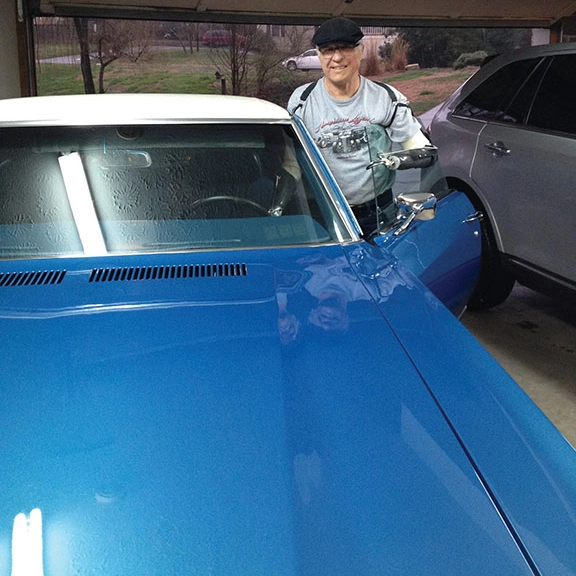
Image courtesy of Jim Haag.
“I feel good about what I’ve accomplished personally,” Haag says. “At 65, I’m thinking, ‘how could all these years have passed by so quickly?’”
Renewed Purpose
Tragedy struck Raissa Laurel-Subijano when she lost her legs in the 2010 Philippine Bar Exam bombing in Manila. She was there to support friends taking the exam and to take part in the festive atmosphere, but she was injured in the hand grenade explosion and spent the next six months recovering.
“I didn’t know that day would change everything in my life,” Laurel-Subijano says. “But I believe everything happens for a reason. It does not mean that when a person loses a part of his or her body, it makes him or her any less. Life goes on.”
And her life has gone on.
“After four years of being an amputee, I feel like a normal person because of my faith, help of the proper assistive technology, and my determination,” Laurel-Subijano says. “I remember that first time I tried to stand using my training prostheses. It was hard because I didn’t know where my center of gravity was.” But with the help of her doctor, physical therapist, the Nippon Foundation, a nonprofit organization that focuses on humanitarian outreach, and Exceed, a non-governmental organization created to empower people with disabilities, Laurel-Subijano was able to receive the proper prostheses and rehabilitation.
Now she can participate in physical activities again like running, boxing, working out, and driving. In addition, “being an amputee is not a hindrance to pursue my dream of becoming a lawyer,” she says. At the time of writing, she was scheduled to graduate from law school in April.
And that’s not all—the incident has opened doors for her to share her story as a motivational speaker and advocate for people with disabilities in the Philippines. In September 2013, she was given the honor of sharing her experience at an event about assistive technology during the United Nations High-Level Meeting on Disability Affairs and Development in New York.
Unlike Laurel-Subijano, Richards has known no other life than the one she leads now. “I was so young [that] I learned how to walk on prosthetics,” she says. “The way a kid learns how to be a kid, that’s what I learned on prosthetics.”
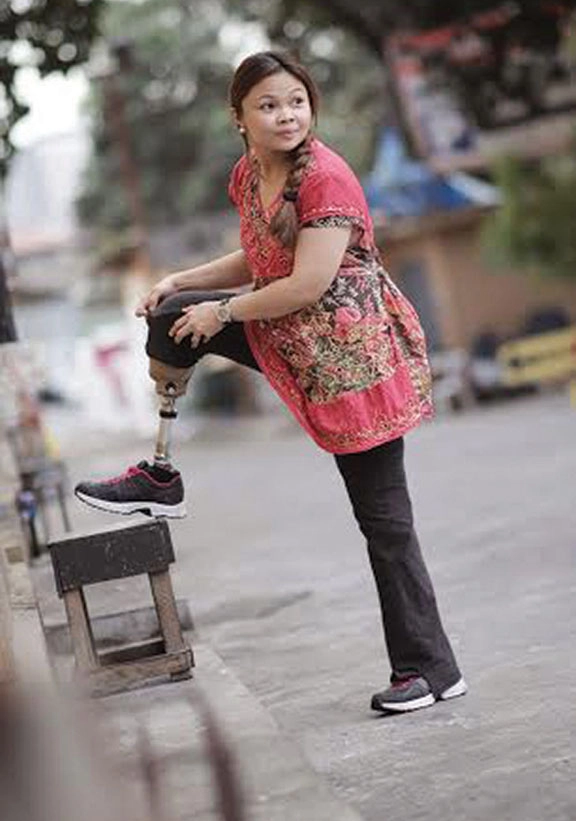
Image by Derek Yee.
Despite her struggles growing up—missing her left arm at the elbow, with just three fingers on her right hand, and with clubbed feet that her parents opted to amputate below the knee when she was a month old—she has used her experiences to motivate others. She recently modeled custom prosthetic leg covers for Canadian-based ALLELES Design Studio, an experience that boosted her confidence and served as an inspiration for aspiring amputee models around the world. A member of the War Amps of Canada since she was a year old, she often speaks to groups to raise awareness about amputees, to let people know that amputees are not “aliens.”
“I think if we can all find the confidence in ourselves, it would be such a happier world,” she says.
Just the Beginning
The overwhelming message from each of these amputees is that people should look for the possible positive outcomes from every situation.
It’s possible that everything does happen for a reason. Brandy believes that the tragedy that affected Adrian and their family served a specific purpose. “He was the only child injured on that playground, and there were over a hundred kids [there],” she says.
Since his amputation, Adrian has not only persevered in school, in athletics, and in his own life, he has served as an example to countless other children and people all over the country who have followed his story.
Adrian has mentored a few recent amputees, including a boy from his school who became an amputee after a bacterial infection.
“There were no amputees here…so [Adrian] helped the kid and now they’re friends at school,” Brandy says. “It all fits together, like a puzzle.”
Regardless of the situation, “the number one thing to remember is that you’re still alive,” Brandy has taught Adrian. “Every time something bad happens, think about what’s good about it, and don’t give up. You can’t give up.” And possibilities are endless. Richards has high hopes for the future of available technology for amputees. “It’s like being a bionic human. Who knows? In the future I could probably turn half-robot with the robotic arms and legs that they’re going to have,” Richards says. “We’re going to be capable of everything.”
By Stephanie Zultanky