
After an accident changed his childhood hockey dreams, Zabelny found a new way to the ice—and to Team USA.
WORDS Mary Elizabeth Frandson
The game was over, but Bill Zabelny wasn’t ready to leave the ice.
His first win in international competition had already given him plenty to remember: pulling on a Team USA jersey, playing against some of the best standing amputee hockey players in the world, and seeing the scoreboard settle in his team’s favor.
Then came the anthem. Zabelny stood on the blue line as “The Star-Spangled Banner” filled the rink. Across the ice stood the team he and his teammates had just beaten.
It was a long way from the rink where he had first learned to play at age five, and even further from the moment, seven years later, when the childhood dream of becoming a professional hockey player suddenly seemed much less certain.
Zabelny was 12 when he was struck by a car while delivering newspapers. His injuries resulted in the loss of his right leg. For a kid who had already spent much of his young life on the ice, the accident raised a question that reached beyond learning how to walk again: Would he ever skate again? He would, but he would have to teach himself how.
Nearly three decades after the amputation, standing on that blue line in a Team USA jersey after an international victory, the significance of the moment was difficult to put into words.
Almost.
“Nothing feels better than having your opponent listen to your anthem,” Zabelny says with a grin.
It’s an understatement to say Zabelny loves hockey. He loves the friendships, the locker room stories, and the feeling of a perfectly executed play. He loves watching someone make an extraordinary save. He loves the challenge of a game that demands strength, agility, skill, and smarts every time a player steps onto the ice.
But make no mistake: Zabelny also loves to win.
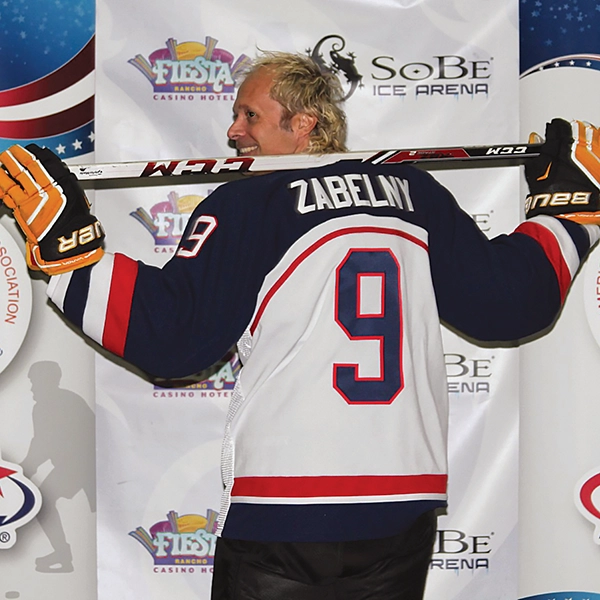
That competitive streak eventually took him around the world as a standing amputee hockey player for Team USA, earned him four silver medals, and produced moments the hockey-loving kid he once was could scarcely have imagined.
“To be able to compete for Team USA has been the most exciting, humbling, unexpected period in my life,” he says.
Standing/Amputee Hockey is recognized by USA Hockey as one of its disabled hockey disciplines. It is played upright and largely follows the rules of traditional ice hockey; athletes with congenital or acquired amputations and other physical impairments may use prostheses to skate or control a stick. For Zabelny, it offered something even more fundamental: the chance to compete without being treated differently as an amputee.
“With standing ice hockey, I can compete with others without receiving sympathy,” he says. “I am treated as an equal.”
His road to that blue line began decades earlier, in a hockey-loving family where one brother skated, another never walked, and the kitchen floor sometimes doubled as a rink.
A Family Game
Hockey entered Zabelny’s life through his father, who wanted to share the sport with his three sons and daughter.
Zabelny began playing alongside an older brother three years his senior. Being smaller meant learning quickly how to survive against bigger players. For a while, his strategy involved going after the puck around their knees, earning him a childhood nickname, Kamikaze.
Eventually, getting knocked around by bigger kids persuaded him to reconsider the technique, but hockey was more than something the family played at the rink.
Zabelny’s brother Rob was born with muscular dystrophy and never walked. He loved hockey too. Inside the family’s kitchen, Rob would position himself in his wheelchair with a goalie stick while Zabelny and their older brother played with a rubber ball.
Zabelny and Rob, just a year apart, were especially close. They shared comic books and video games, and Zabelny remembers admiring his brother’s imagination. Rob made small clay figures and found satisfaction in what he could create and do rather than focusing on what he couldn’t.
“He made things that he could handle more important and relevant,” Zabelny says.
When their oldest brother left for college, Zabelny took over his paper route, partly to earn money for the family and partly, he remembers, to buy comic books for him and Rob. It was while working that route that he sustained the injuries that changed his life.
When he finally returned home from the hospital, he was in a wheelchair. Rob met him at the doorway.
“Get out of the chair because you can,” Rob told him. For Zabelny, those words became both challenge and mantra: Don’t waste the opportunities available to you. One of those opportunities was hockey.
Learning the Game Again
Getting back on the ice after amputation was hardly a given. Prosthetic technology was far different from what athletes have access to today. Zabelny describes his first hockey prosthesis as an exoskeletal leg with a SACH foot bolted to the bottom.
That was it, so he taught himself to skate with it.
His high school coach took a chance on him, too. Zabelny recognizes now that the coach could easily have kept him safely on the bench, technically part of the team, without giving him much meaningful ice time. Instead, he let him play.
Zabelny wasn’t necessarily the fastest skater, but he understood hockey. He could pass. He could shoot. He could stickhandle. He understood where to be.
“He may not be as fast or fleet-footed,” Zabelny recalls how teammates and coaches viewed him, “but he understands how to play the game.”
Eventually, Zabelny scored his first high school goal and added a couple of assists. His accomplishments earned him recognition in Sports Illustrated’s Faces in the Crowd and a silver bowl engraved with his name.
It became, he jokes, his Stanley Cup.
He continued playing club hockey in college, occasionally “retiring” from the game, only to be recruited back when another league needed a player. That provided an excuse for a retirement party. And then an out-of-retirement party.
Zabelny estimates he managed to repeat the cycle three or four times. The game wasn’t going to let him go that easily.
The Call
After college, Zabelny moved to Las Vegas, where he helped open the MGM Grand. Hockey remained part of his life, but standing amputee hockey wasn’t yet a world he knew much about.
Then, in 2001, the phone rang.
Scott Harrington, an amputee hockey player Zabelny knew of from Harrington’s time in Las Vegas, had become involved with the American Amputee Hockey Association.
“We know that you’re an amputee and you play the stand-up game,” Zabelny remembers Harrington telling him. “Would you want to try out?”
There wasn’t much to consider. It was an absolute yes.
At the time, Zabelny says, he knew of perhaps two other amputees who played ice hockey standing up with a prosthetic leg. Suddenly, he was being invited into an entire community of players.
The opportunity arrived at a complicated moment in Zabelny’s life. He had recently started a new job and was in a relationship. Then came September 11, 2001. In the weeks after the terrorist attacks, with the country still reeling and anxiety around air travel high, Zabelny had another reason to question whether he should make the trip to Boston.
Zabelny’s tryout was scheduled in Boston just a couple of months later. For a moment, he questioned whether he should go at all. But the opportunity to play for Team USA was one he wasn’t willing to let pass. So, he got on the plane.
That decision began his international career with Team USA.
A Different Locker Room
Joining other amputee players was an eye-opening experience for Zabelny.
Until then, most of his hockey life had unfolded alongside nondisabled players. Now he was entering a locker room filled with athletes whose experiences of disability could be both familiar and completely different from his own.
There were players with lower-limb amputations and upper-limb amputations. There were women and men. At first, Zabelny remembers, leg amputees tended to gravitate toward other leg amputees, while arm amputees did the same.
One of Zabelny’s favorite memories involves something as ordinary as baby powder. At the time, he used it to help keep his residual limb dry. One of his teammates, an upper-limb amputee from Minnesota, forgot his own and asked Zabelny if he could borrow some. The next practice, he asked again. And then again. Soon, borrowing Zabelny’s baby powder became something of a pregame ritual between the two players. Looking back, Zabelny sees something more in it. It was a point of connection. It meant they were ready to play.
The fundamentals were the same ones Zabelny had learned as a boy: skating, stickhandling, shooting, passing, and understanding the flow of the game. For Zabelny, few things compared with a perfect play. “The tic-tac-toe,” he calls it. One player finds another. That player finds someone else. Everyone sees the play developing at once.
Whether Zabelny ended up with the goal or the assist almost didn’t matter. The puck always seemed to find the net.
Playing for Team USA in international competitions gave Zabelny opportunities he had never imagined when he was teaching himself to skate again.
He traveled through Europe. He scored goals and recorded assists. He earned four silver medals. There were moments when a goaltender made a spectacular save and moments when a play unfolded exactly as everyone on the ice hoped it would.
And then there were experiences that had little to do with the scoreboard. Like his first autograph.
Someone actually wanted his signature. For Zabelny, it was a humbling experience.
“To be able to compete for Team USA has been the most exciting, unexpected period in my life,” he says.
But one of the memories that has stayed with him most vividly came not from scoring or winning, but from seeing what the players on another team didn’t have.
Team USA and Team Russia were sharing transportation back to the area where the players were staying during an international competition when Zabelny began noticing the condition of some of the Russian players’ equipment.
Some items were taped together. Socks had holes.
Team USA wasn’t exactly flush with resources itself. Zabelny remembers operating on a shoestring budget, with people involved in the program sometimes contributing their own money to help make international competition possible. Still, Zabelny and Harrington realized they had equipment and prosthetic supplies they no longer needed. They looked at each other. Why not give it away? The two brought the idea to their teammates. If there was something they weren’t using anymore, something that might help another player, they could give it to Team Russia. And that’s exactly what they did.
The next day, conversation wasn’t really possible. The American and Russian players didn’t need to share a language. Some of the Russian players pointed to what they had received and gave them a thumbs-up.
“It speaks for itself,” Zabelny says.
For someone who had always loved the competitive side of hockey, the moment revealed something else about what it meant to compete.
“It wasn’t about competition anymore,” he says. “It was trying to have other people have the ability to have a better life.”
Wanting the Best Game
Zabelny hasn’t stopped wanting to win.
Ask him about hearing the national anthem after a Team USA victory, and that becomes clear pretty quickly. What has changed is his understanding of what makes a victory satisfying. He wants the other team’s best players on the ice. He wants them healthy. He wants them properly equipped. He wants them to play well.
“You wanted them to be as good as they could,” he says, “because you wanted the best game possible.”
It is a perspective Zabelny admits a younger version of himself might have found ridiculous. Once, an opponent’s disadvantage might simply have looked like an opportunity. International competition changed that.
There was something different about standing across from an opposing team after an intense game, seeing the exhaustion on their faces and knowing they had given everything they had. The competition hadn’t become less important; It had become more meaningful.
The Game Today
Prosthetic technology has evolved considerably since Zabelny strapped on that exoskeletal leg with a SACH foot and figured out how to skate again. So has his skating.
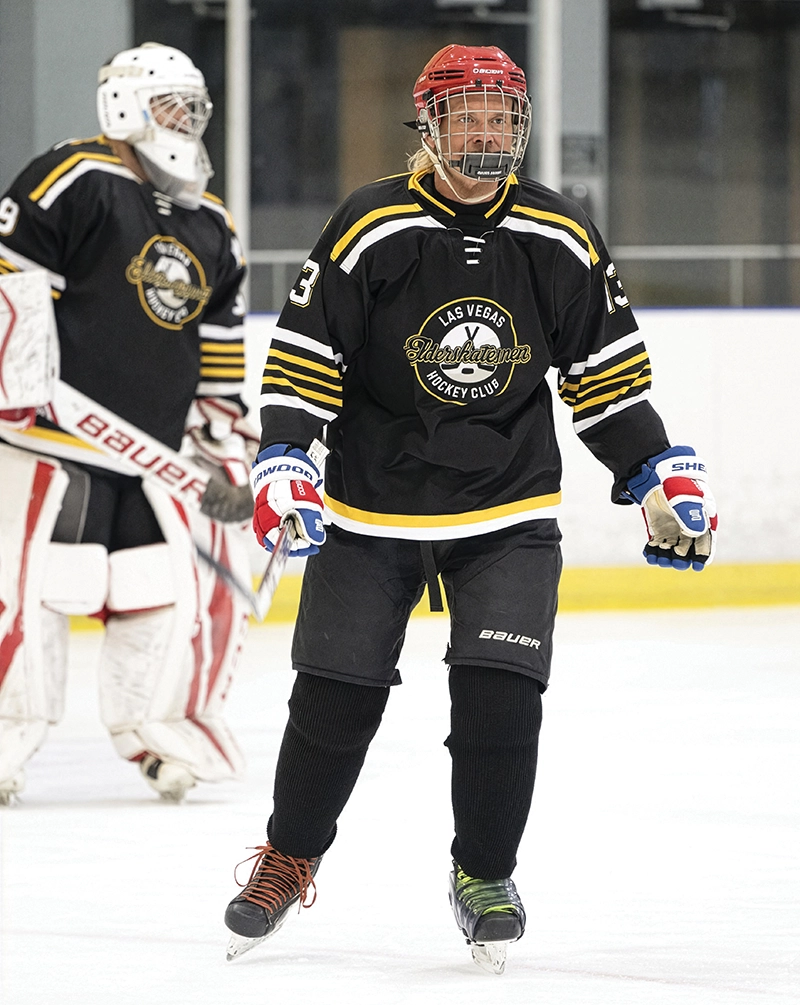
His Elderskatesmen teammates on the over-50 Las Vegas hockey club sometimes tell him how much he has improved over the years. Zabelny credits both better prosthetic technology and a fairly straightforward training regimen. He skates four days a week.
For someone interested in trying standing amputee hockey, finding a dedicated league may not be as simple as searching for a local recreational team. Zabelny recommends beginning with a prosthetist and letting them know you want to skate.
From there, he suggests learning to stickhandle off the ice, getting comfortable on skates, and finding local stick-and-puck sessions where players can develop their skills.
Zabelny’s own hockey life illustrates how fluid those opportunities can be. Standing amputee hockey took him into international competition, but he has spent much of his life playing alongside nondisabled athletes. That remains true today.
Another Kind of Family
Zabelny is now president of the Elderskatesmen club. Its members include men and women from different backgrounds, nationalities, and skill levels. Some new members didn’t even realize Zabelny was an amputee until they saw his hockey prosthesis in the locker room. He likes it that way.
“Many of my Elderskatesmen teammates don’t see me as being different on the ice,” he says. “I’m treated as an equal.”
For Zabelny, leading the club means preserving what previous leaders built while finding ways to make it even better. He has helped create competitive events, including international games, and the club’s annual USA versus Canada games have become a tradition. But ask him what makes the Elderskatesmen special, and his answer isn’t competition.
It’s family.
The members skate together, but they also gather for meals. They tell what Zabelny calls the old stories of hockey grandeur, then tell new ones about whatever happened during the most recent skate.
“The hockey is great,” he says, “but the friendships are even greater.”
Perhaps nowhere is that philosophy more visible than in the range of players who continue to show up. One player is in his 80s. He lives in Utah and drives to Las Vegas every Wednesday to get on the ice. He’s slower than other players, but they give him the puck anyway.
Zabelny notices when more experienced players do the same thing with beginners: passing instead of taking the shot themselves, giving someone else the chance to make the play, watching a newer player light up when a pass connects or the puck finally reaches the net.
It’s a different kind of satisfaction from the one Zabelny felt after an international victory. After more than five decades of hockey, Zabelny still has the competitive spirit of the little kid nicknamed Kamikaze. He still wants the perfect play. He still wants to win. But these days, he also reminds the faster players what time eventually does to every athlete.
“One of these days, you’re going to be that player,” Zabelny tells them, “and you’re going to hope that someone gives you the puck.”
It’s a lesson hockey has been teaching him almost from the beginning. His father gave him the game. His brother taught him not to waste what his body could still do. A high school coach gave him ice time when it would have been easier to give him a place on the bench. Standing amputee hockey gave him a Team USA jersey, teammates, rivals, and a chance to discover just how far the game could take him.
And now, Zabelny gets to help decide what kind of game he leaves for the people skating behind him.