
How Quad Amputee Mary Telstad Paints Her Way Into a New Life
By Kim Ousley
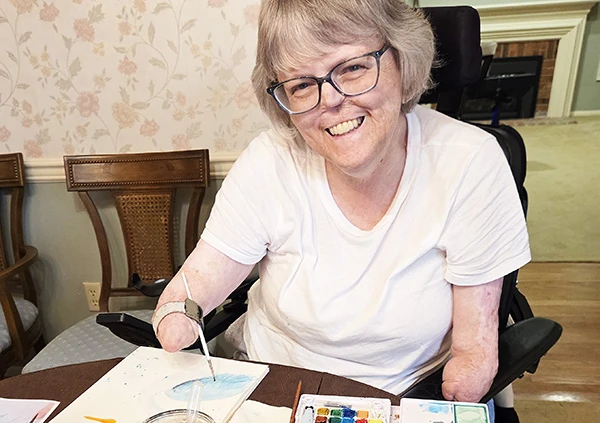
Mary Telstad slips a paintbrush into a universal cuff just below her elbow and begins to paint. With a steady, looping motion, she turns watercolor into galaxies, agates and fields of soft blues and greens.
I first knew of Mary through Zoom groups for amputees. Then I attended an art class at EmpowerFest and met this delightful soul in person. We sat at the same table, creating art. Hers looked like a masterpiece. Mine looked like my 8-year-old self came out to play. Then someone showed us some of the gorgeous pictures Mary had painted of galaxies to go with the Bold Moves theme of this year’s event.
Mary didn’t set out to become an artist. She became one because her life demanded a new language. A way to express herself despite losing her hands and feet to sepsis.
After sepsis took both arms and legs in 2019, Mary returned home to a world that felt unfamiliar. Her sister sensed the emptiness that trauma leaves behind and handed her a stack of watercolor supplies: brushes, paper, a how-to book, a small easel.
“Mary, you need a hobby,” her sister told her.
It was a simple statement, but it opened a door.
Mary began at her kitchen table, learning how to hold a brush using a universal cuff, a small adaptive device she wears just below her elbow. The cuff helps her hold utensils or a pen. She slips the brush through the opening and paints with a steady, looping motion.
“I have a very steady hand,” she said. “I’m not shaky.”
She shares that her handwriting is just as precise as it was before the loss of her hands. The same motion helped her relearn how to write, and somehow her perfect teacher penmanship returned, as if her brain remembered exactly what to do.
Painting became her place where her body didn’t feel broken. It felt inventive.
Her early paintings were whimsical and imperfect: Easter bunnies with dramatic eyelashes, flowers she laughs about now. But florals came naturally, and soon she was creating abstract pieces filled with layered blues, greens and gold accents. She gravitated toward muted blues, soft greens, gentle pastels and gold embellishments that shimmer like sunlight caught in water.
She now paints pebbles, agates, galaxies and soft landscapes of color rather than place. Her hallway is lined with her work, each piece coordinated in tone and mood.
“Mary is a very calm person,” she said when I asked what her art reveals about her. “It comes out in my muted colors.”
Watching her paint is a lesson in adaptation. She pulls brushes out with her mouth. She positions her paper carefully. She moves slowly, intentionally, letting her arm guide the brush in fluid strokes. People who see her paint for the first time are often stunned.
“Despite no fingers, it’s possible,” she said.
She’s seen artists paint with their mouths or toes, but she hasn’t met another quad amputee who paints the way she does. Her work is proof that creativity doesn’t disappear when the body changes. It simply finds a new path.
Her art room, once her daughter’s bedroom, is now a sanctuary. Everything is arranged so she can reach it from her wheelchair.
But the steadiness isn’t just physical. It’s emotional. Painting gives her a place where she isn’t fighting her body. She’s collaborating with it. She taught elementary children for 35 years. Now she gets to relax and enjoy a different kind of life.
When I asked her what another amputee might understand about her experience without explanation, she didn’t hesitate.
“That Mary’s not scared of doing something new,” she said. “If I can do something like this, then it’s possible for someone else to get out of their box and try something new too.”
Her paintings carry that message quietly. They don’t shout resilience; they whisper possibility.
Mary is still working toward walking again. She’s in deep-tissue therapy, preparing to switch to a new prosthetic clinic and determined to get back into her stubbies.
“I’m committed,” she told me. “Motivation is good, but commitment is stronger.”
Her goal is to walk onto a plane next spring to attend the next EmpowerFest.
Her story is not about what she lost. It’s about what she created. One brushstroke at a time.