

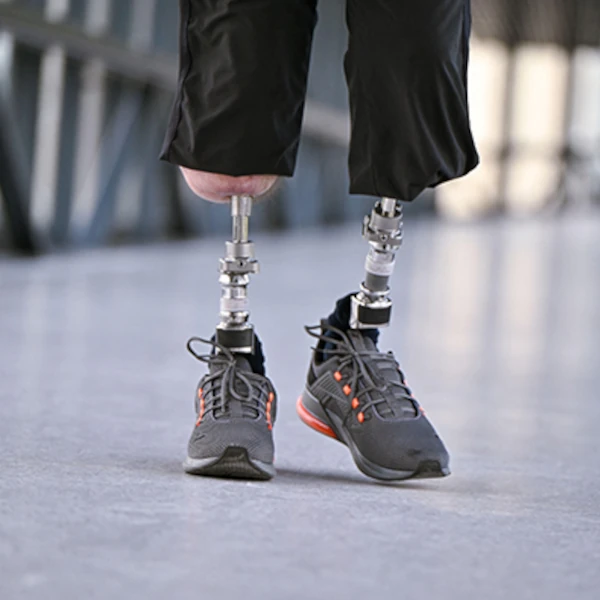
When osseointegration surgery achieved FDA approval five years ago, the lack of outcomes data created a lot of uncertainty. The possibility of infection, implant failure, and other complications deterred many patients (and their doctors) from pursuing OI. But according to a new study based on nearly a thousand patients who’ve undergone the procedure, OI’s long-range track record is pretty impressive.
Published in Musculoskeletal Surgery, this large-scale data dive aggregated data from 22 studies encompassing 979 individual amputees. While the overall complication rate was 65 percent—ie, nearly two-thirds of patients experienced at least one complication—that topline finding is a bit misleading, because a minor infection that can be treated with a round of antibiotics counts as a “complication.” A closer look at the data reveals that most OI complications are manageable, and far outweighed by the benefits of the procedure.
The most common complication, breakage of the abutment (which connects the bone implant to the prosthesis), is not just manageable—it’s built into OI’s design. The abutment acts as a built-in safety mechanism. The abutment breaks when forces get too high, which prevents breakage of the bone and/or the implant embedded within it. Replacing an abutment is a relatively simple procedure compared to dealing with a fractured bone or failed implant. About 38 percent of the patients in this data set experienced an abutment failure.
The second most common complication, infection, occurs in 36 percent of patients. That sounds alarming, but the vast majority of those cases were superficial soft-tissue infections that cleared up with antibiotic pills. Only 9 percent of patients experienced serious infections. About 6 percent of the study group suffered bone infections that required interventions such as debridement, wound vacs, and/or IV antibiotics. Another 3 percent needed implant removal as a result of infection, bone fracture, pain, loosening, and/or mechanical issues.
To put these numbers in context: About 2 percent of hip replacement patients sustain a serious infection, so this level of complication is about four times more likely in OI patients. That stands to reason, because OI creates a permanent skin opening (stoma), whereas hip replacements are completely internal.
OPRA vs Press-fit
The study found some noteworthy differences in outcomes between the two major OI design approaches, screw-fit implants (OPRA) and press-fit implants (ILP/OPL). Mechanical failure occurred in 68 percent of patients with OPRA implants, versus a failure rate of just 19 percent in press-fit patients. Nearly all of these failures involved the abutment, rather than the implant itself—ie, the safety mechanism was working as intended. But such failures can cause injuries in a worst-case scenario, and they always require a time-consuming repair process, during which the patient has limited mobility.
Overall infection rates showed less dramatic differences between the two systems: 51 percent for ILP/OPL patients versus 30 percent for OPRA patients. The analysis didn’t dive beneath those topline numbers to reflect the respective rates of serious versus superficial infections.
Perhaps the most encouraging finding from this meta-analysis is the implant survival rate. At five years, 89 percent of OI implants remained in place without requiring revision surgery. At ten years, 77 percent were still going strong. Again, compare those figures to hip-replacement data, various studies place five-year survival rates between 90 and 100 percent, and ten-year rates between 62 and 98 percent. Bone-anchored prostheses are performing right in the middle to lower end of that range—respectable for a technology that’s still relatively new and evolving.
The authors identified a few patterns related to mechanical failure:
- Younger, more active patients experienced higher rates of abutment failure—their active lifestyles simply put more stress on the components. Body mass index may also play a role, though more research is needed.
- The analysis did not show significant outcome differences between above-knee and below-knee patients. The big caveat here, however, is that the study group included far fewer below-knee patients (only 61) than above-knee cases.
- Outcomes have improved over time, as surgical protocols and rehab procedures have crystallized.
The study’s authors emphasize that OI isn’t for everyone. But for the right candidates, the evidence is increasingly clear that OI carries an acceptable level of long-term risk, delivering outcomes that are roughly equivalent to those of hip-replacement surgery.