
As Amplitude described last year, the R&D process for brain-controlled prosthetics doesn’t move quickly. But it does move—and one of our key sources for that article, Case Western Reserve University bioengineer Emily Graczyk, is poised to take another few strides toward the finish line.
Backed by a $9.9 million grant from the Congressionally Directed Medical Research Program, Graczyk is leading a clinical trial to test a sensory-enabled bionic arm that could provide upper-limb amputees with a sense of touch. The pre-recruiting process is already underway, so if you’re interested in participating, keep reading.
Conducted in partnership with the VA’s Louis Stokes Medical Center, the trial is part of a long-running effort to bridge the gap between what’s possible in the lab and what’s available to people to consumers. It will test an experimental device called iSens, which allows users to both control and “feel” their prosthesis.
“Having a sense of touch improves so many different aspects involved in quality of life,” Graczyk told the Case Western newsroom. “It enhances self-sufficiency, self-image, and social interaction.”
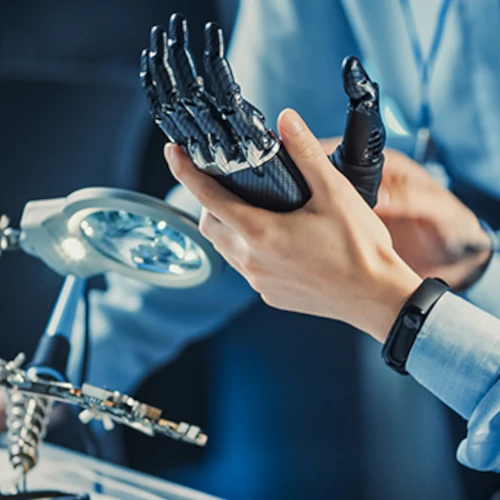
The iSens system connects mind to machine via electrodes implanted in the residual limb and sensors in the bionic fingertips. The electrodes detect muscle activity and transmit those signals to the device, facilitating dexterous, intuitive motor control. Meanwhile, the fingertip sensors convey signals in the opposite direction, sending information about contact to peripheral nerves to produce the sensation of touch. A Bluetooth-enabled device connects the prosthesis, electrodes, and nervous system in real time, creating a closed loop between movement, intention, and sensation.
Graczyk’s previous research with this device has shown that sensory feedback promotes a sense of embodiment, a key step in successful prosthesis adoption. When users can feel their prosthetic hands making contact, they rely less on vision, handle objects more naturally, and feel more connected to their artificial limbs. Those sensations, researchers say, also ripple outward—improving independence, self-image, and emotional connection with others.
The study will recruit a dozen adults with upper-limb amputations to test iSens over an 18-month period. In the initial phase, researchers will collect baseline data about participants’ use of their current prosthesis. Next, volunteers will undergo outpatient surgery to implant the electrodes and control modules, then spend a period of time alternating between their standard prosthesis and the iSens prosthesis with touch feedback enabled. In the final stage, they will use the iSens arm exclusively, alternating between two modes—one with only advanced motor control enabled, the other with both control and sensation. This crossover structure allows each participant to serve as their own de facto control group, helping the researchers identify exactly how sensory feedback affects day-to-day function and quality of life.
The results may validate what prosthesis users have long sensed intuitively—that true embodiment depends on more than function. When you can feel what your hand is doing, even faintly, everyday activities become less about calculation and more about confidence. Grasping a doorknob, typing on a keyboard, or hugging a loved one could all feel more natural and fluid. That subtle shift can have profound implications.
“We’re not just trying to make devices that move better,” Graczyk said in the project announcement. “We’re trying to make devices that feel better—that feel like you.”
While iSens isn’t yet available commercially, this trial is designed to move the technology closer to that goal. Data from the study will help determine whether sensory-enabled prostheses can significantly improve function, user satisfaction, and quality of life compared to standard devices. If the results are positive, the findings could support applications for FDA clearance and pave the way for future commercial partnerships. The multidisciplinary research team includes engineers, surgeons, neuroscientists, and rehabilitation experts from Case Western, the Cleveland VA, Brown University, and other organizations.
Recruitment for the trial is expected to begin in early 2026. Participants will need to meet specific eligibility criteria, including good general health and an upper-limb amputation that allows for electrode implantation. Because the study involves surgery and a lengthy participation period, it requires a substantial commitment. If you’re interested, contact study coordinator Jessica Jarvela via email at jrw20@case.edu.