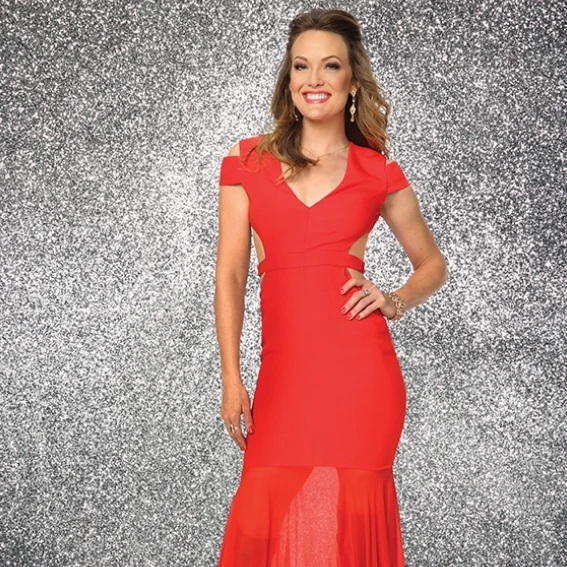
“I always wanted to act,” Amy Purdy says. “I went on to be an athlete and then did Dancing with the Stars, so I think it was always in me to perform.”
Athletics and acting are both on Purdy’s mind this week, with the Winter Paralympics in full swing and the Academy Awards happening this weekend. Purdy, whose road to stardom began with a medal-winning performance at the 2014 Winter Games, is still actively connected with the Paralympics; many of this year’s snowboarding contenders trained at her Adaptive Action Sports facility in Colorado. But you may not know that she also takes a keen interest in the Oscars—and might even have notched a nomination of her own by now if things had turned out differently.
In 2013, the year before her athletic breakout, Purdy was slated to co-star in Kingsman: The Secret Service as a double-amputee assassin named Gazelle. She spent weeks training for the blockbuster film, which went on to gross nearly half a billion dollars and spawned two sequels; during pre-production, she helped design Gazelle’s persona, costumes, and weaponized prosthetic legs. But just before the film started shooting, Purdy was replaced by Sofia Boutella, a nondisabled French actress.
She hasn’t discussed this experience at length very often. But with the conjunction of the Oscars and the Paralympics—and the impending release of Purdy’s new book, Bounce Forward—this week seemed the perfect time to share the story. It’s presented in Purdy’s own voice, as told to longtime Amplitude contributor Diana Theobald. The narrative has been edited for clarity and length.
I’VE ACTUALLY HAD A GOOD EXPERIENCE with Hollywood. I got my first job when I was 21—I worked with Madonna because she was looking for a double leg amputee to walk the runway in a music video. She was really specific about that. I was a new amputee living in Vegas at this time, and I had nothing to do with Hollywood or LA, but my prosthetist told me about it — he’d gotten an email. So I ended up kind of getting this role.
For some reason, when they put me through costume, they had me in this long dress, and it completely covered my legs. I was sure that this is not why Madonna hired me. So an hour before filming, we all had to walk out in our outfits in front of Madonna, and I walked to the end of the catwalk and lifted up my long dress and did this dance. Because I thought, “You gotta see that I got prosthetic legs. That’s why you brought me here.” And she was like, ”Oh my god, that was amazing. Hold on. We gotta sex you up a little bit.” And I was like, “You’re Madonna. You can sex me up all you want.” She grabbed a pair of little boy shorts off this guy, and we ended up just having tape on my boobs — she really sexed me up — and I put on these tall black shoes, and she said, “Okay, now walk down the runway.”
Well, what’s such a bummer is the video wasn’t allowed to air. It was an anti-war video, and there were other amputees in it who were depicting what it looks like if we go to war. It was about to go to air, and then we declared war on Iraq and she decided to pull it and shelve it. The original has never been aired. All I have is this little photo that the photographer gave me from. that video.
But I was really inspired. It’s so cool that she saw the art in having prosthetic legs. So my entry into Hollywood was a very positive one of acceptance.
A few years later I moved to California, and I found out about a movie called What’s Bugging Seth? There was a deaf director, and there were two main characters, and they were looking for a single leg amputee for the female lead, but I showed up as a double leg amputee and was able to get that role.
What’s Bugging Seth ended up going to a bunch of film festivals, and so that was another cool, inclusive experience within Hollywood. I haven’t watched that movie in a long time, but I was able to give a little input on the dialogue on the character. I was able to bring the reality of what it’s like to be an amputee, versus a writer trying to write my experience. I was able to consult a little, not as much as I wanted to, but I was able to make a couple little tweaks here and there,
It just kind of showed me that if you’re going to have a role with someone with a disability, have somebody who’s got that disability consult with you before you write the script. that doesn’t happen enough. I know right now, the inevitable Foundation is pushing for people with disabilities to get more writing jobs in the industry, not just to give advice from the side. Because it would be a whole different script if it came from the actual perspective of an amputee or of someone with a disability.
I took some acting classes after that, and I spent another year or two there. But I didn’t go on any other auditions or get an agent or anything like that, because I was also snowboarding and starting Adaptive Action Sports with my future husband. We were trying to get snowboarding into the Paralympics, and I was trying to snowboard as much as possible. But I was still in the public eye. There were articles about me in Women’s Health and a few other magazines, and I think that’s where this opportunity for the Kingsman came from. I got an email that they were looking for a double leg amputee to play the role of Gazelle; they needed somebody who could act and someone who is athletic. So I recorded my audition for them, and they ended up flying me out to London to audition in person.
It was so exciting. I had never flown first-class before, and I was sitting on the airplane, drinking champagne, eating filet mignon, and asking myself, “Is this my big break?” I did an audition in front of Matthew Vaughn, the producer, and Claudia Schiffer, the supermodel, who was also a producer. I grew up in the 1980s idolizing Claudia Schiffer. So anyway, in addition to the acting audition, they also wanted to make sure that I physically could do this role. So they put me in with their stunt team, and we worked for the day on martial arts and roundhouse kicks and all this stuff. I was at the peak of my athleticism at that time, because I was training for the Paralympic Games, so I was physically able to do all these things they wanted me to do. I still have a video of me doing a back flip and all this different stuff.
I thought it was really cool that they were dedicated to having a double leg amputee, a real amputee, in this role. The story that’s never been told is that they had created that role for Oscar Pistorius. It was initially supposed to be a male role, because it looks like he was a man in the comics. But then, of course, Oscar Pistorius killed his girlfriend, and they went looking for somebody else. But they were dead set on having a real amputee play this role.
By the time they came to me, they had auditioned everyone they could think of. They had tried different Paralympians, and there were a handful of double leg amputee actors out there. They brought everybody out there to audition for this role, but everyone they brought in either was athletic enough but not able to act, or a good actor who as not athletic enough. I just kind of happened to be able to do both. My acting skills were not fantastic, but they saw potential.
They ended up keeping me in London for an entire month, and I worked with a brilliant acting coach that they put me in touch with. We worked like eight hours a day together to build out this character, Gazelle. And I was also working with the design team to design the legs, and I was working with Claudia Schiffer on the outfits. At this point there was still no contract, but they were working with my agent, and they were developing me. I was willing to fully dive in and do whatever I needed to do to get this role. I really did feel like I was family with Warner Brothers and all the people on the team. We were developing this character together. They even had me work with Samuel L. Jackson, so they could see me doing the character with him. I was freaking out inside, of course, because — Are you kidding me? Samuel Jackson?
All this was happening in the fall of 2013. The Paralympic Games were in the spring of 2014. So we had decided that if I got the role, I would just go on weekends — or whenever they were not shooting scenes I was in — I would go snowboarding in Austria, because that was the closest snowboard area to where we would be shooting. The shoot date was supposed to stop right before the trials for the Games, and I had it all planned out where I could shoot this film and then still do all the World Cup races leading up to the Paralympics.
At the end of the month, I needed to fly home to pack all my stuff and get back out there in time to start shooting. I was in first class again, drinking champagne and all this stuff, and I just felt like, “This is my big break. Oh my gosh, this is awesome.” And I’ll tell you, this role was perfect for me. I was very athletic, I was able to do all the stuff they wanted me to do, and if was I ever going to play any kind of character with prosthetic legs, I wanted it to be this powerful, capable character — like a superhero or something. Now, Gazelle was was a bad guy, an assassin, but she was so badass, right? I had this vision in my mind of playing a role like that, and now it was happening.
So I flew back to Colorado, took like a week to pack all my snowboard gear and everything, and then I flew to Florida, because that’s where my prosthetist at the time was, Stan Patterson. He was helping to create the legs we had developed, and the plan was for me to get fitted with him, then fly to London and just stay there while we shot this film. I was there at Stan’s clinic and I got a phone call from my manager who said, “I have really bad news for you.” And I was like, “What?” And he said, “They dropped you from the film. They ran into insurance issues because you’re training for the Paralympics. Basically, they’re concerned that if they start filming with you, and then you get injured halfway through or whatever, they can’t just replace you. There’s nobody out there that they could put in your role to take over.”
They needed me there 100 percent, and I couldn’t commit to that because I had sponsors for the Paralympics. I had commitments to Coca Cola and Kellogg cereal and these other brands that would compete in the Games. So I couldn’t just say, “I’m going to go act and not compete.” And I wanted to compete, I had been training for that for so long. So it was devastating. It just felt like everything was pulled out from underneath me. Stan, my prosthetist, was standing there, and he said, “Amy, it just means there’s something bigger and better for you around the corner.” And I just thought, I know you’re trying to make me feel better, but what can be bigger than this? It was a lead role in a huge film. There’s not going to be anything bigger or better. So I flew back to Colorado and unpacked my bags. What a massive, massive letdown.
A few weeks after that, I got a phone call from a producer with Dancing With the Stars who had seen me on a billboard in LA. I guess it was a big Coca Cola billboard of me snowboarding. She asked if I was interested in dancing, and I said “Yeah, that would be cool.” But I’m never getting excited about anything again. Because you can be dropped just like that.
The cool part, though, is the filming for the Kingsman ended up pushing into the spring. I don’t think they finished filming until May or June. So if I had done Kingsman, I wouldn’t have been able to do the Paralympics. I wouldn’t have been able to do Dancing with the Stars. And the Paralympics and Dancing With the Stars were the most amazing, empowering things I’ve ever done in my life — absolutely life-changing for me. So Stan was right. When one door closes, another door opens. There’s always something bigger and better on the horizon for you.