By Kim Ousley

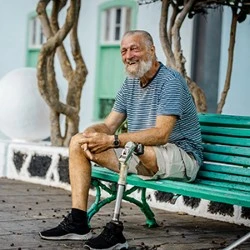
After more than 15 years as a lower left leg amputee following synovial sarcoma cancer, I thought I had found my rhythm with mobility. Then Covid hit, and one split-second accident changed everything.
I slipped on a toy, went down hard into the splits, and severely injured the knee on my sound leg. Since then, I’ve been battling osteoarthritis, bone density loss, and now osteoporosis — challenges I never anticipated when I first adapted to life with limb loss.
As amputees age, many begin experiencing secondary physical issues that can include knee pain, hip pain, back pain, and degenerative joint conditions. For lower limb amputees especially, the body spends years compensating for altered movement patterns and uneven load distribution. Over time, that wear and tear adds up.
Research has shown amputees may face an increased risk of osteoarthritis and bone density loss due to reduced mechanical loading on certain bones and joints. Less weight-bearing stress can weaken bone over time, increasing the risk of fragility fractures, particularly in the hip and femur.
Recently, I attended an online amputee support group meeting where graduate student Lydia Moylan shared research she’s conducting on osteoarthritis and osteoporosis in amputees.
Moylan is part of the University of Michigan’s Master of Science in Orthotics and Prosthetics program. During the Zoom discussion, she asked amputees about their lived experiences with arthritis, mobility changes, and aging.
“Amputees have over a 70 percent chance of developing osteoarthritis,” Moylan explained during the discussion, noting that factors can include reduced mobility, disuse, lack of muscular activation, and limited rehabilitation following amputation.
She also discussed how altered weight-bearing through a prosthetic socket can change how force is distributed through the body, reducing stimulation in areas like the femoral neck and proximal tibia — both critical for maintaining bone strength.
For Moylan, the topic is personal as well as academic.
After learning about a history of osteoarthritis in her own family, she became increasingly curious about how degenerative bone disease might impact amputees even more significantly over time.
“The thing about an amputation is it’s going to have lasting effects on the biomechanical principles of how you walk,” said Moylan. “That alone is going to change how your bones are structured.”
She also noted that researching these conditions in amputees can be difficult because so many overlapping health factors are involved. Pain, mobility limitations, aging, prosthetic fit, muscle loss, and activity levels all influence one another.
Another major contributor is what many amputees know as “overuse syndrome.” When a limb is missing, the rest of the body compensates with every step, transfer, and movement. Over decades, those repetitive stresses can contribute to joint deterioration throughout the body.
Bone density loss is another often overlooked concern. Bones remain strong through consistent mechanical loading and activity, but as mobility decreases with age, maintaining bone health can become more difficult.
While aging with limb loss presents unique challenges, there are proactive ways amputees can support long-term mobility and bone health, including:
- Strength training, especially for the hips and core
- Balance and stability training
- Regular bone density monitoring
- Maintaining proper prosthetic fit and follow-up care
- Fall prevention planning
- Accepting adaptive tools early, such as canes or trekking poles
Aging with limb loss does not have to mean decline. Like every stage of the amputee journey, it requires adaptation, awareness, and support. With a proactive plan and continued movement, amputees can continue thriving well into their later years.