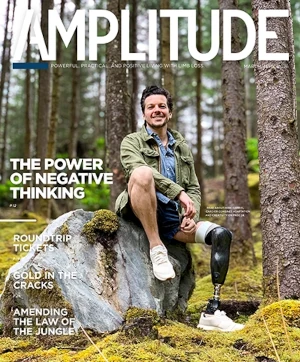

by Melissa Bean Sterzick

The job hunt is an unnerving prospect for anyone no matter their ability or disability, specialty, experience, personality or industry. Resumes are a delicate balancing act of too-much versus too-little information; the cover sheet is an excruciating exercise in trying to seem confident and casual while bragging and begging at the same time. Job interviews themselves are one of life’s most universal hazing rituals – wear the right clothes, say the right things, smile pleasantly, and use your 25 to 40 minutes to convince a skeptical hiring committee you are the best candidate for the job.
Add to all that a missing limb, a prosthetic, an uneven gait, or a wheelchair, and the scenario takes a drastic turn. Now you face all of the above as well, presenting yourself with a physical difference which is, at the very least, a pretty major distraction, and at the very worst, a matter that could cost you the job. I am a congenital amputee – left arm below the elbow, and I don’t wear a prosthetic. In the 31 years since I graduated from college (yikes), I’ve interviewed for several dozen jobs and experienced everything from awkward reactions to outright discrimination.
There are several federal laws protecting people with disabilities navigating the hiring process, but the Americans with Disabilities Act (ADA) is the most widely applicable. The act prohibits employers from discrimination against “qualified individuals with disabilities” in hiring, firing, and promotions. The law also requires employers to provide “reasonable accommodations” to job applicants and employees, including workplace accommodations or adjusted schedules, unless this creates an “undue hardship.”
I was once required to take a typing test at an employment agency. I resisted for half a minute but felt I couldn’t object if I wanted work. This was not legal – I don’t type the way people with two hands type. I watch my fingers more, and I make more mistakes. I performed well, but felt completely overwhelmed and angry. Legally, according to the ADA, employers are required to modify the application process and offer accessible testing and materials so individuals with disabilities can compete for jobs. I can’t say how you test a one-handed person’s typing ability, but there’s enough creativity and intelligence in the world to figure out a way.
Employers cannot legally ask if an applicant has a disability; and that’s why many job applications ask about disabilities and offer the option to check “I prefer not to say,” which seems like another way of saying “Yes, I have a disability, but I don’t want to tell you.” I agonize over this answer every time I apply for a job. In addition, employers cannot ask about the type or degree of a disability before a job offer is made. However, they are allowed to ask if the applicant can perform essential functions of the job with or without reasonable accommodation.
When I was around 30, I was the editor of magazine for a non-profit youth soccer organization. My interviewer was a wonderful woman who became my director, mentor and friend. Halfway through the interview she glanced at my resume and said, “You type 55 words a minute. How does that work?” I told her I had been typing since I was 12 years old. I told her Dan Rather, then anchor of the CBS Evening News, types with two fingers, while I type with five fingers and I’m quite good at it. She laughed and we moved on to the more relevant questions.
My policy for the in-person job interview is to give no warning; ask no permission. Any explanation will be as brief as possible. I don’t hide, but also don’t draw attention to my arm. I hope to delay that moment when their eyes stop and then dart away, and I know their minds are filling with questions. It adds a degree to stress to the situation that’s hard to describe. I want to be met as an individual, if possible, before they notice my limb difference and begin to wonder about my abilities.
One job interview, two years after graduation, for a position as a copy editor at a small-town newspaper went wonderfully. I shared my clips, answered questions with intelligence and humor, and was offered the position at the end of the meeting. Two weeks later, I started the job. Six months later, when my managing editor and I had become friends, and the subject of my limb difference became an appropriate topic of conversation, we talked over her initial realization. She said that she hadn’t noticed my arm during the interview. Then, when I showed up for work, she couldn’t understand how I’d managed to lose an arm in two weeks.
My most recent job interview involved an organization that requires fingerprinting, which they carry out on site. I didn’t give them any advance notice, per my policy. The busy human resources associate led me to a small room in an outbuilding and set up the fingerprinting program. First the right thumb and hand, she directed. “Now the left.” Knowing she hadn’t noticed, I gently raised my left arm and said, “I won’t be able to do this side.”
She jumped a little, and I genuinely felt sorry for her, however, I prioritize myself in these situations and sat quietly while she tried to figure out her next step. Without going into all details of a highly uncomfortable episode, during which I felt annoyed, upset, frustrated, patronized and a little sad, three phone calls, two supervisors and 40 minutes later, they used the nub of my left arm to create “fingerprints” in order satisfy the computer program’s demand for full sets of prints. The program had options for fingerprinting an amputee, but either it wouldn’t accept my incomplete prints or the staff didn’t know how to carry out the process for an amputee. We all felt awkward – and some of us (the supervisors) were probably wondering if we were about to get sued.
I don’t usually eat my feelings, but I took my sweaty, flustered self out for a donut after that circus. It shouldn’t be so hard. Of the many things that are difficult about being an amputee for me, interpersonal dynamics are just about the hardest. They are consistently difficult in social situations, but hugely problematic when it comes to finding a job.
I can drive a car, tie my shoes, carry a tray, and ask for help when I need it. I type fast, but need a specific type of desk, computer, keyboard, and a phone with a headset. I am confident in my abilities and proud of who I am. What I can’t do is reassure everyone who has feelings, doubts or concerns about my capabilities. I can’t remove their prejudices, predict their degree of acceptance, or truly measure their willingness to make accommodations.
The mental load that comes with being an amputee is an enormous burden I don’t always up to carrying. I face it with a tried-and-true set of coping skills: pragmatism, self-compassion and care, a constantly maintained emotional boundary between me and anyone making judgments about me, and a carefully cultivated certainty of my worth and identity as an individual.