
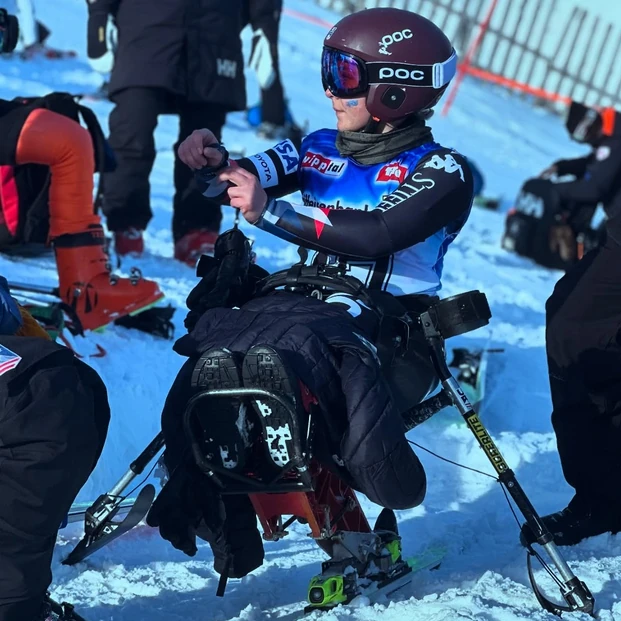
Within the next day or two, Saylor O’Brien will find out if she’s headed to her first Paralympics. The 22-year-old sit-skier’s resume includes a US national title, a handful of World Cup podiums, and recognition as US Ski & Snowboard’s Adaptive Athlete of the Year for 2024-25. So far during the 2025-26 season, she’s added another national title and notched top-five finishes in both of her World Cup races.
She’d like to add some Paralympic medals to the list. But first she’ll have to make the team, and it’s a tight field. The US team has limited slots for paraskiers, and several of those have already been clinched. O’Brien is on the bubble with teammates Anna Soens, Kelsey O’Driscoll, Allie Johnson, Annika Hutsler, and Mackenzie Dickman. [Ed. note: It’s official — O’Brien was named to the Paralympic team.]
We caught up with O’Brien last month at Winter Park, Colorado, where there was juuuust enough snow for a week’s worth of slalom and giant slalom races. She and Soens dueled to a 1-2 finish in the GS on the day we attended. Paralympic roster decisions are due this week, so keep an eye on O’Brien’s Instagram feed and/or US Para Ski & Snowboard for the announcements. This conversation is edited for clarity and length.
I have the impression that last season was a big one for you.
It was, Last year I had one World Cup victory win, and I think three other World Cup podiums, and then a couple additional national wins as well.
What do you attribute that improvement to? Is there any one thing that you can think of, or was it multiple factors?
I think there were a bunch of different things that happened, especially in the off-season. I wasn’t officially named to the national team last year, but I was still qualified to go to World Cup races. I was still traveling with the national team and still wearing the uniform. I was just on the development side. That gave me a lot of freedom to just ski how I know how to ski, which created really amazing results.
When you say you were able to ski with freedom, was that more a mental thing, or was it both mental and physical?
It was more mental thing. As far as biomechanics and that stuff, I didn’t really change much of anything. I mostly focused on simple tactics, and that made things less crowded mentally for me. I would just pick one thing to focus on, and that gave me room to think about the fact that I’m here because I love skiing.
How does that translate into shaving seconds off your time? Everything you’re describing makes sense to me, but it’s a little bit of a mystery as to how that simple shift in mindset can actually lead to faster time.
If you’re skiing recreationally or you’re just out on the mountain, you don’t really know how fast you’re going and you don’t focus on that. All you’re focusing on is that you want to make this really sick carve. There’s freedom in that. When we’re training in the gates, it’s like, you have to turn right here, right now. But when you just free-ski the mountain, you can create so much more dexterity, and then you build off of that.
In my first couple years of racing, I was doing a lot of gate training. And it’s not that it didn’t benefit me, but I think returning back to the mindset that I love skiing because it’s fun, it helped me unlock the ability to ski at a higher level. When you’re focused on going to World Cups and trying to go to the Paralympic Games, it’s so stressful and puts so much on you mentally that gate training sometimes just does not just help. So the last couple of years I’ve gone back to free-skiing, because that feeling is so valuable.
Did that impulse come from within, or did a coach or another racer suggest that to you?
I think it was a mix. Some coaches were super adamant about doing more free skiing. And on top of that, I did a little more skiing with friends and less formal training. So it just ended up perfectly for me to work more on free skiing and not so much on gate training.
Where do you stand right now in terms of qualifying for Milano-Cortina?
If I wanted to qualify immediately, I’d have to podium at a World Cup. I haven’t done that yet for this season, but I’m still in the mix. When they go through the selection process, they look at what everybody’s results are overall during the season, and they pick the best results. So I’m very much in the mix, but there are only six spots for the women, and that’s for all classifications. So we could have four standing, one sit-skier, and one vision-impaired. It just comes down to whoever is going to give our team the best chance.
You’ve been on the team throughout the transition from US Paraski being a separate organization to the merger with US Ski & Snowboard, putting disabled and nondisabled skiers in a single governing body. How has that played out for you? Has it affected your training or racing at all?
I think it’s affected me in a very positive way. I’ve very much enjoyed that transition, and love being with US Ski & Snowboard now. Their resources have been amazing. Having all the staff and people integrated under one umbrella means I get to train with the best able-bodied skiers as well as the best paraskiers. I’m getting to work with their best, and that’s been really awesome.
Have you learned anything from that exposure, either from a coach or a racer, that’s different from what you might have been exposed to if you remained separate?
There’s just a sense of like community, a sense of sharing and collaborating. I can talk to any of the coaches, and all the skiers talk to each other. I can just mingle with everybody, and that makes it super collaborative.
Where does US team stand competitively? Do you feel there’s momentum building and a pipeline of new talent is building up?
Very much. We have an incredible pipeline coming up. For a big portion of my career, I was the only woman on the development team. Now there are more of us, and to see that has been amazing. Getting a chance to race with them, support them in coming up, and being teammates with them is such an honor. It’s amazing to have that. I see that as the future. We’ve got a visually impaired girl [Meg Gustafson] who’s trying to make the Games, and she’s only 16 or 17 years old. It would be super exciting for her to go [to the Paralympics]. Kelsey O’Driscoll is another one. She’s been training and skiing at the club level the last couple of years, and she made it onto the national team this season. She’s skiing really well this year.
Having grown up in Park City, you’ve got to be excited about the Winter Paralympics coming to Utah in 2034.
I totally want to be there, but it’s a long way off. People have asked me, “When are you going to retire?” And I keep saying I’ve got to make it to 2034. I if I can go past that, great. But when it’s going to be at home, I want to be there.