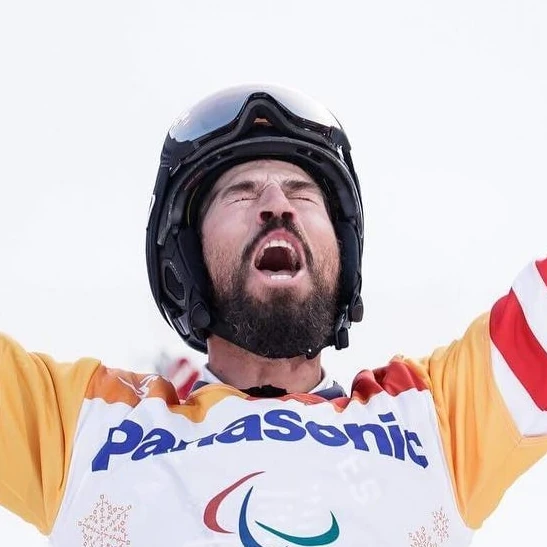
When Keith Gabel started competing in parasnowboarding in 2010, it wasn’t even a Paralympic sport yet. He helped get it added to the 2014 Winter Games, where he earned his first medal as US men swept the podium in boardercross.
Gabel added a silver medal in 2018 and is now vying to qualify for his fourth Paralympics. And he’s leaning in to his role as a wise elder and mentor for younger adaptive athletes—not only elite competitors with Paralympic aspirations, but also recreational athletes who simply want to stay fit and have fun on the slopes.
“I believe that being at the top of the mountain is where you’re closest to God,” Gabel told us last month at the Hartford / Move United Ski Spectacular. “It truly makes me feel whole. And if that’s what it does for me, then it needs to be readily available for everybody.”
For that reason, he’s taught snowboarding at the Ski Spectacular every year since 2010. One of the largest snowsports clinics in the world, Ski Spec welcomes nearly 1,000 attendees every year from all over the nation. “It impacts lives in such a positive manner,” Gabel told Amplitude. “It gives people a home to come back to each year, whether they’re never-evers who just want some winter recreation or they’re serious racers who want make it to the Paralympics. We’re here to support all of them.”
We learned a lot from Gabel about the early days of competitive parasnowboarding and its emergence as a Paralympic event. That part of our conversation is below, edited for clarity. You can follow Gabel’s quest for Paralympic glory at our website and his Instagram feed @grizzlygabel.
You mentioned you’ve been coming to the Ski Spectacular for 15 years. What was your first introduction to the event back in 2010?
I learned about it through Ogden Valley Adaptive Sports. I was part of their snowsports program as an instructor, and they were sending a handful of people over for Ski Spec. Fifteen years later, here we are.
Rewind that tape a little more for me. How did you get involved with Ogden’s adaptive sports community?
I don’t share this a whole lot, but 2010 was a rough year for me. My whole life had basically fallen apart. The recession hit my business really hard, and I was going through a divorce, so I’d lost everything. We had a really nice house, my wife rode horses, we had everything you could ever want. But I was a construction contractor when the recession hit, and it just sunk me. The one bid that would have kept the company afloat, I lost by 87 cents.
I just didn’t know what to do with myself, so I went to my local mountain at Snow Basin, about 20 minutes from where I grew up, and I got a job as a snowboard instructor. New Year’s Eve rolls around, and I went to a place called Powder Mountain, which had night riding, to bring in the new year with some friends. There was a moment when I dipped off into the trees, where it was dark, and looked up at this beautiful, clear sky—at the universe. I put my hands out and said, “I’m gonna make my life about snowboarding and nothing else. Do what you will with me.”
Where did snowboarding fit into your life prior to that?
Snowboarding has always been in my life. It just makes me feel whole. It’s the one thing I was holding on to when I lost my leg. It’s the thing that’s always got me through the hard times, and it ended up turning into something that I could have never dreamed of.
Were the Paralympics even on your radar at that time?
There was no such thing at that time, and I thought that was crazy. When I lost my leg, I called all the big adaptive sports organizations and said, “Why isn’t there Paralympic snowboarding?” And the answer was, there just isn’t. So my thought was, “If there’s no such thing as Paralympic snowboarding, there should be, and we need to start it.”
And I wasn’t the only one with this thought. It was kind of a collective thought across the planet. About that same time, there was a gal from the Netherlands named Bibian Mentel, who was a professional half-pipe rider who lost her leg due to cancer, and eventually lost her life to cancer. She was the founder of it all. By the time I started working as a snowboard instructor in 2010, they were having one of the first World Cup-sanctioned adaptive snowboarding races in France. So—another quick story, if I may—this one morning, a huge storm comes through and dumps about 36 inches of fresh powder. It was my only day off in about three weeks, and I had signed up for this snowboarding clinic to get a teaching certification. But I’m looking at the weather and thinking: “I’m gonna blow this clinic off and go rip pow with the boys all day.” I get up to the mountain, and all the homies are there, and everybody’s stoked. And something inside of me said, “I should probably go to this clinic. I don’t know why, but I should go.” I’m already late at this point, so I go over to the snowsports area and check in, and the whole time I’m thinking, “Dang it, I really wanted to go ride pow; I really wanted to get that for my soul.” But I went up and did the clinic, and at the end of the day, the instructor goes: “I hear you got one leg.” That’s not something I usually told people, because my experience was that if you tell people you’re missing a limb, they’re not gonna hire you. So I said, “Damn it. Yeah, I’m missing a leg. Does this mean I don’t get my certification?” He says, “No. Why aren’t you on my team?”
Like, the US national team?
There was no national team yet. Not for para snowboarding. There were just local clubs showing up to represent the United States. This guy was from the National Ability Center in Park City, and he said, “I’m a taking a team to France in two weeks for a World Cup race. I’ve got one more slot left. Do you want it?” I said, “That sounds great, but there’s one problem. I don’t have a passport.” So he says, “You figure that part out. Meet me in Lyons, France, in two weeks and we’ll go from there.”
So I did. I was just a skeezy dirtbag snowboarder who showed up in baggy clothes with a Skate Banana that probably had 200 days of riding on it. I didn’t even own a car at the time; I sold it to pay for snowboarding. I had two credit cards that were completely maxed out. I went over there and competed, and I got on the podium. We had a second race the next day, and I got on the podium again. And I thought, “This is cool. We got to make this happen. We’ve got to push to make this a thing.”
This was literally a few weeks after I dedicated my life to snowboarding: “Do what you will with me.” So that’s how I got involved with it all. I was super lucky to just kind of get discovered out of nowhere, and I ran with it because I had nothing else going for me at the time.
And that was the same year you came to your first Ski Spectacular?
All in the same year. I truly believe snowboarding is my church, and I truly believe being at the top of the top of the mountain is where you’re closest to God. It truly makes me feel whole. And if that’s what it does for me, then it needs to be readily available for everybody. So when I had a chance to come to the Ski Spectacular, I didn’t have to think twice, and that hasn’t ever changed. I keep coming back.
You’re basically growing the church, it sounds like.
100 percent. We’re building our congregation. This is the largest adaptive snowsports clinic in the country. It’s in its 39th year, and there are 800 to 1,000 participants every year. Some of us make it to the Paralympics, but for most of us, our Paralympics is just to get out that front door, get out here, and keep moving forward. It’s a home that people can always come back to. Not everybody in the church is on the pulpit or in the choir, but we’re all making the connection. Everyone’s part of the community, and we want to support them all.
For more information about the Hartford / Move United Ski Spectacular, visit Move United’s website.